17 Earth-Tone Studio Apartment Ideas With a Relaxed Vibe
Studios get a bad reputation. People think “one room” and immediately picture a cramped box where the bed, the couch, and the kitchen are all having an awkward conversation. Here’s the thing — a studio can feel like the calmest, most pulled-together space in the building if you lean into earthy colors, natural textures, and a few smart zoning tricks.
Below are 17 studio looks I keep coming back to. They’re warm without being cluttered, small without feeling stingy, and most of the ideas cost less than a weekend furniture run. Pick one or two and try them in your own space — that’s all it takes.
1. Add One Saturated Vintage Element
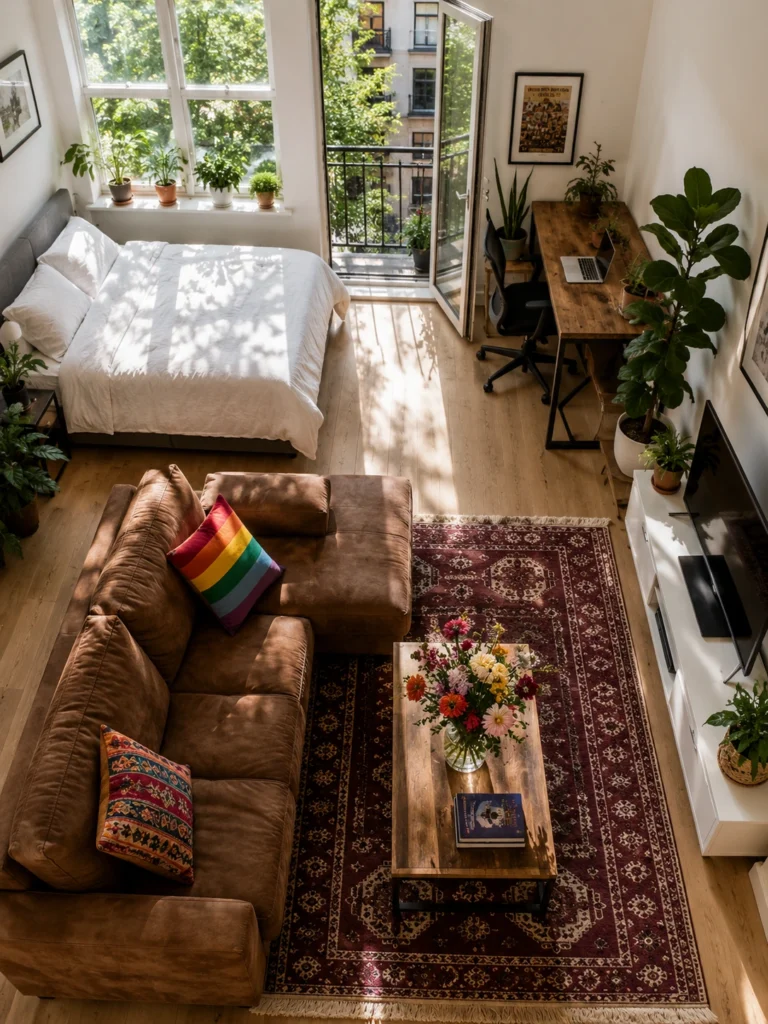
Earth tones don’t have to mean muted. A deep, saturated piece — like the burgundy Persian rug here — adds soul to a space that might otherwise feel too “neutral apartment starter pack.” The cognac leather sofa picks up the same warm reds, and suddenly the whole studio has a personality.
Vintage rugs are also one of the few decor purchases that actually hold their value. Hunt them on Facebook Marketplace, eBay, or Etsy. A real wool rug with a little wear has more character than anything new from a big-box store, and the price is often friendlier than you’d expect.
I’ve owned three vintage rugs from estate sales and one new “vintage-style” rug from a chain store. The estate sale ones still look gorgeous five years in. The chain store one shed for a year and faded in eight months.
2. Light Your Studio Like a Restaurant, Not an Office
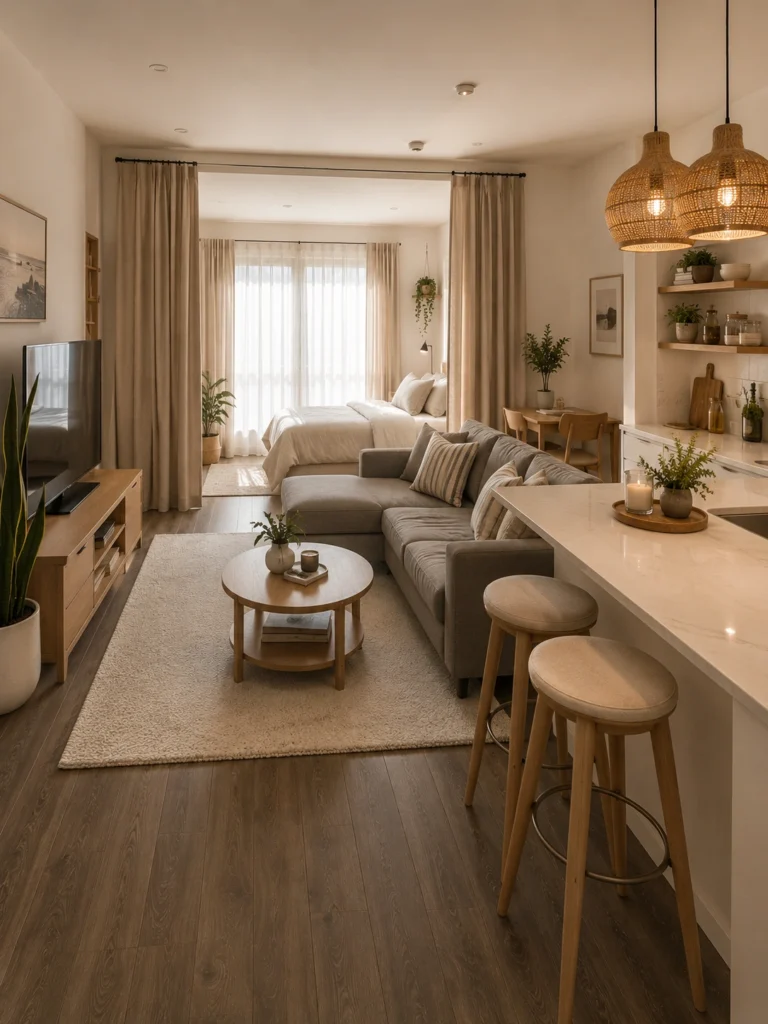
Most studios are over-lit and under-warm — one harsh ceiling fixture that makes the place look like a meeting room. Restaurants understand that lighting is mood, and your apartment should too.
Aim for at least three light sources in your living zone, all soft and warm:
- A floor lamp by the sofa for reading
- A pendant or two over the dining or kitchen counter for ambient glow
- A small lamp on a side table or bookshelf for that cozy “someone’s home” feeling
The studio above is doing all three, plus a candle on the coffee table. The result is the kind of warm, almost-golden light that makes you want to curl up and stay for hours.
Pro tip: Swap every bulb in your apartment to 2700K (warm white). It costs about $20 total and changes everything. Trust me on this one.
3. Use a Half-Wall Shelf to Create a “Bedroom”
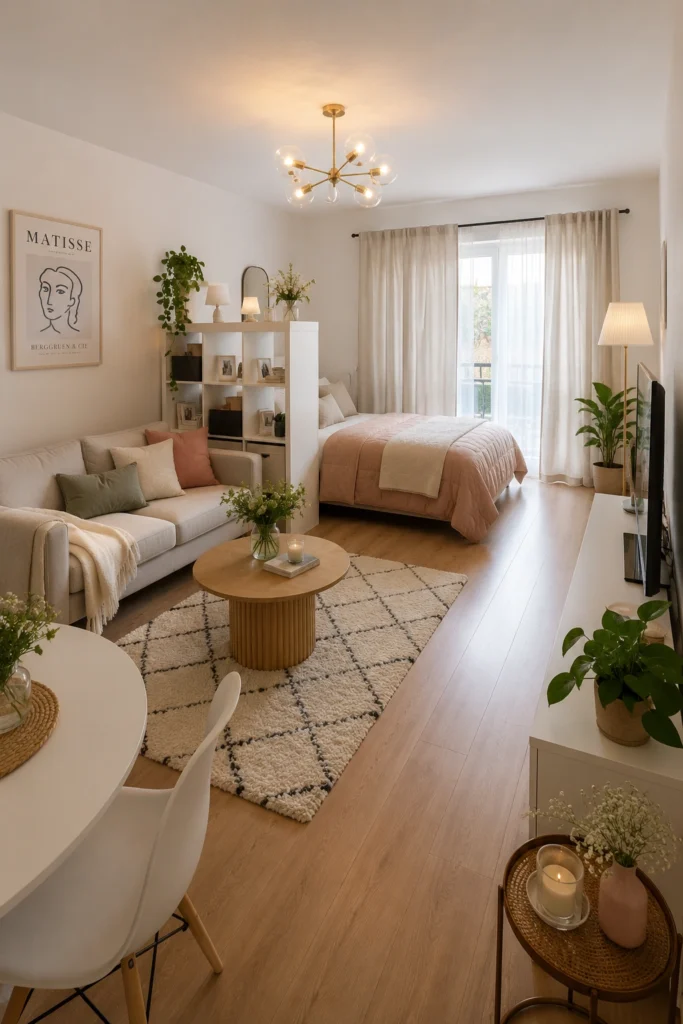
If a full bookshelf feels too tall or too heavy, try a half-height divider instead. It does the same zoning job — your bed lives over there, your living area lives over here — but it keeps the ceiling visible and the whole space feeling airy.
The styling here is doing something subtle that I love: the bedding is a dusty pink, the sofa pillows pick up the same warm tones, and the brass chandelier above ties everything to one warm metal. Even though the room is divided, the color story flows from one zone to the next, so it still reads as one apartment, not two cramped rooms.
Renter-friendly alternative: If a permanent divider feels like too much commitment, a curtain on a ceiling-mounted track does the same job and disappears when you want one open space again.
4. Define Zones Without Walls
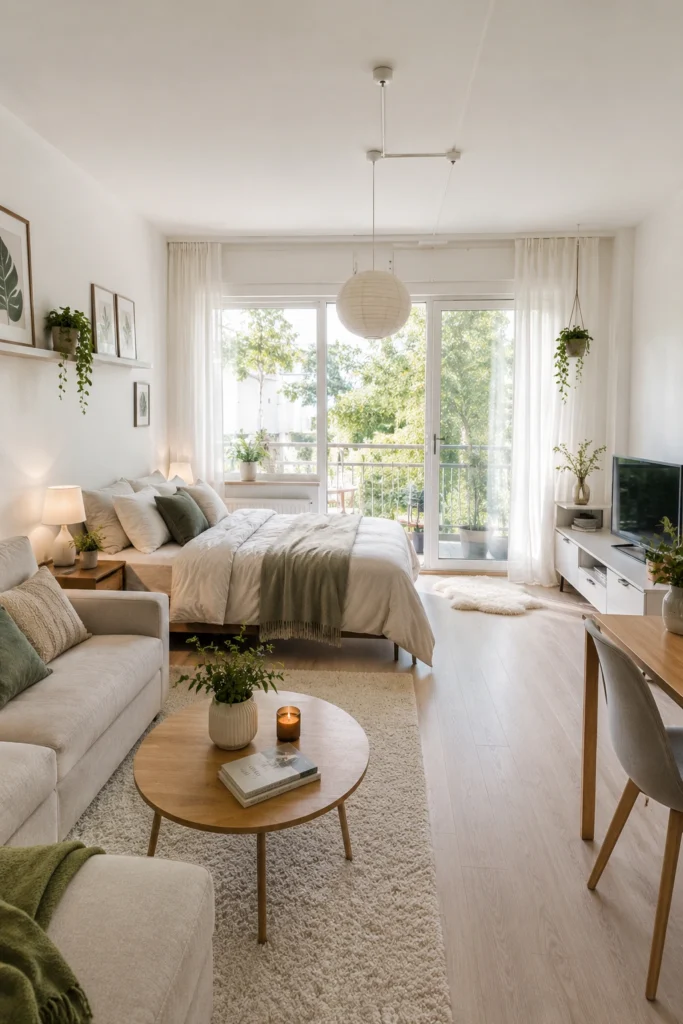
The single biggest mistake in studios is treating the whole floor as one big blob. Your eye needs cues to know where the “living room” ends and the “bedroom” begins — even if there’s no actual wall between them.
In this layout, a low coffee table and a soft cream rug anchor the lounge zone, while the bed sits in its own corner under the balcony’s natural light. Same room, two completely different moods.
Pro tip: A rug is the cheapest, fastest way to draw an invisible line on the floor. Skip it and the room reads like a furniture showroom.
5. Let One Color Story Carry the Whole Space
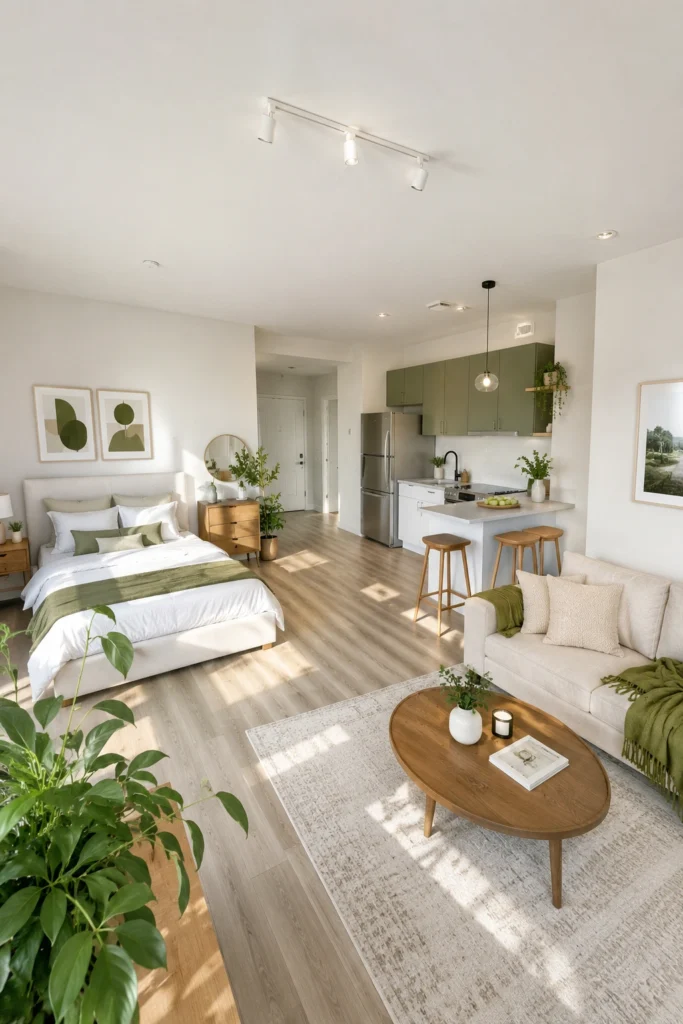
When everything’s visible at once, mismatched palettes turn a studio into visual noise. Pick a color story and let it travel through every zone.
Notice how the soft sage green threads through the kitchen cabinets, the throw on the bed, and the pillows on the sofa. Three completely different zones, but your eye reads it as one cohesive room. That’s the whole point.
You don’t need a fancy color theory degree. Pick two neutrals and one accent. Use them everywhere. Done.
6. Use a Partial Wall Instead of a Full One
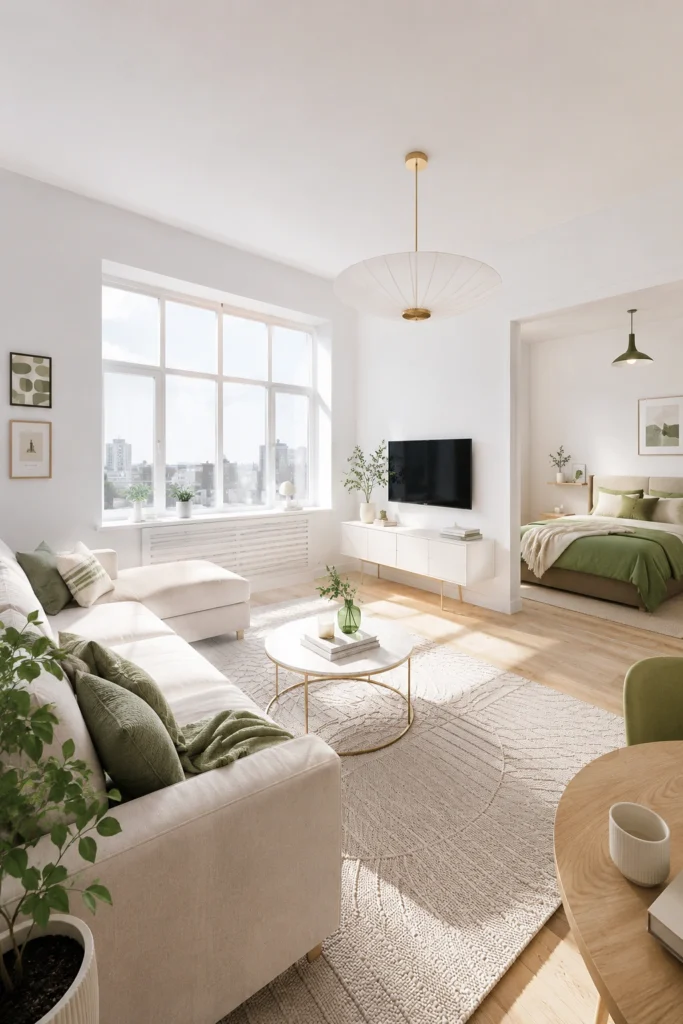
If your studio has any kind of nook, alcove, or half-wall — use it. A partial divider gives you the privacy of a real bedroom without sealing off light or making the place feel choppy.
This one’s a perfect example. The bed sits tucked behind a short wall, but you can still see the window beyond it. The space breathes, but the bed still feels like its own room.
Renting and can’t build anything? A tall open bookshelf does almost the same job. Trust me on this one.
7. Add One Bold Color to Break the Neutrals
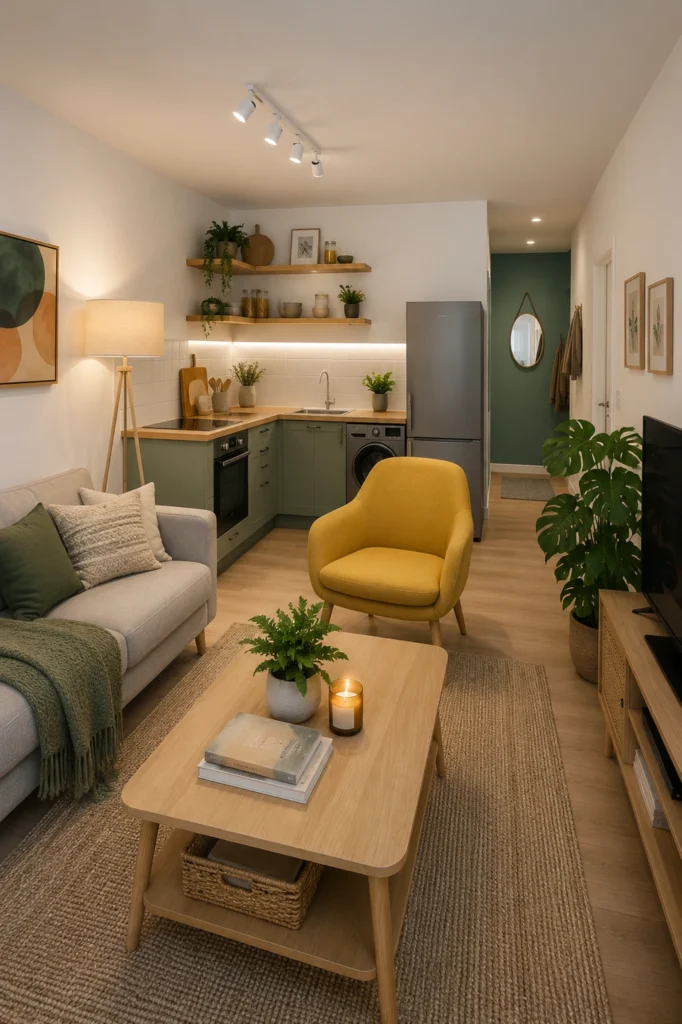
All-beige studios look great in real estate photos and feel lifeless in real life. You need one piece with personality — something that says a human lives here, not a staging company.
That mustard yellow chair? It’s doing all the heavy lifting in this space. Without it, the room would be pleasant but forgettable. With it, you walk in and immediately feel something.
Budget vs. splurge: Save on the chair (HomeGoods, Facebook Marketplace, IKEA reupholstered). The “wow” moment comes from the color, not the price tag.
8. Use a Bookshelf as a Soft Divider
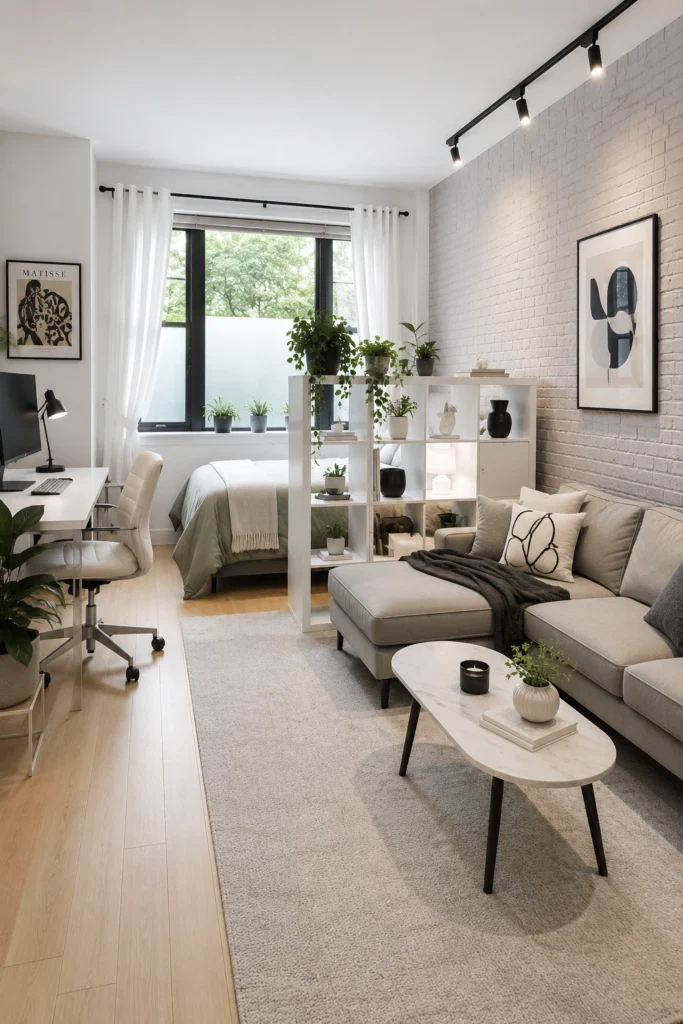
If you’ve ever tried to live with your bed two feet from your couch, you know the problem: you can never fully “leave” work, and you can never fully relax. A cube shelf solves this without putting up a wall.
I love this look because the shelf isn’t trying to hide the bed — it’s just suggesting a separation. Light still passes through the cubes, plants spill down both sides, and your eye reads two distinct rooms even though it’s clearly one space.
- Choose an open-back shelf (not a solid wardrobe) so daylight keeps moving through
- Style both sides — the bedroom side gets a lamp and a candle, the living side gets art books and a small plant
- Keep the top edge below eye level when standing, so the ceiling still feels tall
The classic IKEA Kallax in white costs less than a nice dinner out and does this job better than most “real” room dividers I’ve tested.
9. Mix Eclectic Patterns on a Neutral Sofa
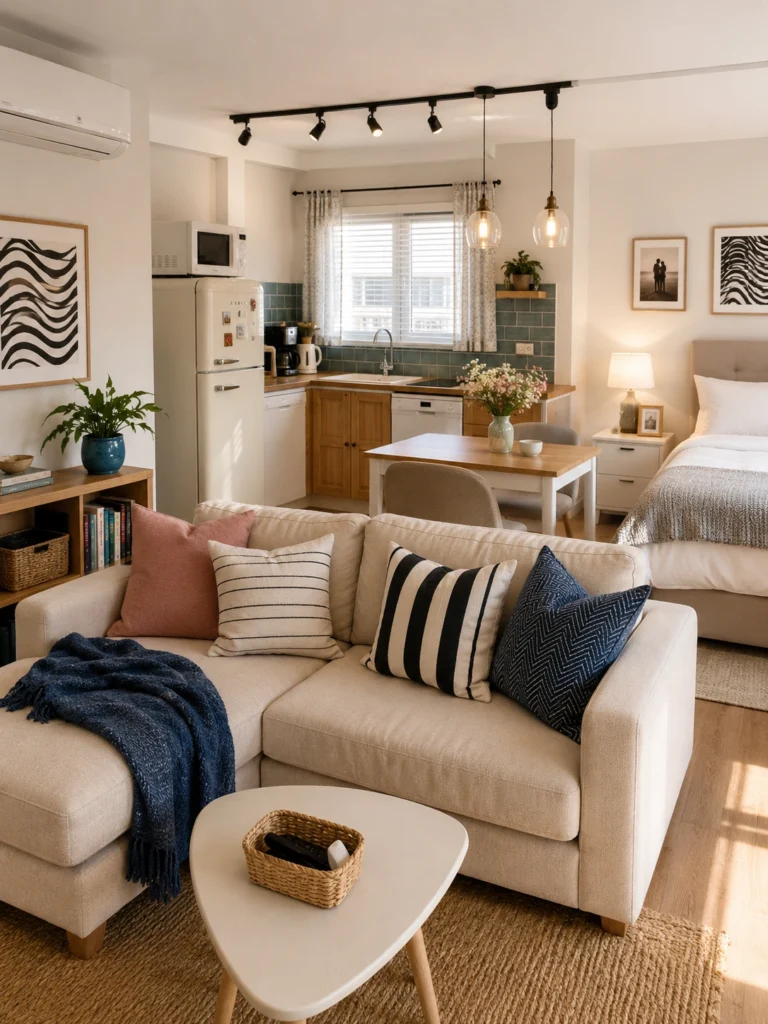
This is the studio that taught me a neutral sofa is never boring — it’s a blank canvas. The sectional here is a soft oatmeal, and every bit of personality comes from the layered pillows: a dusty rose, a black-and-white stripe, a navy herringbone, a knit throw in deep blue.
The trick is keeping your base calm (sofa, walls, bed linens) so the patterns can play without fighting each other. If everything in the room had a print, your eye wouldn’t know where to land.
Renter-friendly alternative: Don’t love your landlord’s beige couch? A linen slipcover from Amazon or Bemz transforms a tired sofa for under $200, and a few new throw pillows on top will fool anyone.
10. Let One Big Window Do the Heavy Lifting
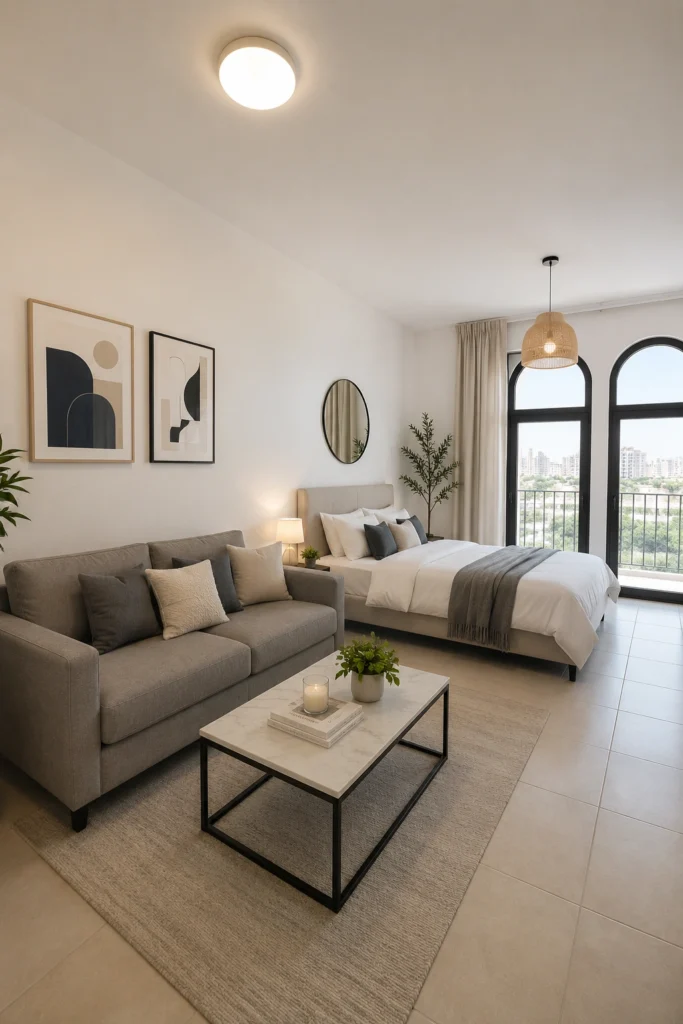
Natural light is the cheapest decor upgrade in the world, and most of us waste it. If you’re lucky enough to have a tall window or a balcony door, do not block it with furniture, heavy curtains, or a stack of laundry baskets. Let it breathe.
Notice how this room keeps the area around the arched doors completely open. The bed and sofa sit perpendicular to the window, which means the light pours across the whole space instead of hitting a wall and stopping. The result feels twice as big as it actually is.
Pro tip: If you must have curtains for privacy, mount the rod almost to the ceiling and let the panels puddle slightly on the floor. It makes the window — and the whole room — read taller.
11. Commit to a Tight Color Story
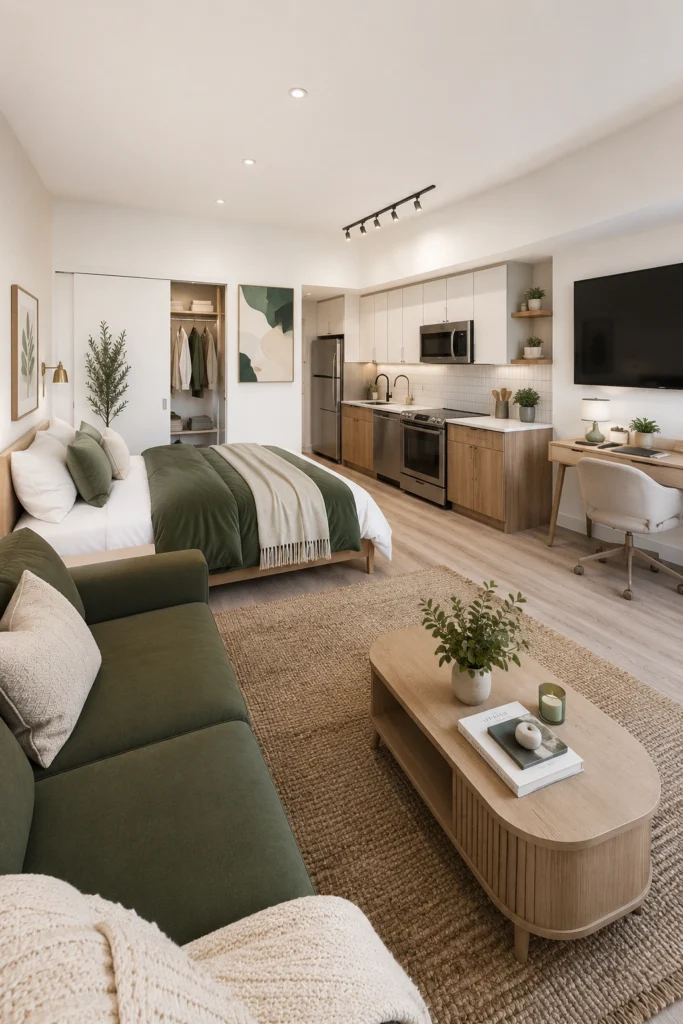
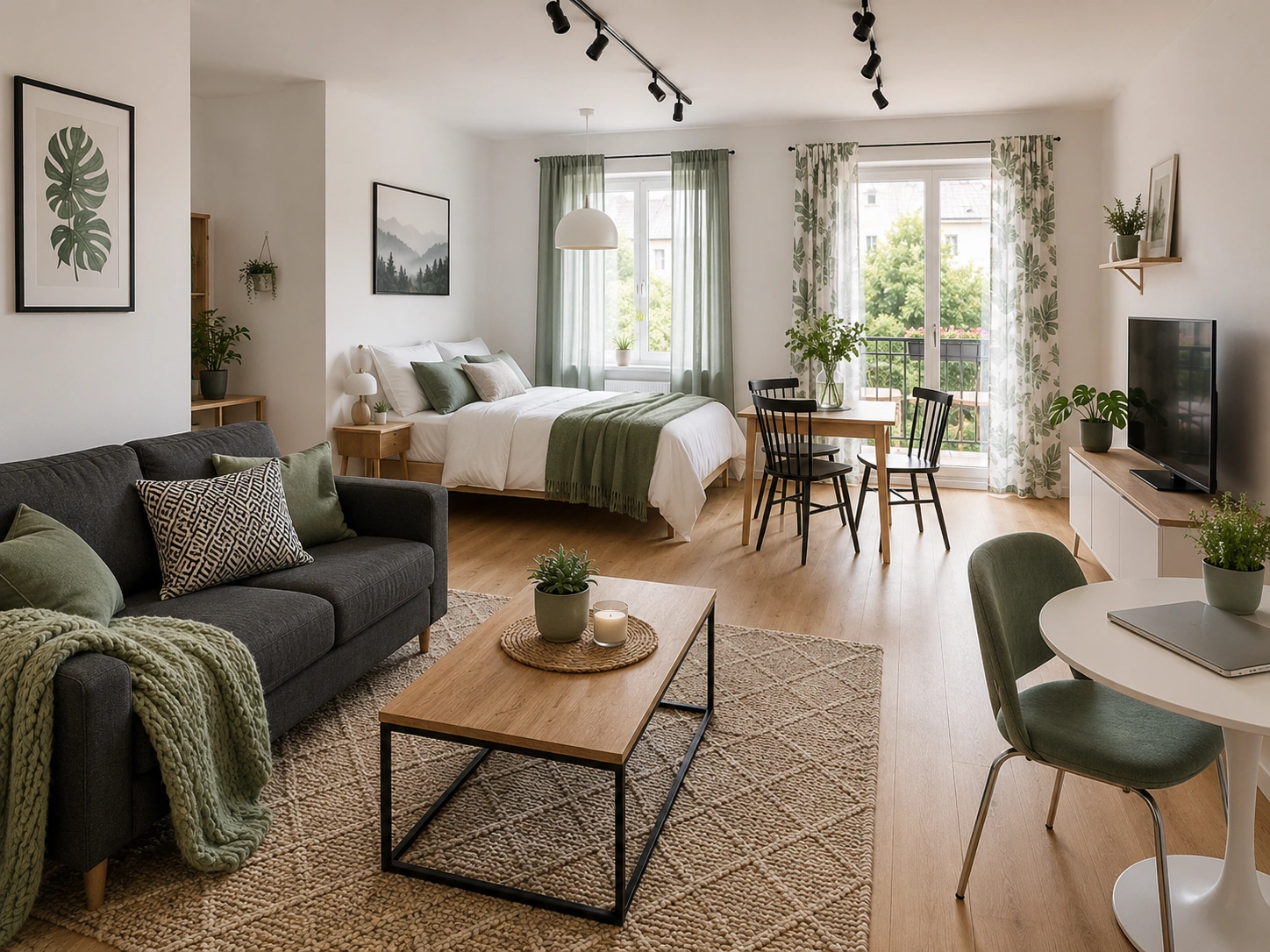
If your studio feels chaotic, the problem is probably too many colors fighting for attention. Pick three and stop there. This studio commits to olive green, warm oak, and creamy white — and because nothing strays from those three, the eye relaxes the moment you walk in.
Look closely and you’ll see the green echoes everywhere: the bedding, the sofa, the framed art, even the candle on the coffee table. That kind of repetition is what makes a space feel intentional rather than thrown together.
Pro tip: When you’re styling a small space, repeat each color at least three times across the room. One green pillow looks like an accident. Three green moments look like a decision.
12. Layer Your Lighting (This Is the Part Most People Skip)
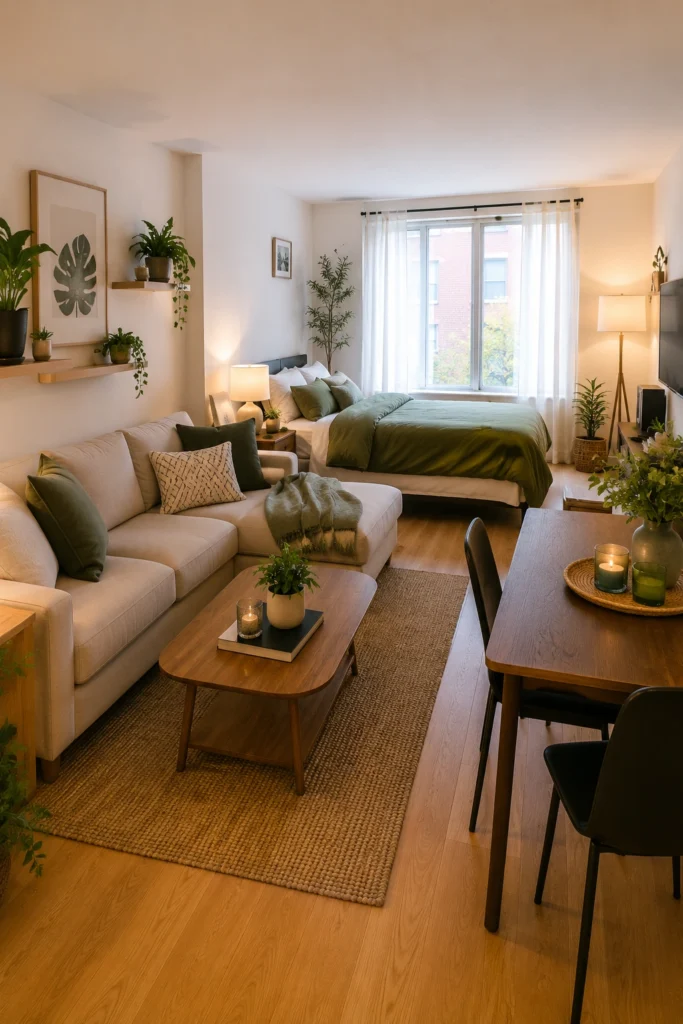
Overhead lights alone will make any studio feel like a dentist’s office at 7 p.m. You need at least three light sources working together: one overhead, one mid-height (a table or floor lamp), and one low (candle, small accent lamp).
Look at this room at night. It’s not the furniture making it cozy — it’s the four or five separate pools of warm light scattered around the space. That’s layered lighting in action.
Pro tip from someone who learned the hard way: Swap every cool-white bulb you own for warm white (2700K). One $15 trip to the hardware store, total mood shift.
13. Give Every Function Its Own Spot — Even If Things Touch
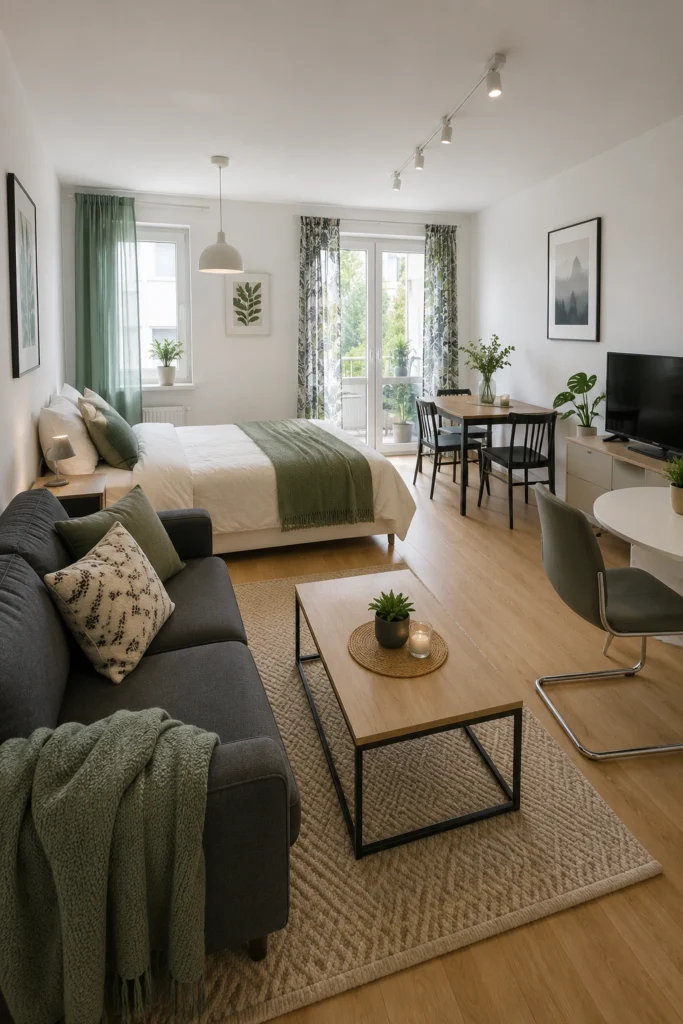
In a studio, your sofa might be three feet from your bed and four feet from your dining table. That’s fine. What matters is that each piece has a clear job and isn’t trying to do three things at once.
This studio nails it: the bed sleeps, the sofa lounges, the small table dines, and the desk works. Nothing overlaps. Nothing’s pulling double duty. That clarity is what makes the room feel calm instead of cluttered.
If you only remember one thing from this whole list, remember that: one function, one zone, every time.
14. Pull the Bed Into a Defined Alcove
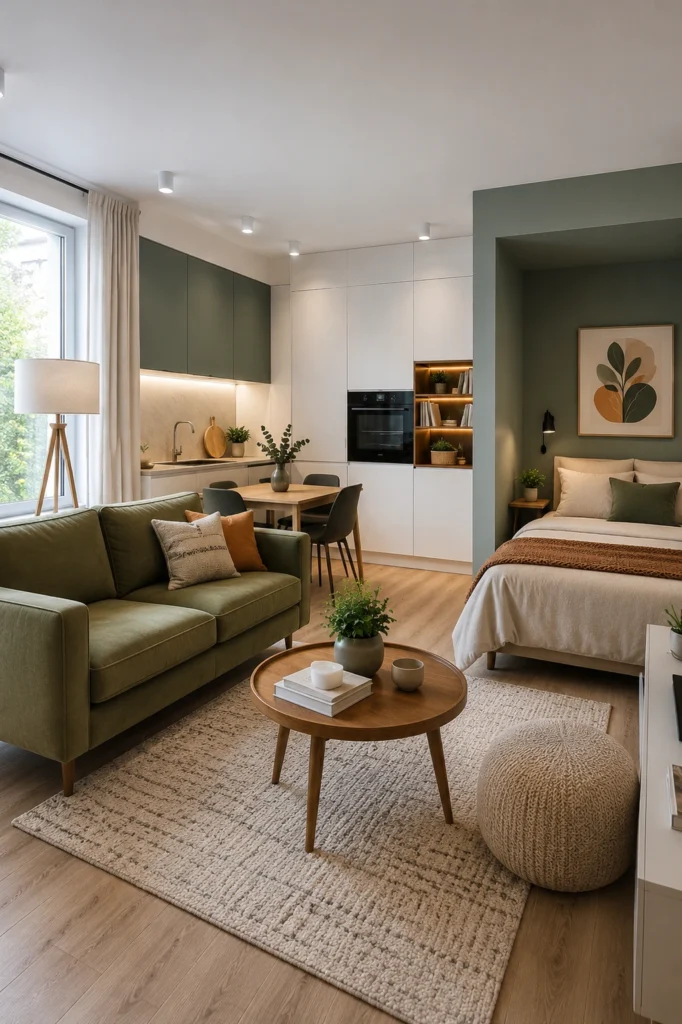
If your studio has any kind of architectural recess — even a shallow one — that’s where the bed goes. Painting the back wall a deeper shade or hanging one piece of art above the headboard instantly turns a sleeping corner into a proper bedroom moment.
The olive sofa anchors the living side, the painted niche anchors the sleep side, and the kitchen quietly does its job between them. Three zones, no walls, no chaos.
Renter-friendly alternative: Can’t paint? Hang a large textile, tapestry, or oversized art piece behind the bed. Same visual weight, zero damage deposit risk.
15. Anchor the Room With One Long Axis
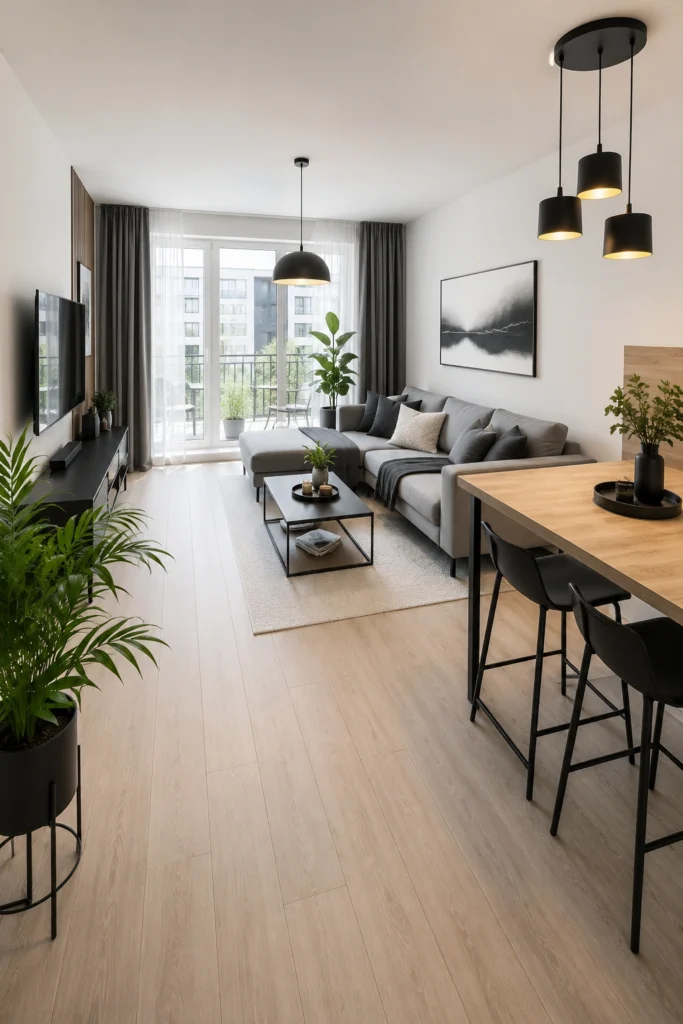
When a studio is narrow, fight the urge to push everything against the walls. Instead, pick one continuous visual line — here, the pale wood floor runs from the balcony all the way through to the dining counter — and let your furniture float on top of it. The grey sectional, low coffee table, and tall counter stools form a clear living-dining-cooking progression, but the floor ties them together.
Pro tip: A single rug under the sofa stops the seating zone without chopping the room in half. Skip the runner rug down the middle — it’ll only emphasize how long and skinny the space is.
The black metal pendants and dining chairs add weight at eye level so the room doesn’t float away. Without those darker anchors, all that pale wood and grey would feel like a showroom, not a home.
16. Paint a Color Block Halfway Up the Wall
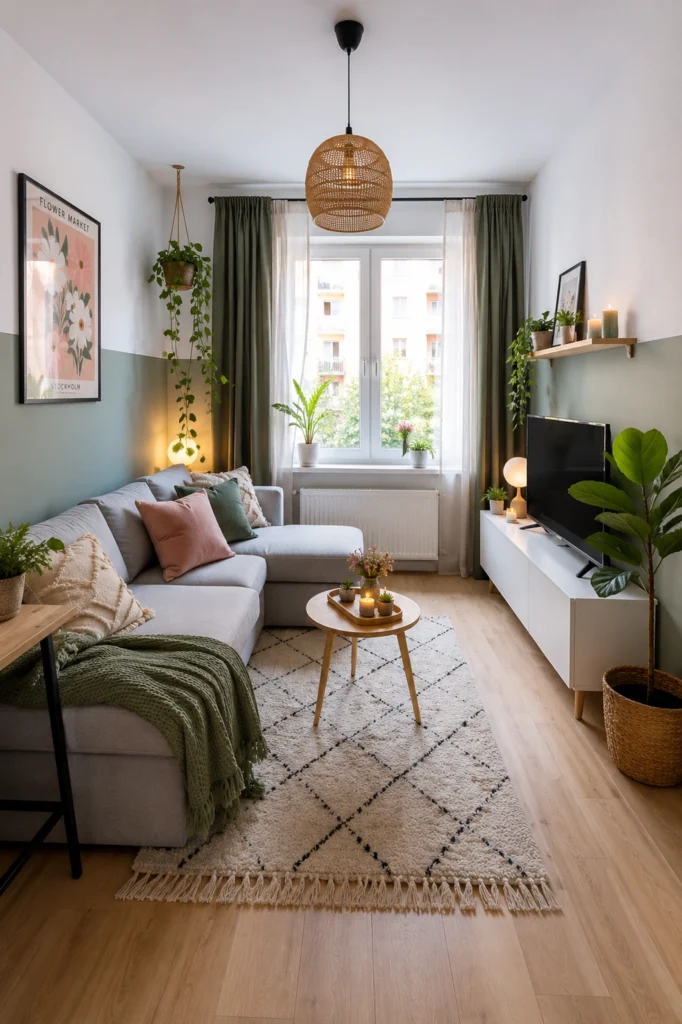
This is one of my favorite tricks for narrow studios that feel like hallways. Painting the bottom half of the wall in a soft, earthy color — here it’s a dusty sage — visually lowers the ceiling and makes the room feel more like a room and less like a corridor.
It also gives you a built-in accent without committing to a feature wall. The rattan pendant, the green throw, and the small plants pick up the wall color and pull the whole space together.
Renter-friendly alternative: If paint is off-limits, look at peel-and-stick wallpaper in muted earth tones, or use a long, low piece of art to create the same horizontal line effect. Tempaper and Chasing Paper both have removable options that don’t wreck your deposit.
17. Layer Warm Wood, Green, and a Hint of Brass
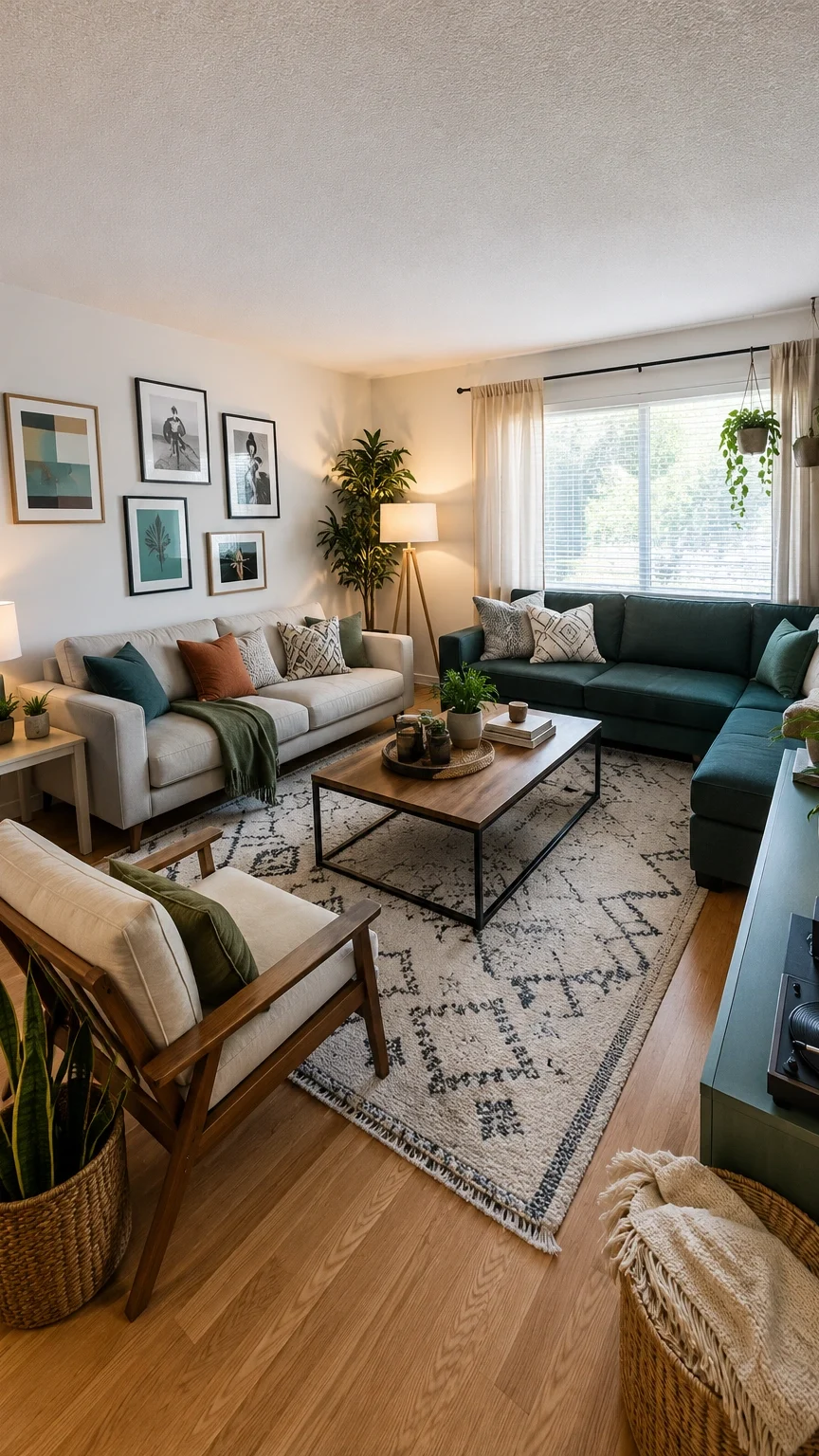
This one isn’t strictly a studio, but the styling principles transfer perfectly to a small open-plan apartment. The palette is doing all the work: cream upholstery, deep forest green, walnut wood, and a Moroccan-style rug in cream and charcoal.
Earth tones don’t have to mean beige-on-beige-on-beige. Green is technically an earth tone — pull from moss, sage, olive, or pine — and it instantly warms up a room that’s gone too neutral. Pair it with mid-century wood frames and you’ve got a space that feels collected over years, not bought in one trip.
Budget vs. splurge: Splurge on the green sectional (you’ll keep it for a decade). Save on the gallery wall — thrifted frames and free printables from Unsplash or the Public Domain Review will do the job beautifully.
Final Thoughts
A studio is not a smaller version of a “real” apartment — it’s its own thing, with its own rules. Once you stop apologizing for it and start designing for it, you’ll be amazed how warm and grown-up a single room can feel.
Pick one idea from this list. Just one. Maybe it’s swapping your bulbs to warm white tonight, or ordering an open shelf divider this weekend. The rest will follow naturally once you see what one good change can do.
Your studio doesn’t need to be bigger. It just needs to feel like yours.