15 Small Studio Apartment Ideas That Create a Relaxing Home Vibe
Studio apartments get a bad rap. People talk about them like they’re a stepping stone — something to survive until you can afford “a real place.” Here’s the thing: I’ve lived in studios. The best ones don’t feel cramped. They feel like a perfectly edited little world where everything has a reason to be there.
The trick isn’t to pretend your studio is bigger than it is. It’s to make it work harder, feel softer, and look more like you. These ten ideas will help you do exactly that, no renovation required.
1. Build a Kitchen-Sofa-Dining Combo Into One Tight Corner
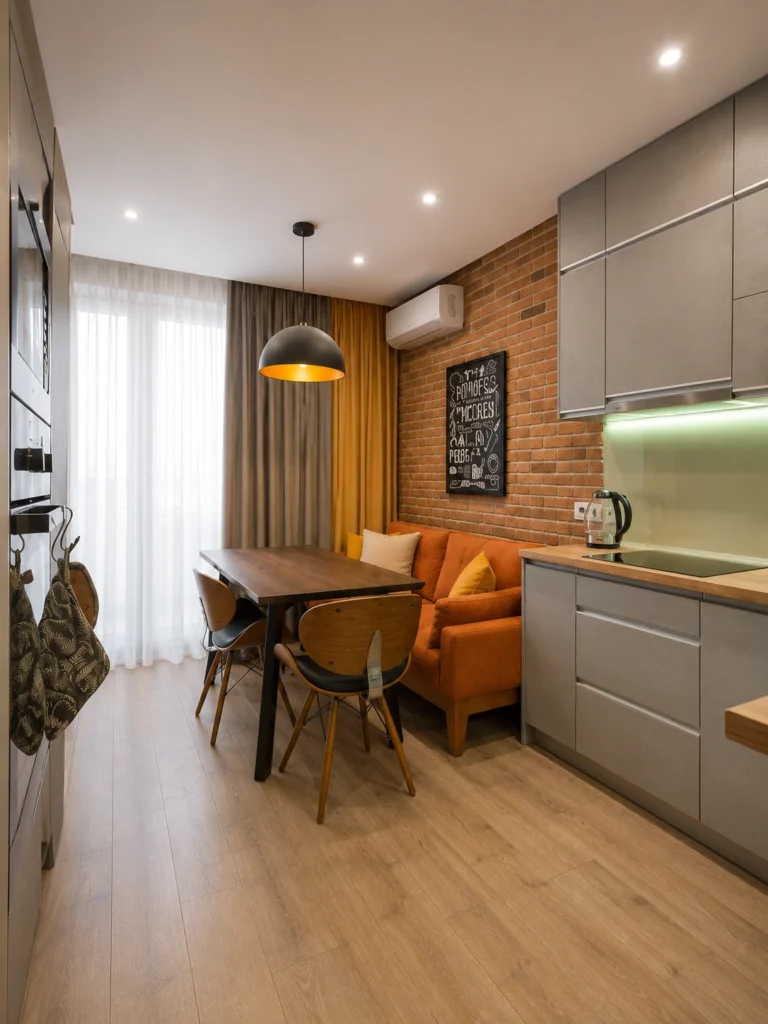
If your studio has one usable wall and you need it to do everything — eat, cook, hang out — stop trying to spread out. Stack the functions.
This setup is genius for how dense it is. The sofa tucks right up against the dining table, which sits next to the kitchen. One pendant light anchors the whole zone. The orange sofa adds the personality, the brick wall adds warmth, and the dining chairs are functional enough for daily life but pretty enough to feel intentional.
The trick: pick one bold color (here, that burnt orange) and let it carry the whole room emotionally. Everything else stays neutral so the eye has somewhere to rest.
2. Keep the Palette Pale, Then Add Two Warm Wood Tones
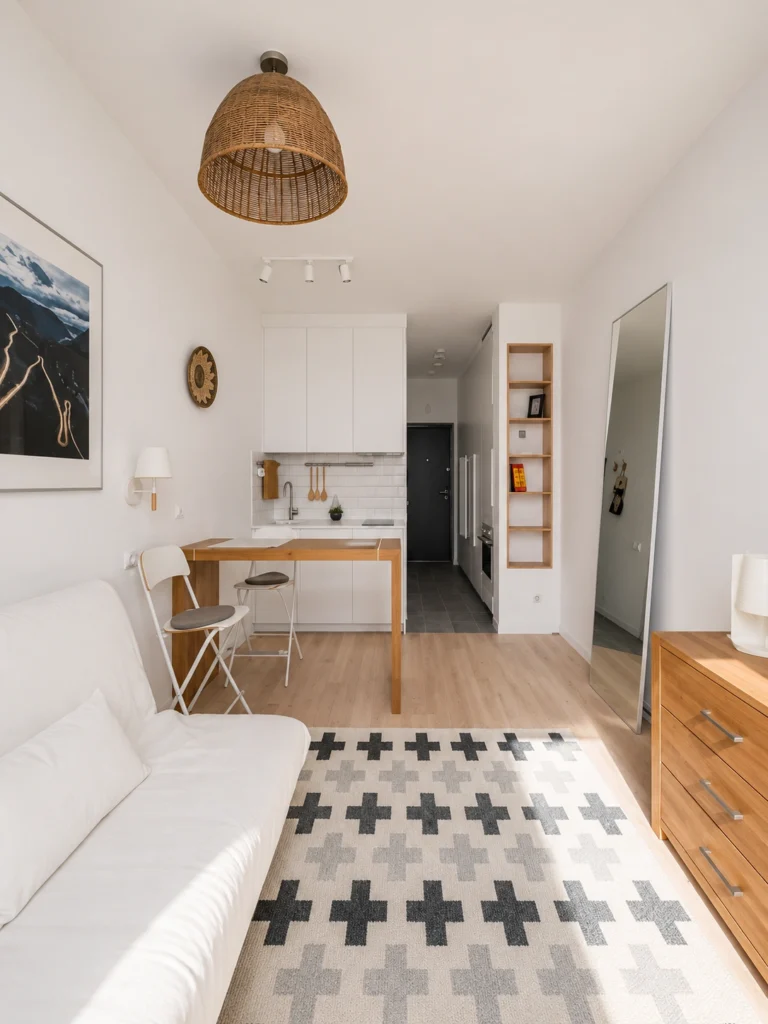
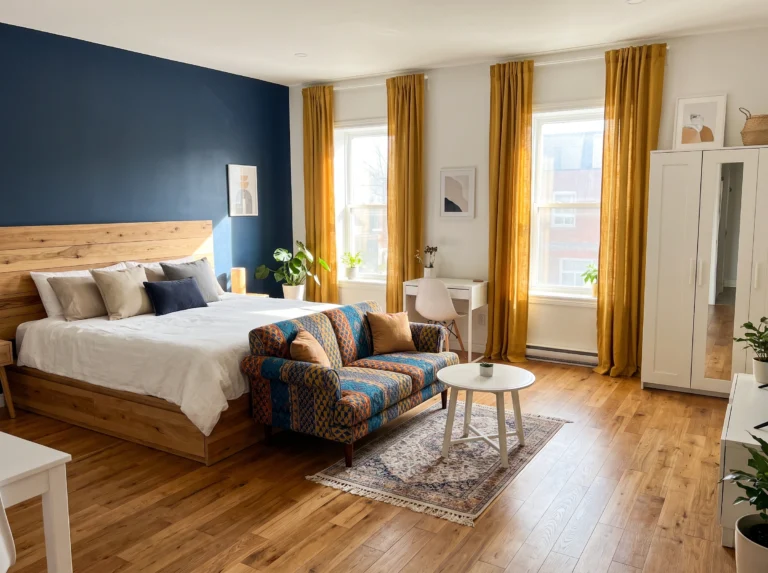
If you’ve ever wondered why some small spaces feel airy and others feel claustrophobic with the exact same square footage, the answer is almost always the palette. Pale walls, pale upholstery, pale floors — that’s the formula.
But pure white-on-white can tip into “rental hospital” fast. The fix: two warm wood tones to break things up. A light oak floor plus a richer mid-toned dresser. A woven rattan pendant overhead. Suddenly the room has depth without losing the airy feeling.
Renter-friendly alternative: If your floors and walls are already builder-beige and you can’t change them, lean into wood through furniture and decor instead. A wood-frame chair, a wood-handled mirror, a wood pendant. Same effect, no security deposit drama.
3. Use a Slatted Screen to Hide Your Bed (Even Just Visually)
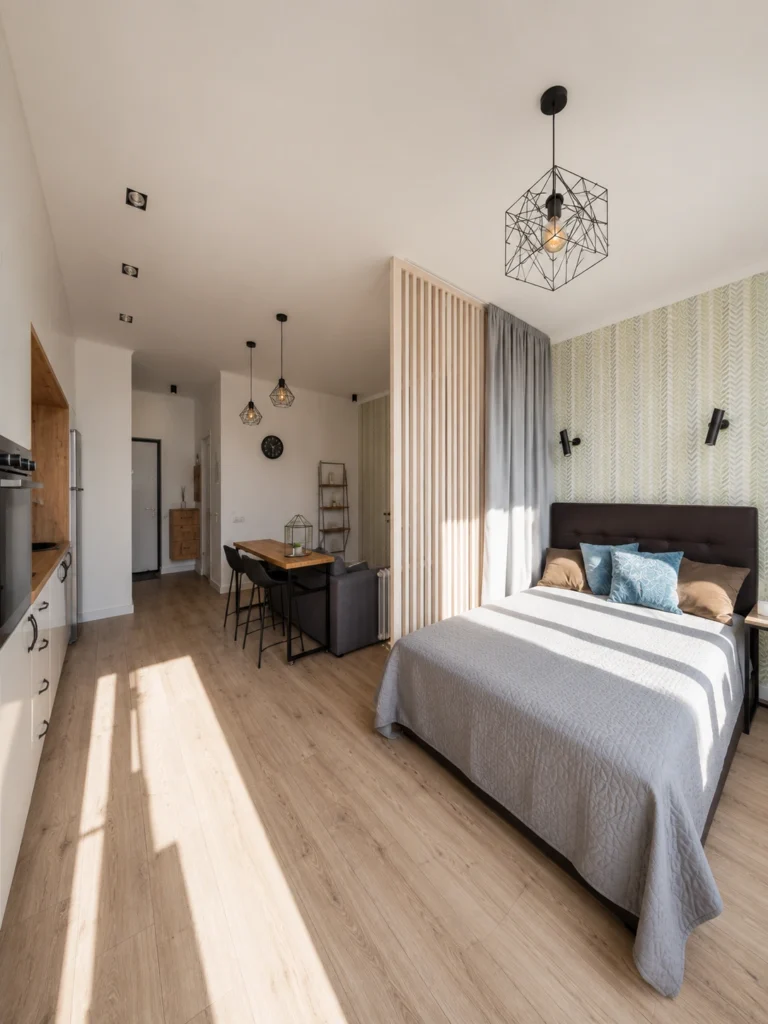
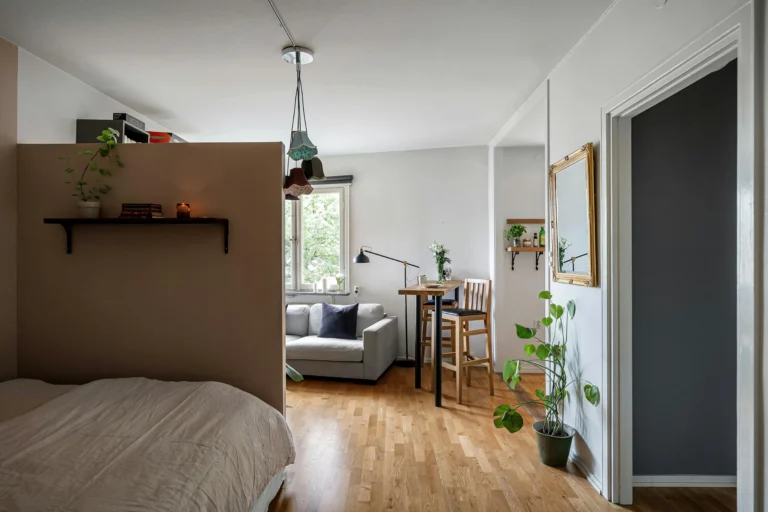
The biggest psychological win in any studio is making your bed feel like it lives in a bedroom, even when there’s no door. A vertical slatted screen does exactly that. It doesn’t block the bed entirely — you can still see through it, light still moves — but the sense of “this is the sleep zone” is instantly stronger.
Pair it with a patterned accent wall behind the headboard (that soft green chevron paper here is doing serious heavy lifting) and the bed area suddenly feels like its own room. Your guests’ eyes land on the dining table when they walk in, not your unmade sheets.
Pro tip from someone who learned the hard way: Always make the wall behind your bed the most decorated wall in the studio. It pulls focus and tricks the eye into reading that corner as “the bedroom.”
4. Go Boho-White if You Want the Space to Feel Like a Vacation
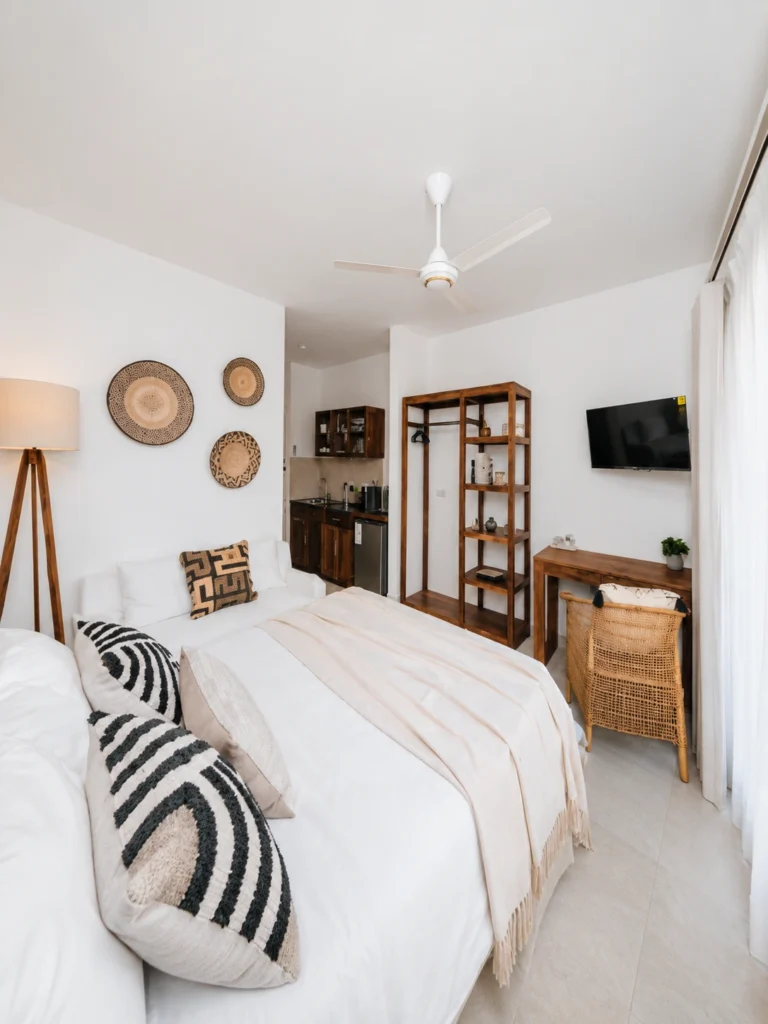
Small studios are perfect for the white-and-woven boho look — and not just because it photographs well. The reason it works is practical: light bouncing off white walls makes a small space feel twice as big, and natural textures (rattan, jute, raw wood) keep it from feeling sterile.
The decor here is doing a lot with very little. Three woven baskets on the wall. A linen throw. A rattan chair. A tripod floor lamp. None of it is expensive. All of it adds up to a space that feels like you’re on vacation in your own home.
Budget vs. splurge: Save on the wall baskets (thrift stores and craft fairs are full of them). Splurge on a good linen bedspread — you sleep on it every night, and cheap linen gets scratchy fast.
5. One Bold Cushion Is All a Neutral Studio Needs
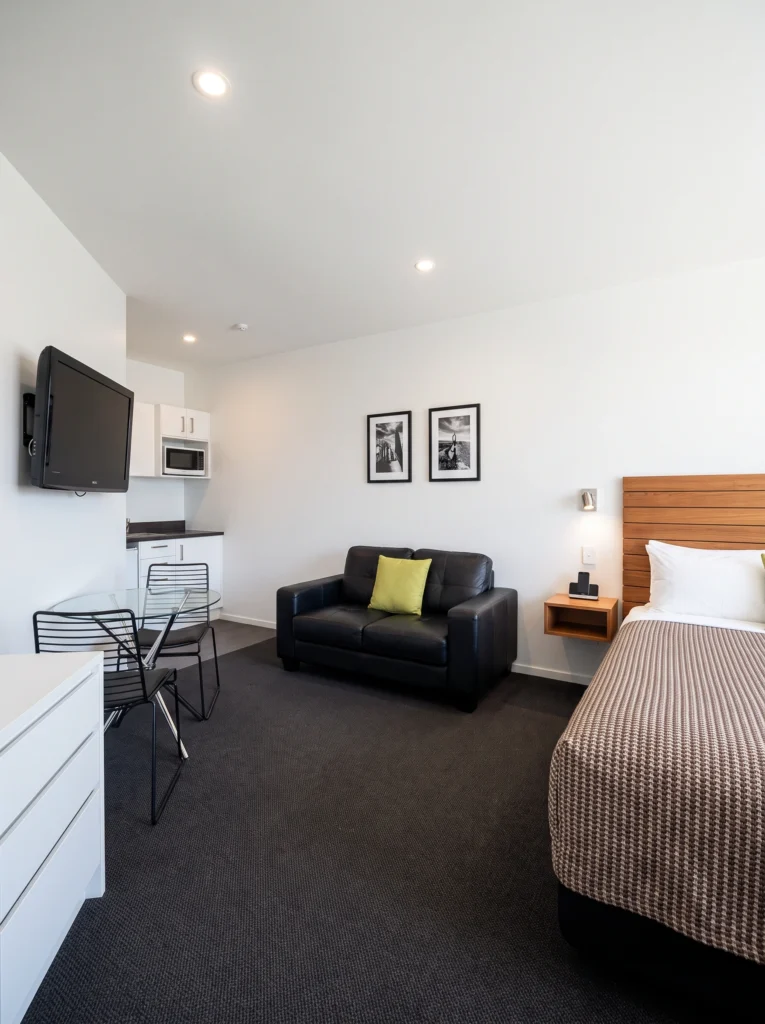
Dark carpet, black leather sofa, white walls, taupe bedding — this studio is almost entirely neutral, and that single lime green cushion is doing enormous work. It’s proof that you don’t need to redecorate to change the feeling of a room. One unexpected color note against an otherwise restrained palette always reads as intentional. The glass dining table and black wire chairs keep the floor visually open despite the dark carpet. Small footprint, clear head, zero clutter.
Renter-friendly alternative: If you’re stuck with dark carpet you can’t change, lean into it — dark floors make light furniture and white walls pop harder. Fighting the carpet with more dark pieces just makes the room feel heavy.
6. Use a Low Shelf Unit as Your TV Stand and Room Divider
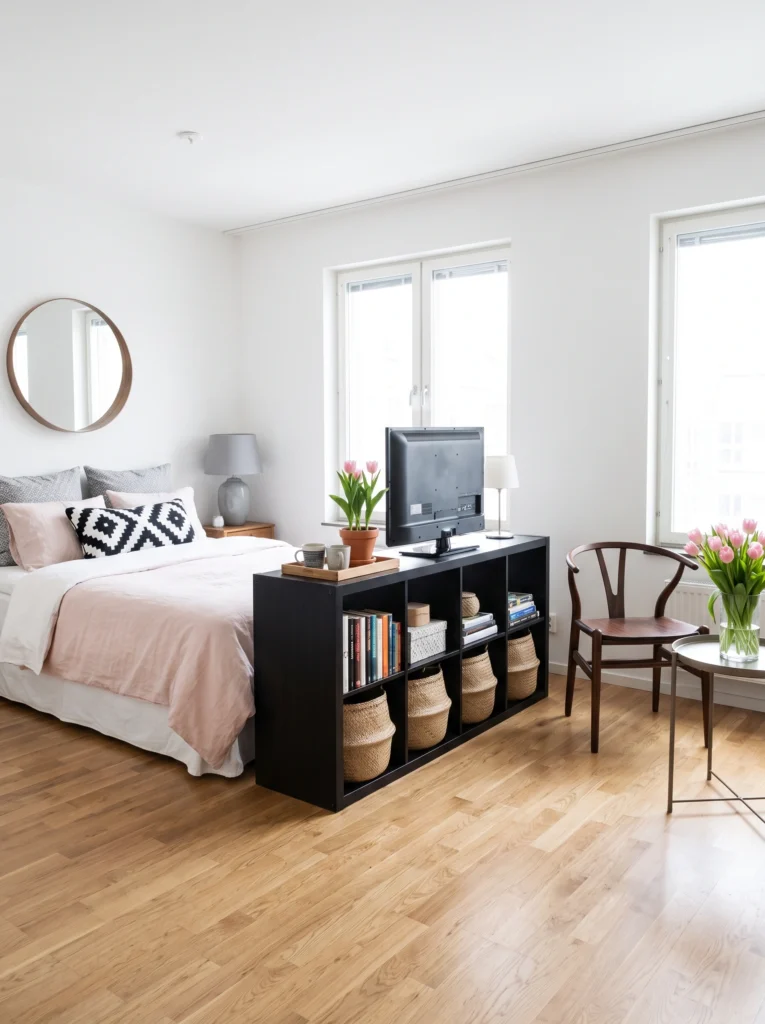
A black KALLAX-style shelf unit placed at the foot of the bed is doing three things at once: it holds the TV, divides the bed from the rest of the room, and provides basket storage inside every cube. Pink tulips in a terracotta pot on top add color without requiring a single frame on the wall. The blush bedding and walnut mirror keep the bedroom side warm and soft. This is the most useful $80 piece of furniture in small-space decorating — and it’s hiding in plain sight at IKEA.
Budget vs. splurge: The IKEA KALLAX shelf (from $59) is genuinely one of the best small-space investments you can make. Splurge instead on quality wicker baskets to fill the cubes — they make the whole unit look intentional rather than utilitarian.
7. Mirror One Wall to Double the Apartment Visually
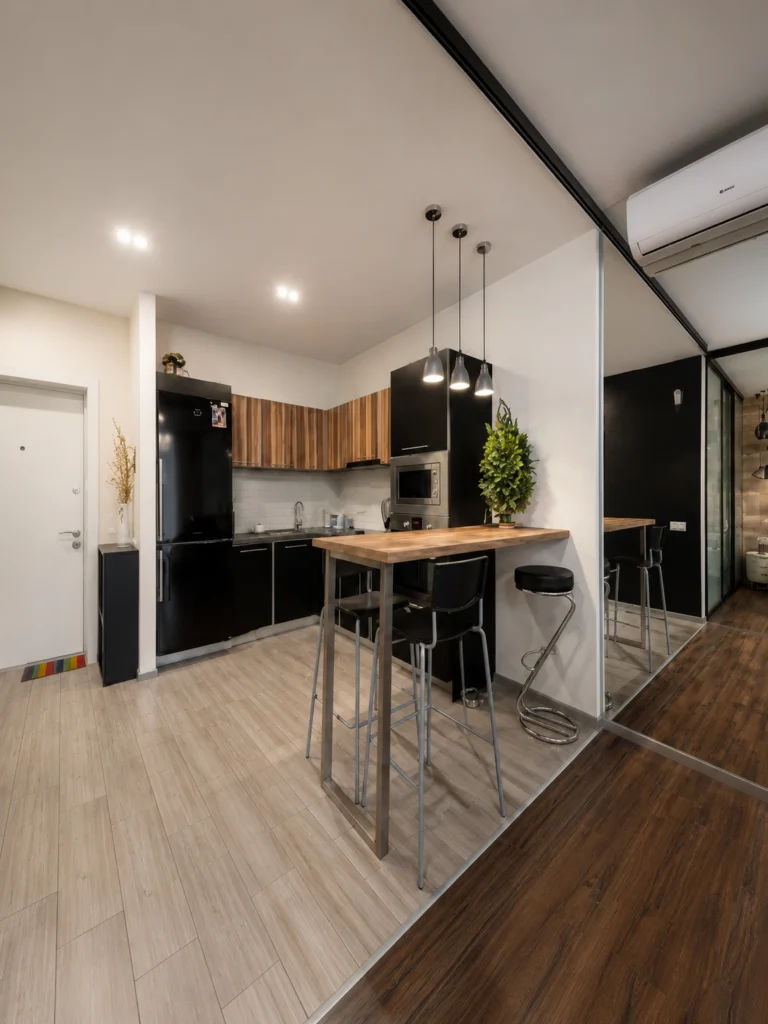
This is the move I recommend most often, and the one most people are scared to try: mirror an entire wall. Floor to ceiling.
It sounds dramatic. It looks dramatic in photos. But in person, in a real small studio, a full mirror wall is the closest thing to actually adding square footage. The room feels twice as wide. Light bounces everywhere. And it solves the “where do I put a mirror to get dressed” problem in one move.
The kitchen here is genuinely tiny, but the mirror wall makes it feel like a proper open-plan space. Renter-friendly alternative: Stick-on mirror tiles or a large leaning floor mirror against one wall will get you 70% of the same effect with zero damage.
8. Use a Bookshelf as a Room Divider
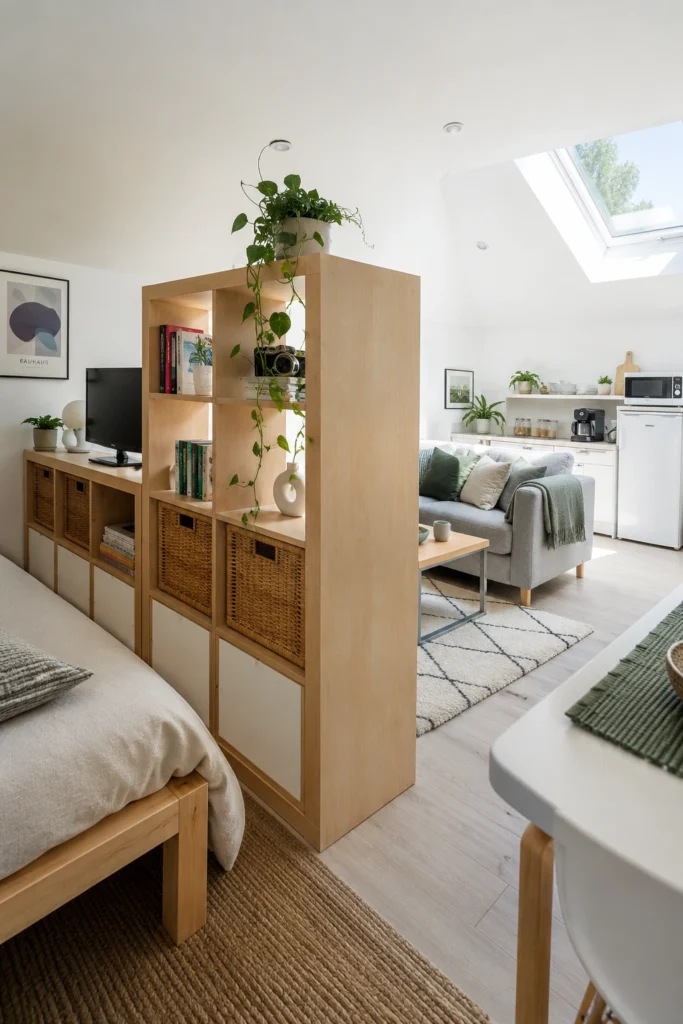
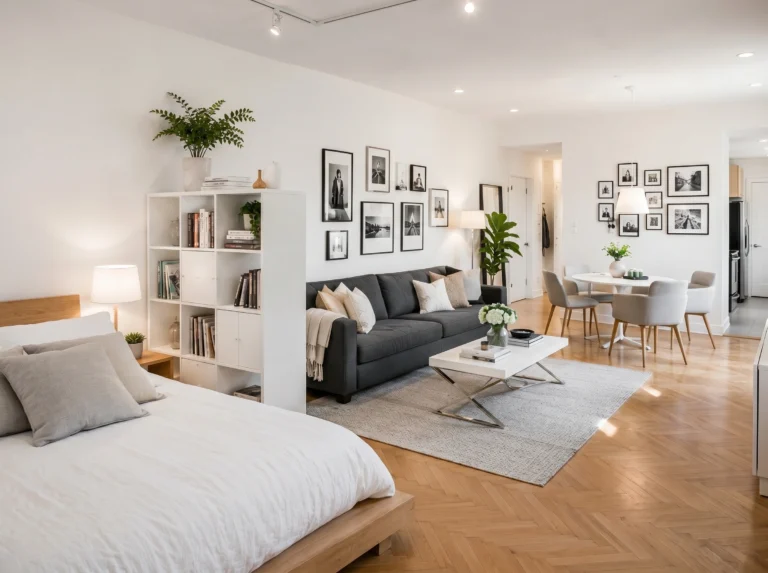
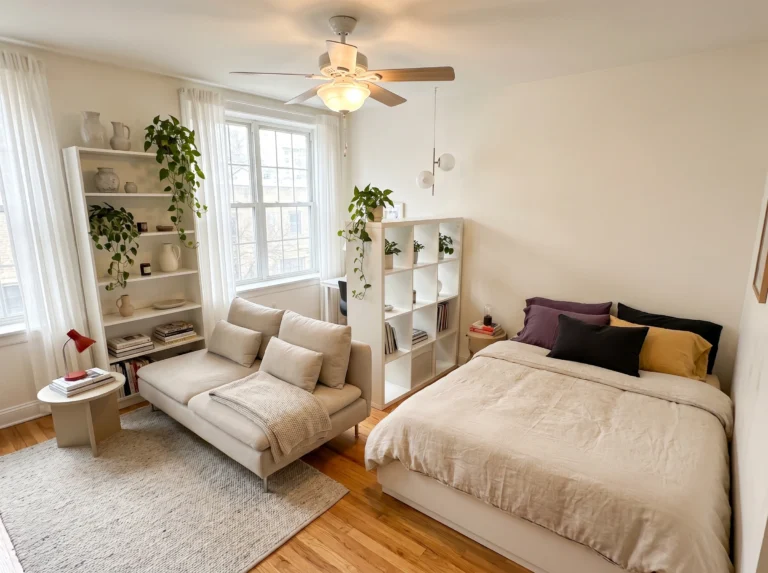
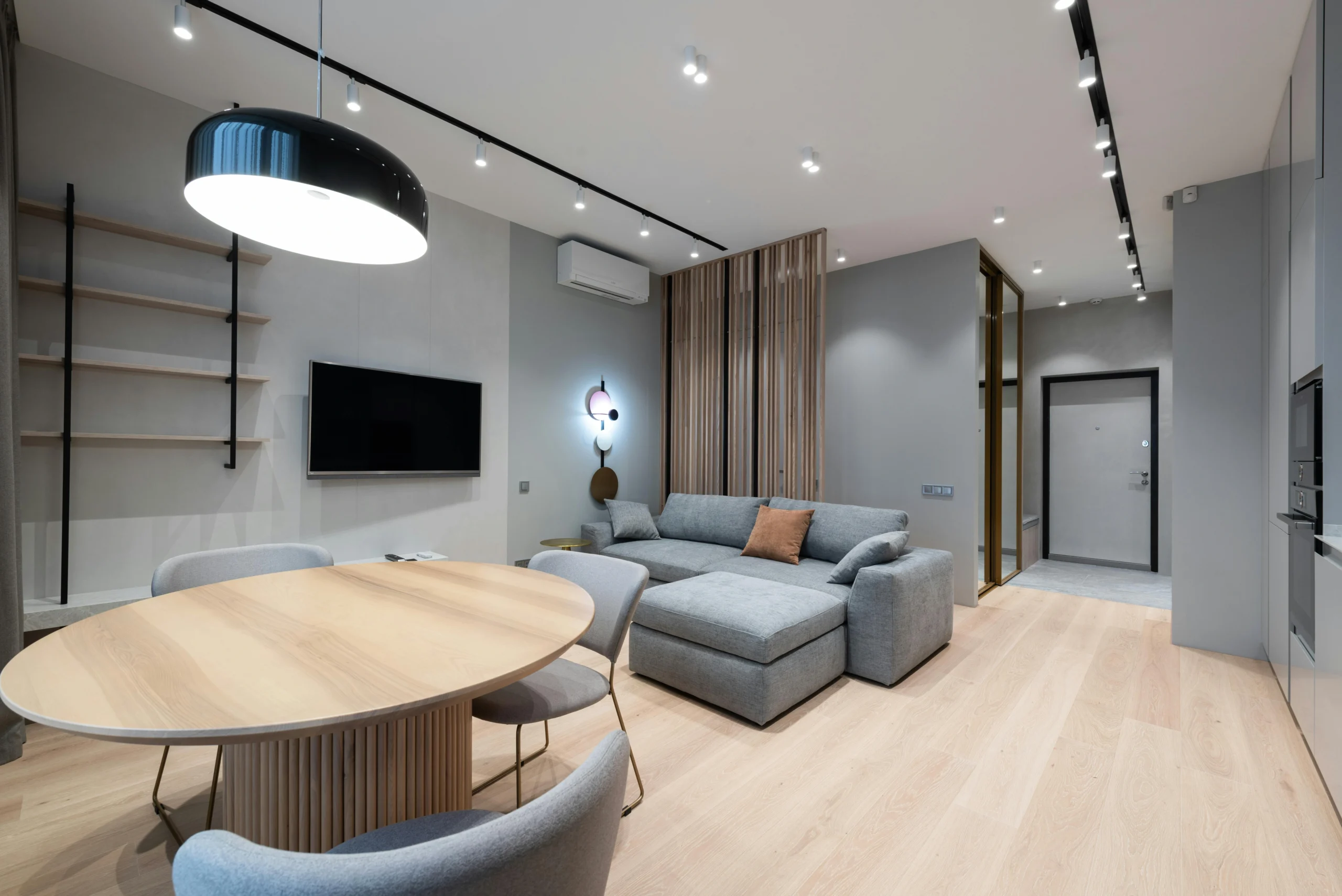
If your studio is one open box, the fastest way to make it feel like a real home is to break it into zones. A tall open-back bookshelf is the secret weapon — it splits the room without blocking light, and you get storage as a bonus.
Look for cube shelves (IKEA’s Kallax is the classic for a reason) and style them as a two-sided display. Books, baskets for hidden storage, a trailing plant on top, a small lamp tucked into one cube. The open back keeps things airy, so the divided room still feels like one space.
Pro tip: Anchor your “bedroom” side with a rug under the bed and your “living room” side with a rug under the sofa. Two rugs in one room sounds like a lot — it isn’t. It’s what tells your brain these are two rooms.
9. Float the Bed Like It Belongs in the Living Room
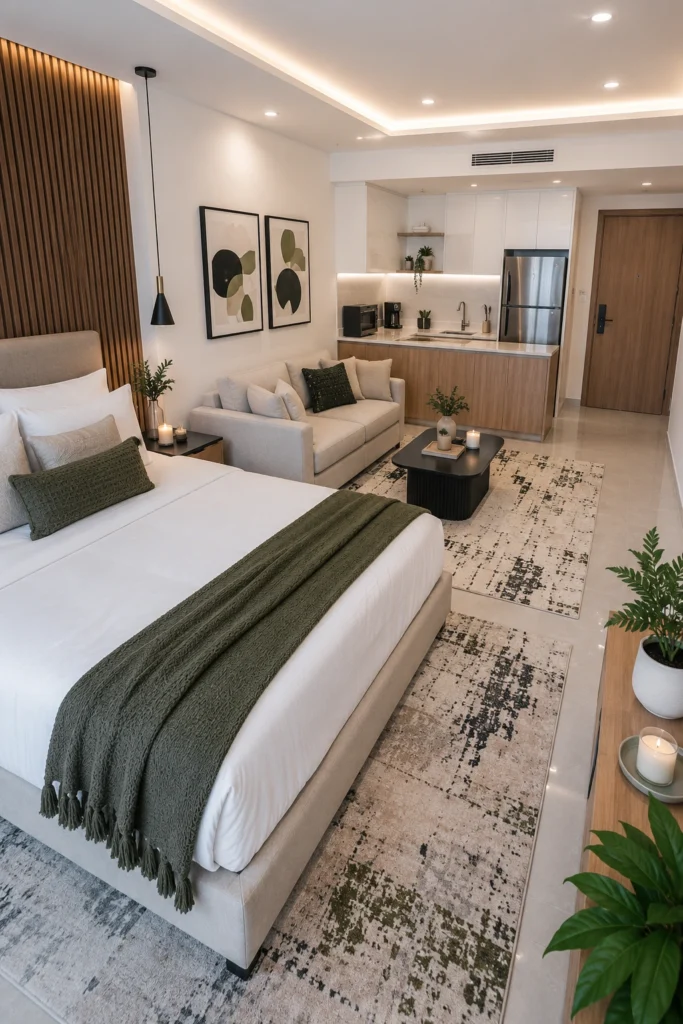
When the bed is the biggest piece of furniture, stop treating it like something to hide. Float it away from the wall, give it a proper upholstered headboard, and let it sit in the room like a piece of furniture you actually chose.
A neutral linen bed, a knit throw at the foot, a sculptural pendant light hanging beside it — suddenly the bed reads as styled, not slept-in. Pair it with a small sofa across the way and a low coffee table between them, and you’ve got a sleep zone and a hangout zone in the same footprint.
A made bed is the single biggest mood-shifter in a studio. If you do nothing else on this list, learn to make your bed properly in the morning. It changes the whole room.
10. Stick to a Tight Color Palette
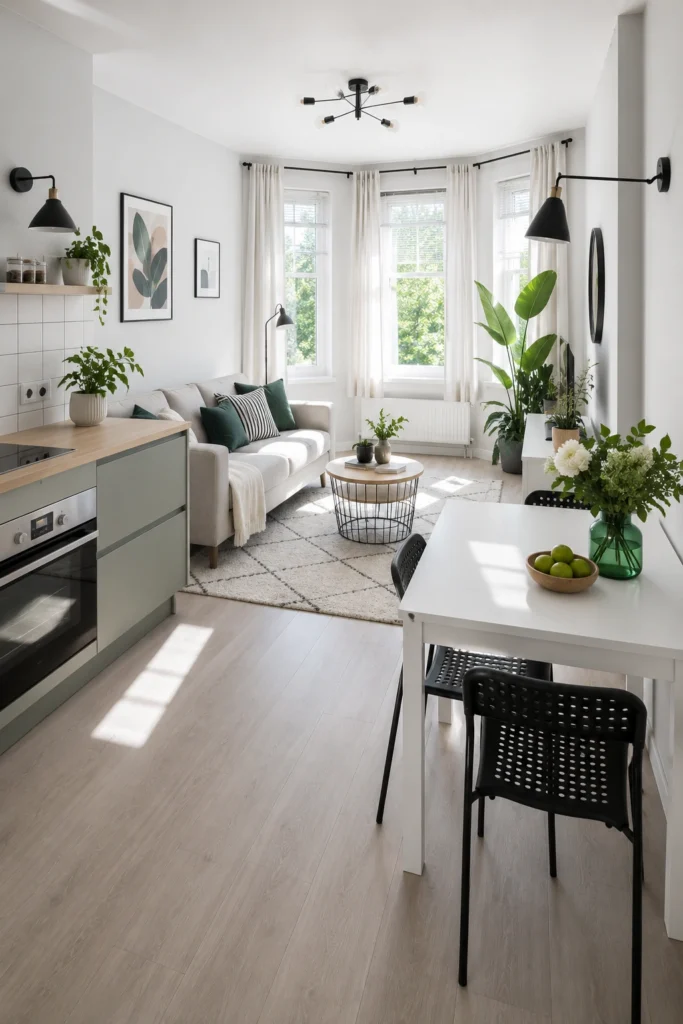
In a small space, every color choice fights for attention. The fix is brutal but easy: pick three or four colors and stop there. White walls, a wood tone, one accent color (sage green, warm terracotta, navy — your call), and black for grounding details like lamps and chair frames.
When everything coordinates, the eye glides across the space instead of stopping at every visual collision. The room reads as calm and intentional, even if it’s twelve feet across. This is the part most people skip — and it’s exactly why their studio feels chaotic.
11. Go Bold With One Saturated Piece
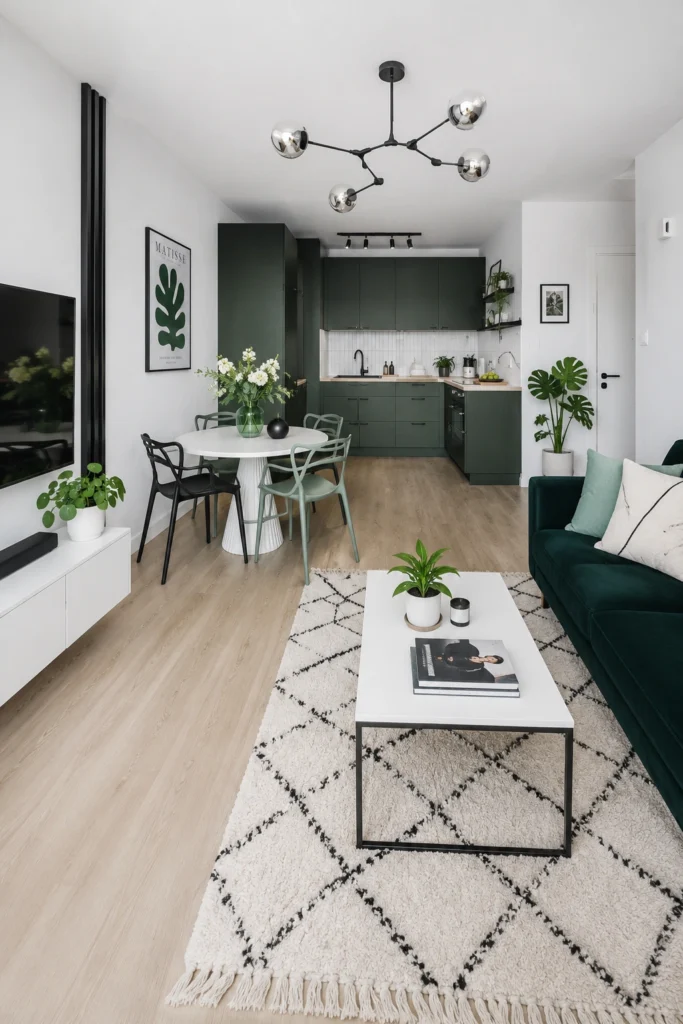
A tight palette doesn’t mean a boring one. In fact, the smaller the space, the more one saturated, gorgeous piece will do for it.
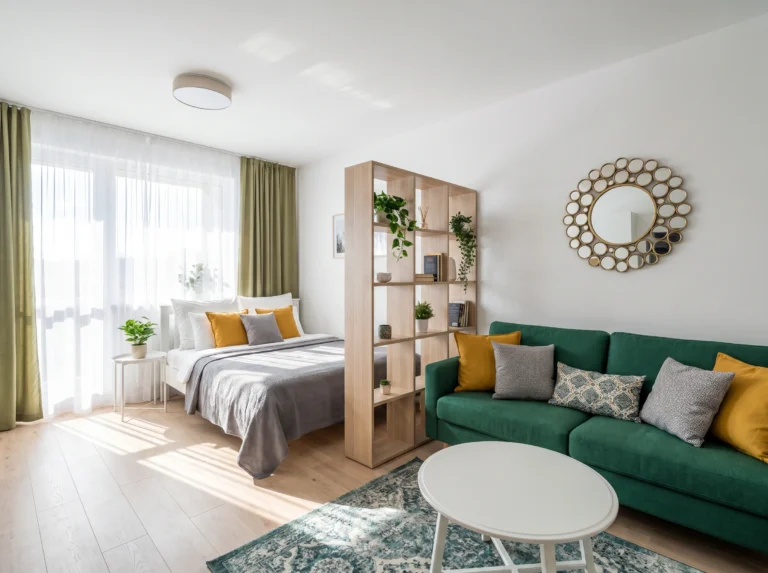
A jewel-toned sofa (forest green, navy, rust velvet) becomes the anchor that everything else quietly supports. Surround it with neutral walls, pale floors, and a graphic black-and-white rug, and the sofa earns every dollar you spent on it. The room has a personality now. That’s the whole point.
Budget vs. splurge: Splurge on the one piece your eye lands on first — usually the sofa or the bed. Save on everything else with neutral, replaceable basics.
12. Add a Real Workspace, Even if It’s Tiny
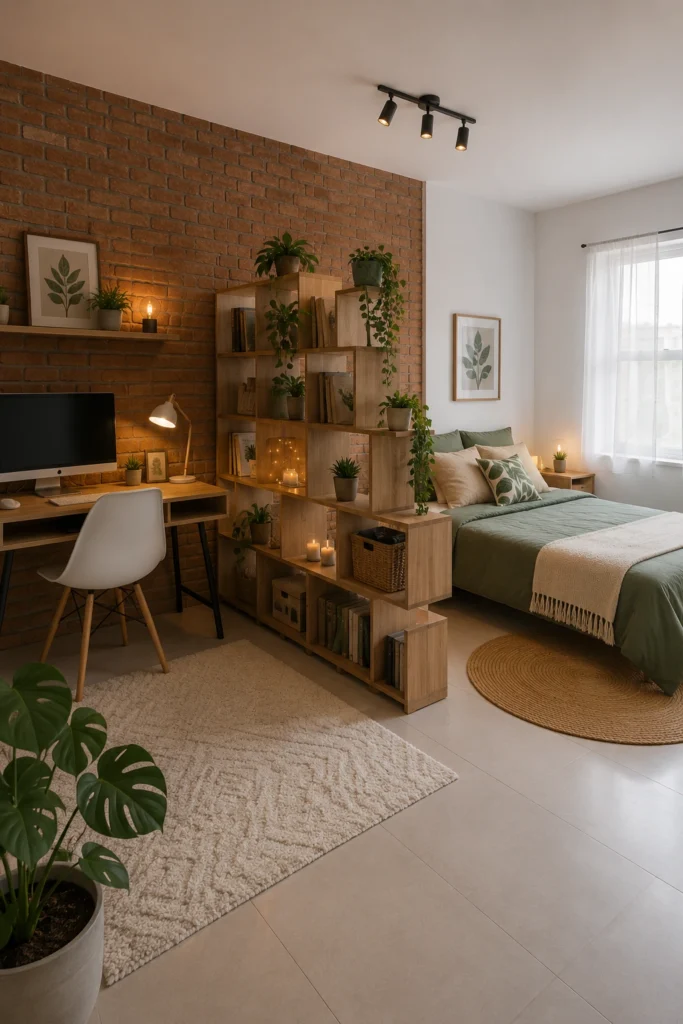
If you work from home — even sometimes — your studio needs a desk that is not your kitchen table or your bed. Trust me on this one. The mental separation matters more than the square footage.
A narrow console desk (24 inches deep is plenty), a comfortable chair, a small task lamp, and one piece of art above it. That’s a workspace. Place it perpendicular to a wall to help break up the room, or tuck it against an accent wall — exposed brick, a wood slat panel, a peel-and-stick wallpaper — to make the corner feel like its own little office.
Renter-friendly alternative: Can’t expose brick? Faux brick peel-and-stick panels look surprisingly convincing now, especially with warm lamplight on them. Most come off cleanly when you move.
13. Hang One Statement Light
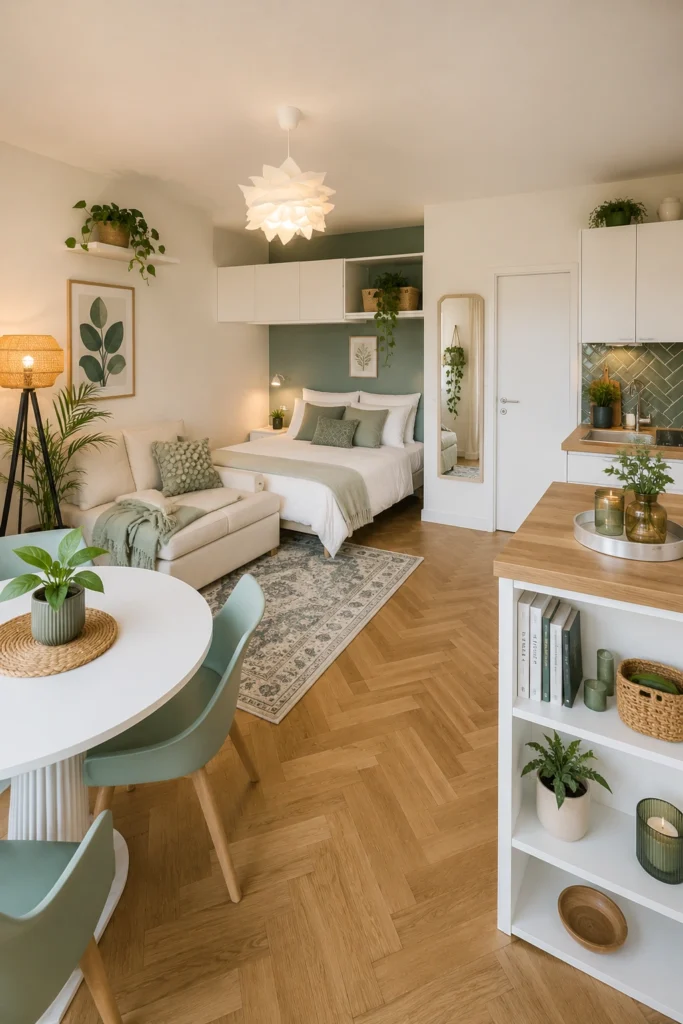
A studio with nothing but overhead fluorescents feels like a dorm room. A studio with one beautiful pendant feels like an apartment.
Pick one fixture that does the heavy lifting visually — a rice paper globe, a pleated linen pendant, a sculptural rattan lantern — and hang it where you spend the most time. Then layer in smaller, softer light sources around the rest of the room: a floor lamp by the sofa, a small lamp on the nightstand, a candle on the coffee table.
That mix of light heights is called layered lighting, and it’s the single biggest reason rooms in magazines look the way they do.
14. Let the Light In — and Let the Floor Breathe
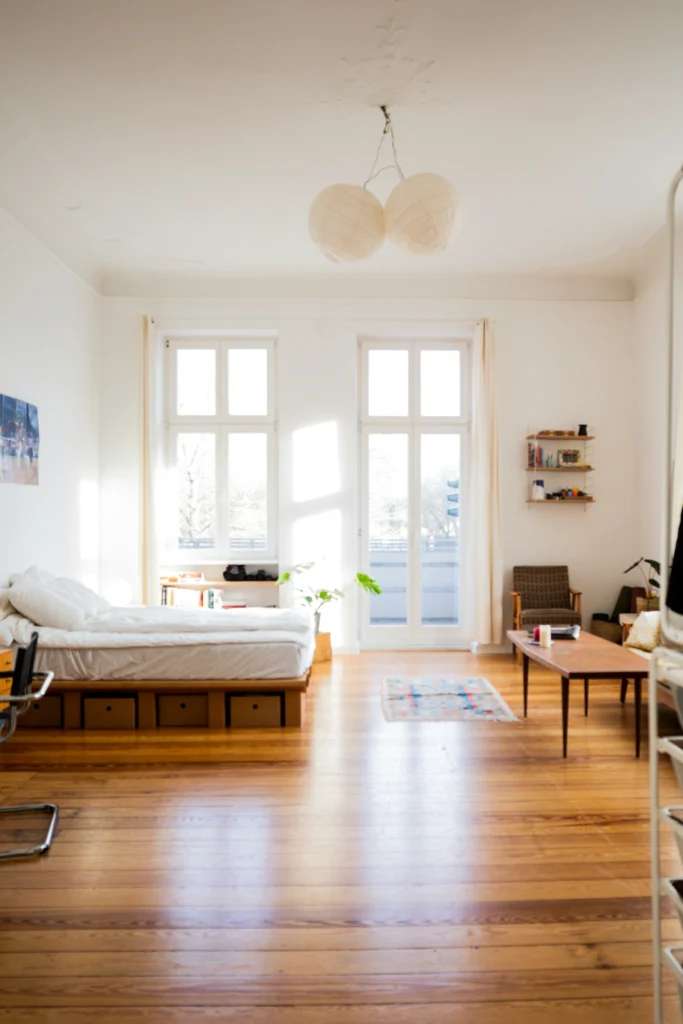
The most underrated small-space trick is also the cheapest: clear the floor. Pull the bed away from the corner. Let the windows do their job. Skip the heavy curtains and go for something light — linen panels or simple sheers that move with the breeze.
When sunlight has room to bounce around bare wood floors, a studio reads twice its actual size. Every piece of furniture you remove from the perimeter gives you that breathing room back. You don’t need to fill a small space. You need to let it exhale.
My rule: if I haven’t used a piece of furniture in six months, it leaves. Sentimental items get one shelf, not one apartment.
15. Define Zones With Different Rugs
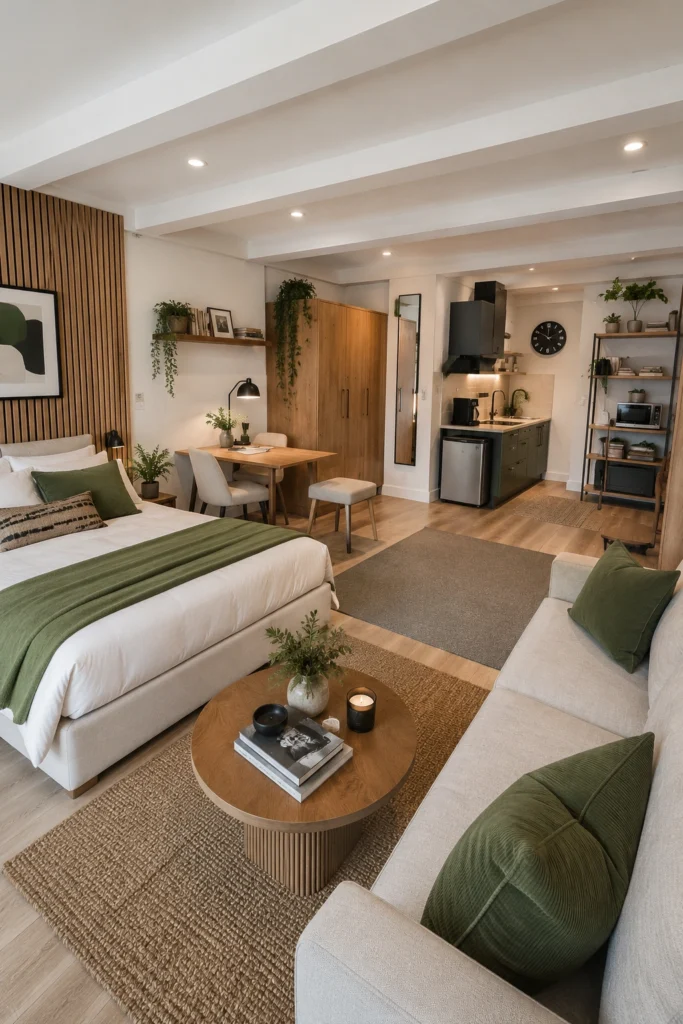
Two rugs in one studio isn’t excessive — it’s clarifying. A flat-weave jute or sisal rug under the sleeping area, a softer wool or shag under the lounge area. Even when the floor flows continuously, the change in texture tells your brain this is a different room now.
Keep them in the same color family so the space still feels unified. Oatmeal jute and a cream wool rug? Perfect. A navy striped rug next to a hot pink shag? Don’t do that to yourself.
Final Thoughts
A small studio isn’t a design problem. It’s a design opportunity — every choice you make actually shows up, because there’s no wasted square footage for a bad decision to hide in.
Pick one idea from this list and try it this week. Move the bed. Add a second rug. Swap the harsh overhead bulb for something warm. You’ll notice the difference the second you walk in the door, and once you do, the rest tends to follow on its own.
Your studio doesn’t have to be bigger to feel like home — it just has to feel like yours.