17 Stylish Studio Apartment Themes for Every Personality
Studio apartments get a bad rap. People hear “one room for everything” and picture a cramped box with a bed pushed up against a kitchenette. Here’s the thing — a studio can feel calm, stylish, and surprisingly spacious if you make a few smart calls early. I’ve lived in one, decorated several for friends, and learned which ideas actually pull their weight in 350 square feet.
These ten ideas are the ones I keep coming back to. No gimmicks, no “transform your space” promises — just real, doable moves that work.
1. Slatted Wood Dividers Add Warmth and Privacy
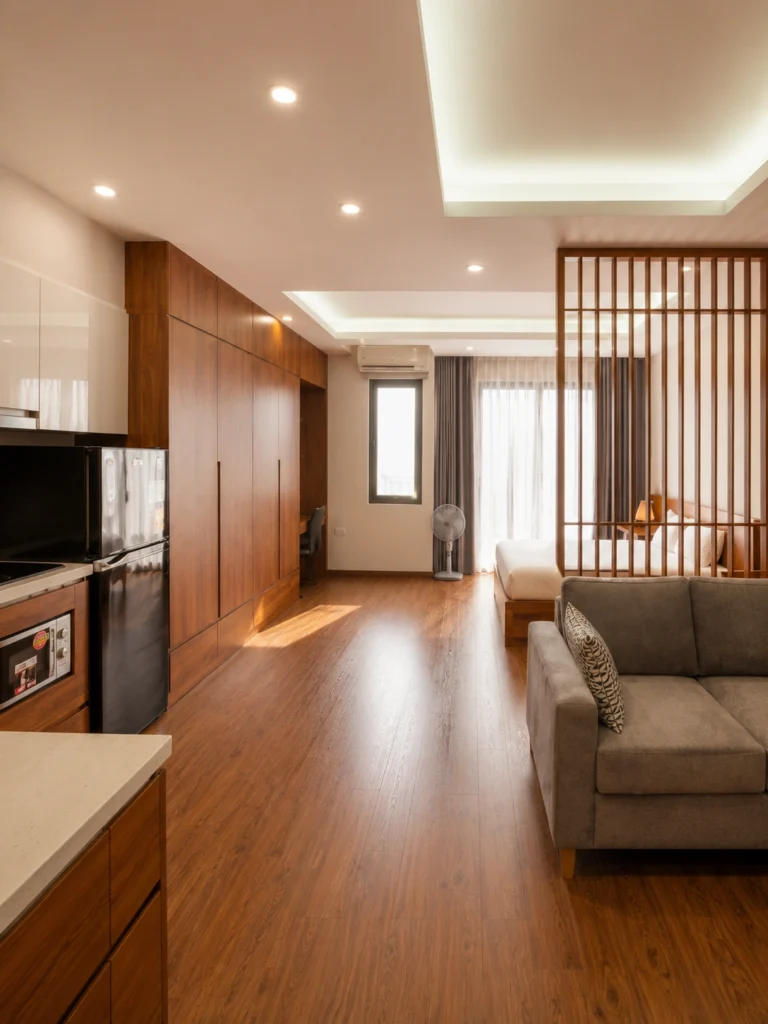
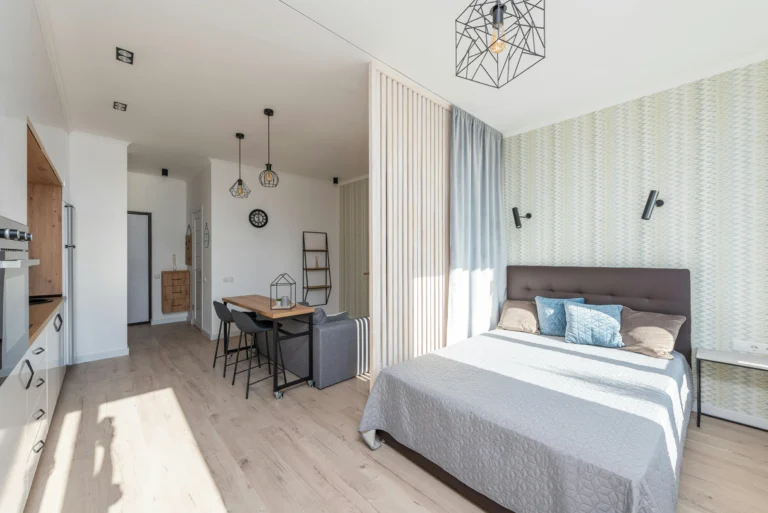
A solid wall feels heavy in a small space. A slatted wood divider — vertical wooden slats spaced an inch or two apart — gives you something in between. You get a real sense of separation, the bed feels tucked away, but light and air still pass through. The space breathes.
It’s also one of the prettiest design moves you can make in a studio. The vertical lines pull the eye up, which makes ceilings feel taller. The warm wood tone instantly makes the room feel less institutional.
If you’re building it in, ask for hidden floor and ceiling brackets so the slats appear to float. The detail matters more than you’d think.
2. Don’t Be Afraid of an Accent Wall
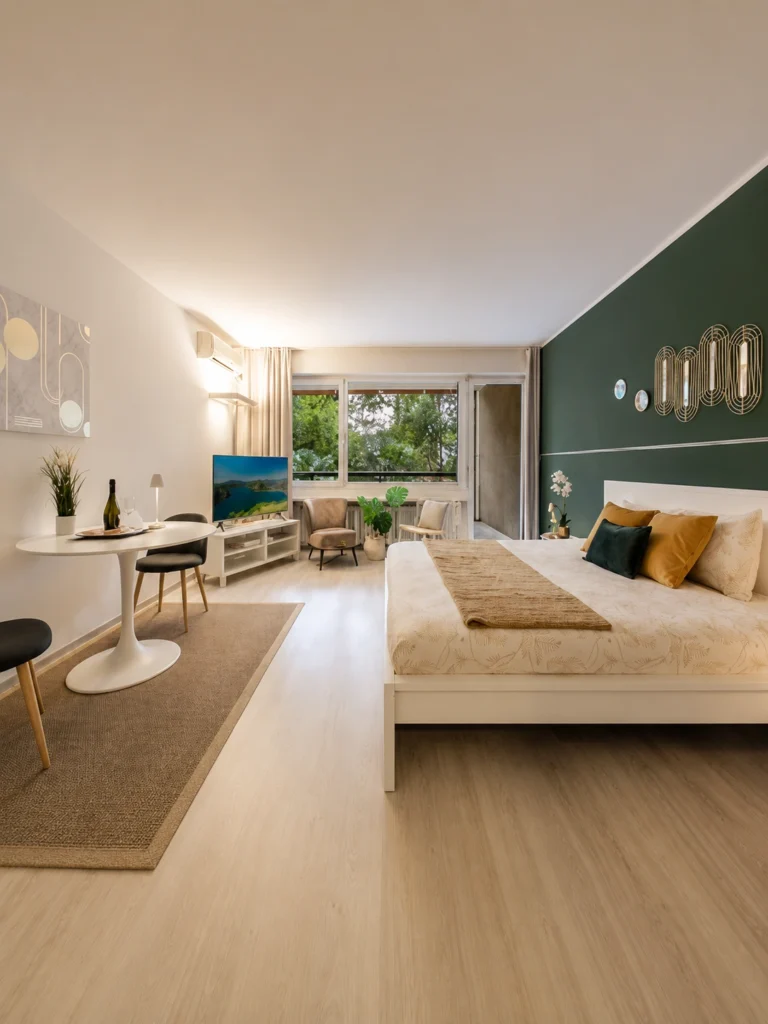
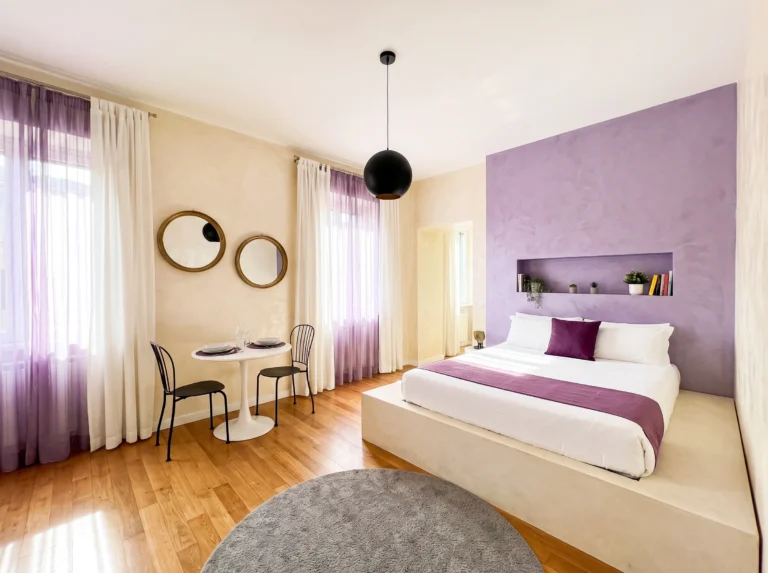
I know. Painting in a small space sounds counterintuitive — won’t it make the room feel smaller? Trust me on this one: it doesn’t. A single moody accent wall actually adds depth, because the dark color recedes visually and makes the wall feel further away.
The deep forest green behind the bed above is a perfect example. It gives the bed a clear identity. It makes the sleeping zone feel like its own little sanctuary. And it ties in beautifully with mustard and forest pillows, brass wall art, and warm wood floors.
Skip the cold grays. In a studio, you spend a lot of time in this room — pick a color that feels like something. Olive, terracotta, deep navy, warm clay. Color with a soul.
Renter-friendly alternative: Peel-and-stick wallpaper or removable paint (yes, that exists now) lets you do this without losing your deposit.
3. Embrace Built-In Storage Like Your Life Depends on It
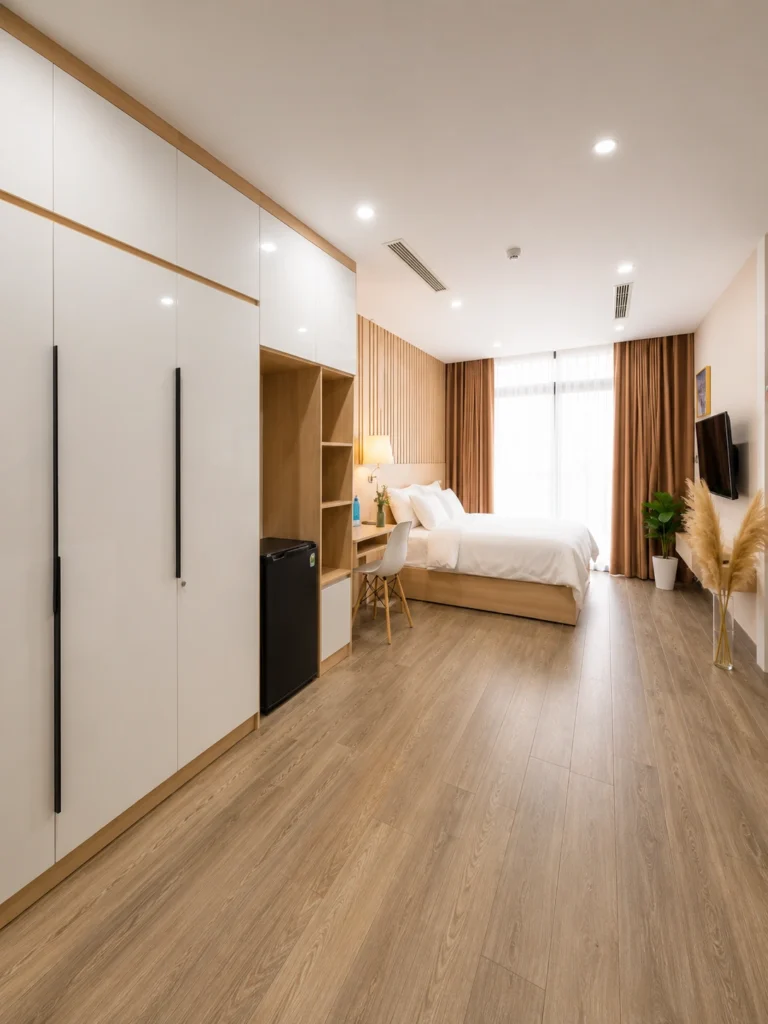
In a studio, every cubic inch of storage matters. The single biggest upgrade you can make is a full wall of floor-to-ceiling wardrobes. Not the cute little dresser you saw on Pinterest — real storage that goes all the way up.
The studio above shows it perfectly: an entire wall of white wardrobes that absorb everything into them — clothes, suitcases, that air fryer you only use twice a year. Because they’re white and run flush to the ceiling, they almost disappear. Your eye doesn’t read them as furniture; it reads them as architecture.
Budget vs. splurge: PAX wardrobes from IKEA cost a fraction of custom built-ins and look nearly identical when installed properly. Splurge on the soft-close hinges. Cheap out on everything else.
4. Lean Into Multi-Use Furniture (But Pick Pieces That Don’t Scream “Multi-Use”)
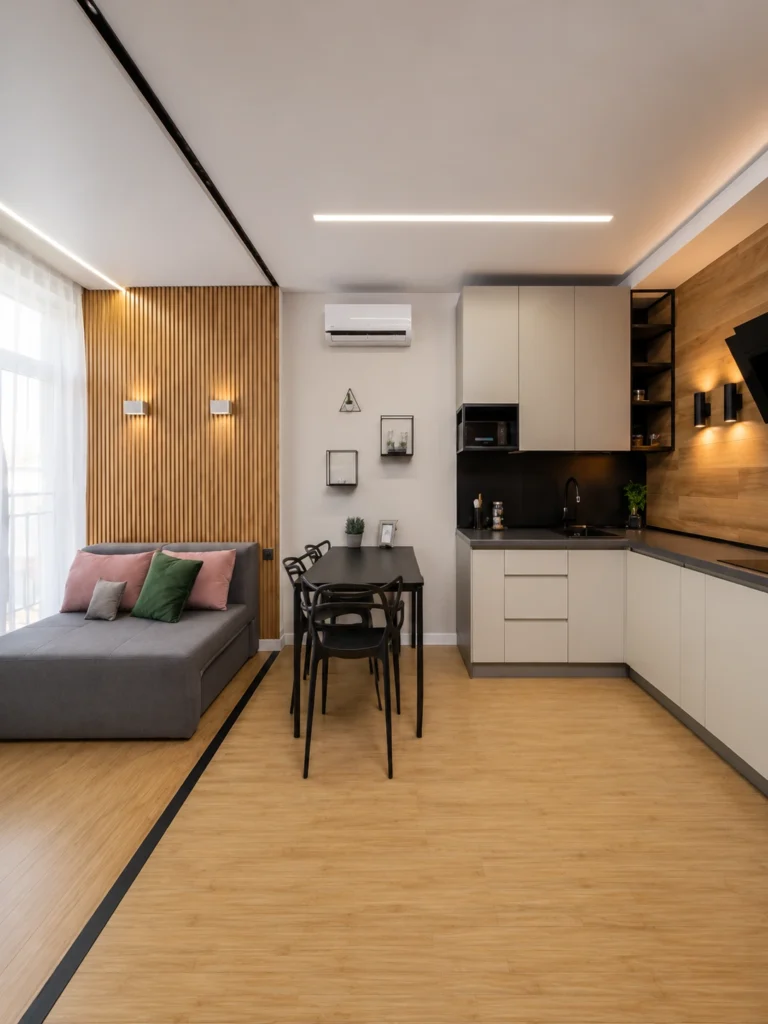
Sofa beds, storage ottomans, fold-out tables — these are the workhorses of studio living. But here’s the thing most people get wrong: cheap convertible furniture looks like cheap convertible furniture. The hinges show. The mattress is two inches thick. You can spot it across the room.
Spend a little more on pieces that look like the thing they’re pretending to be. A modern low-profile sofa bed (like the one in the photo) reads as a sofa first and a bed second — which is exactly what you want when guests come over. A storage ottoman should look like a beautiful upholstered cube, not a hollow plastic box with a lid.
Pro tip from someone who learned the hard way: Sit on the sofa bed and sleep on the sofa bed at the store. If either one is bad, walk away.
5. Layer Your Lighting — Especially the Warm, Low Kind
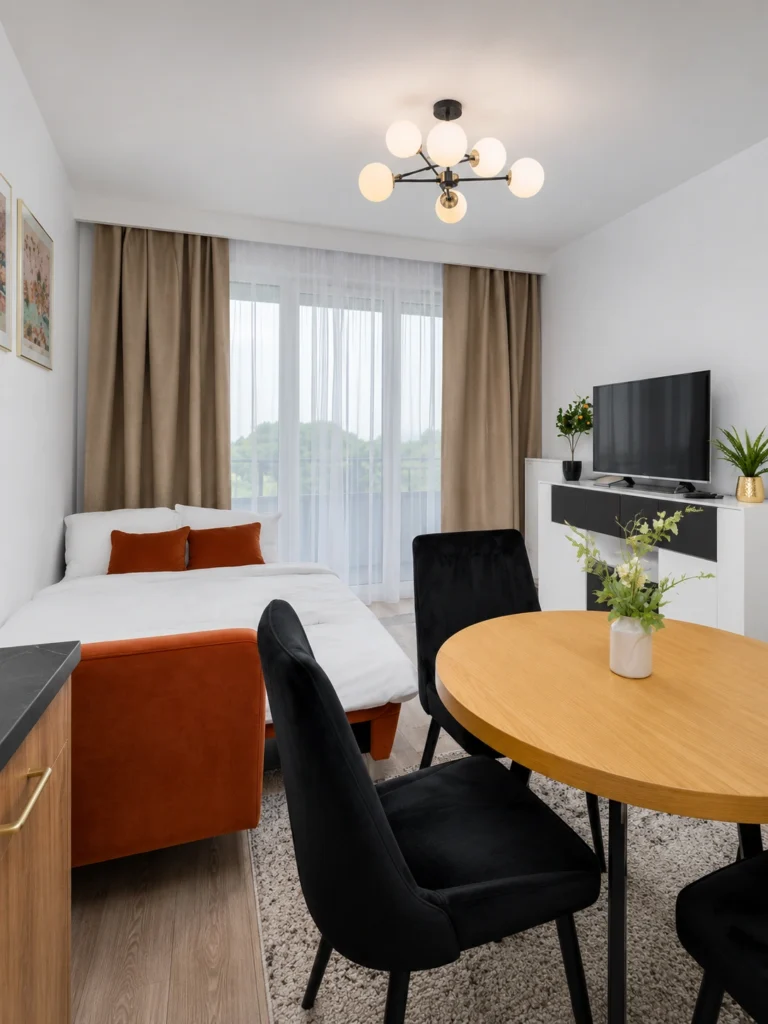
If your studio only has one harsh overhead light, the entire room feels like a dentist’s office at 9pm. The single fastest way to make a studio feel cozy and grown-up is layered lighting: one statement ceiling fixture, two or three lamps at different heights, and warm bulbs throughout (look for “2700K” on the box — that’s the warm color temperature you want).
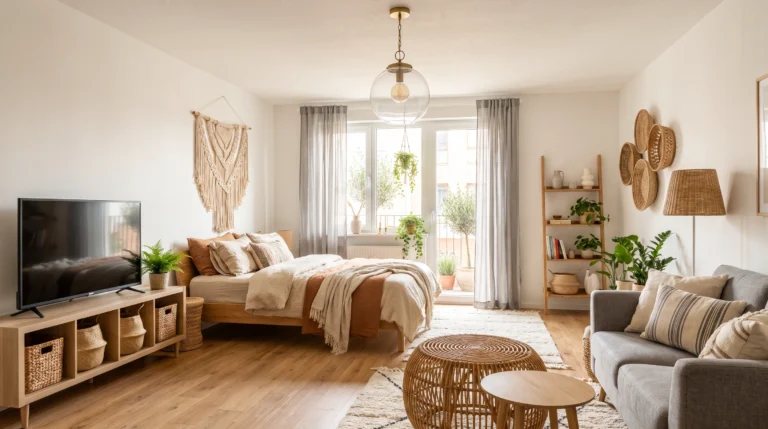
The studio above does it well — a sculptural globe chandelier handles the ambient light, the rust velvet bed pulls warmth from the lamp glow, and the natural daylight from the balcony fills in the rest. Three light sources, three moods, depending on what time of day it is.
In a studio, lighting is the room divider you didn’t know you needed. A warm lamp by the bed at night and a brighter desk lamp in the kitchen zone instantly tell your brain “different room, different mood.”
6. Keep One Statement Light, One Big Mirror, and Almost Nothing Else
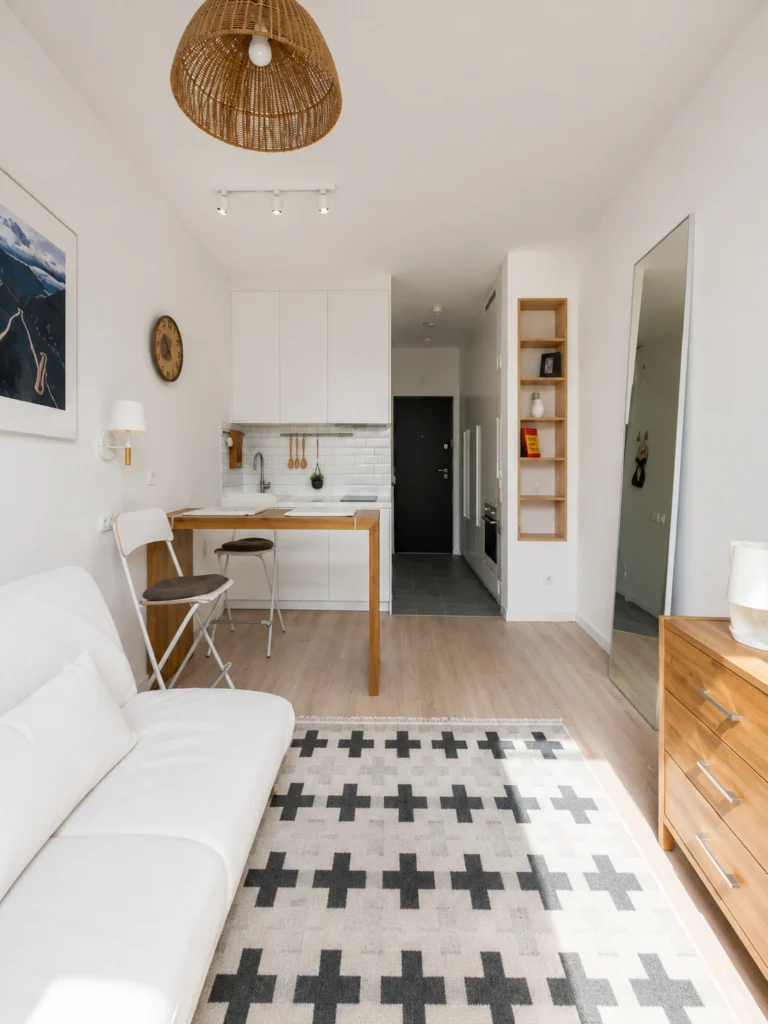
When the space is genuinely tiny, restraint is everything. Pick one statement piece — usually a beautiful pendant light or a large mirror — and let everything else stay quiet around it.
The studio above is maybe 200 square feet and it feels twice that size, because it doesn’t fight with itself. One oversized rattan pendant. One full-length mirror leaning against the wall to double the visible light. One graphic rug. Everything else is calm: white walls, light wood, white sofa, no chaos.
The biggest mistake in small-space decorating is trying to fit “one of each thing.” A small gallery wall, and a small plant, and a small lamp, and a small accent chair… it all stays small and starts to feel cluttered. Pick fewer, bigger pieces. Less stuff, more impact.
7.Use a Peninsula or Bar Counter as a Built-In Divider
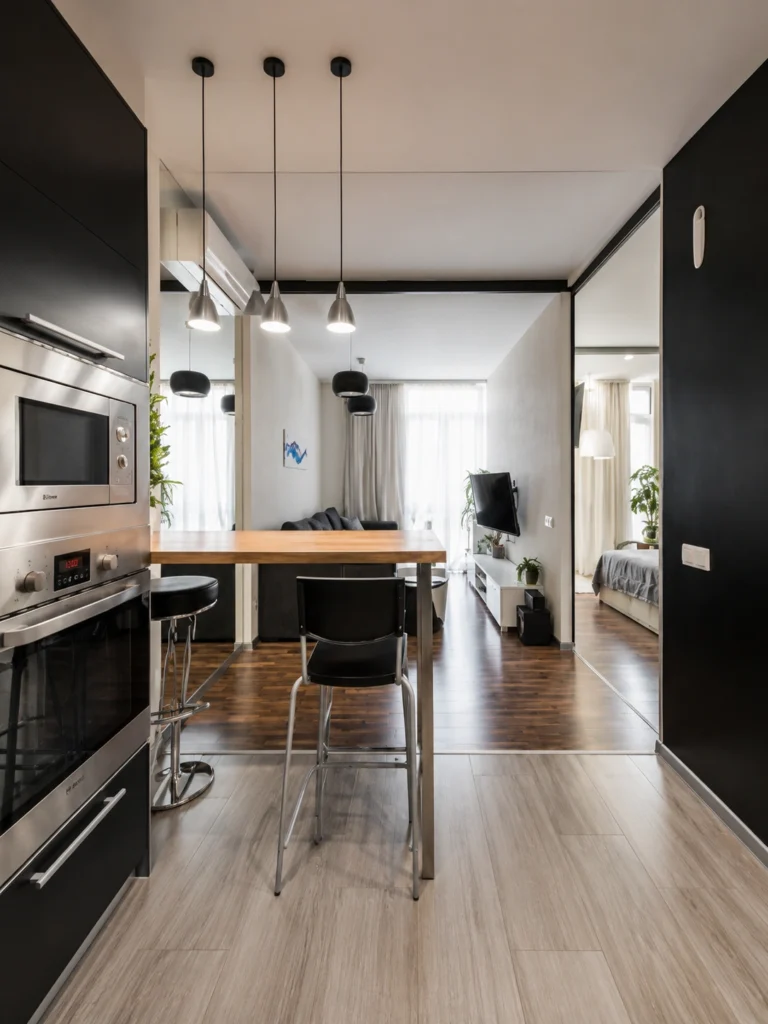
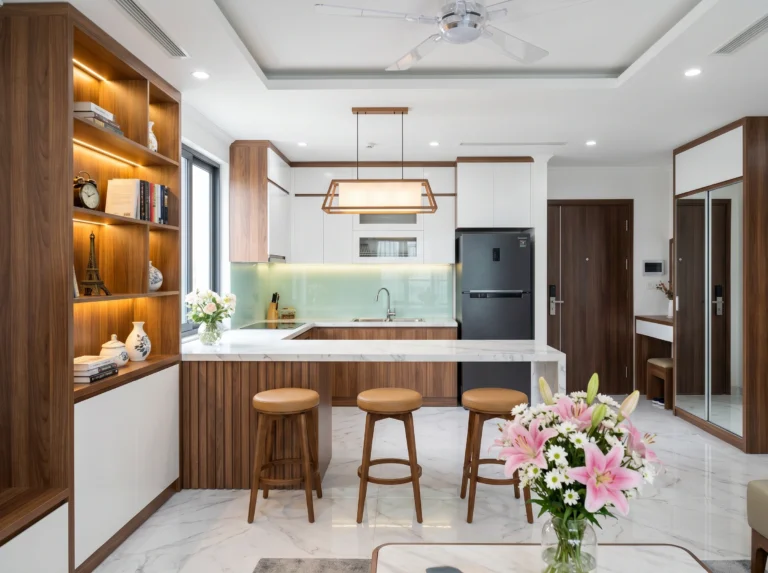
If your studio has the kitchen along one wall, a peninsula or bar counter sticking out perpendicular to it is a quiet design hero. It gives you extra counter space, a dining spot, and — most importantly — a natural break between “kitchen” and “everything else.” You don’t even realize you’re being guided through zones, but you are.
The studio above uses this beautifully: a long wood-topped peninsula, three pendant lights hanging above it, and beyond it, the living and sleeping area opens up. The kitchen feels contained instead of bleeding into the rest of the apartment.
If you can’t build one in, a tall console table or kitchen island on wheels does roughly the same job. Pull it out when you’re cooking, push it back when you’re not.
8. Pick One Light Neutral and Let It Run the Room
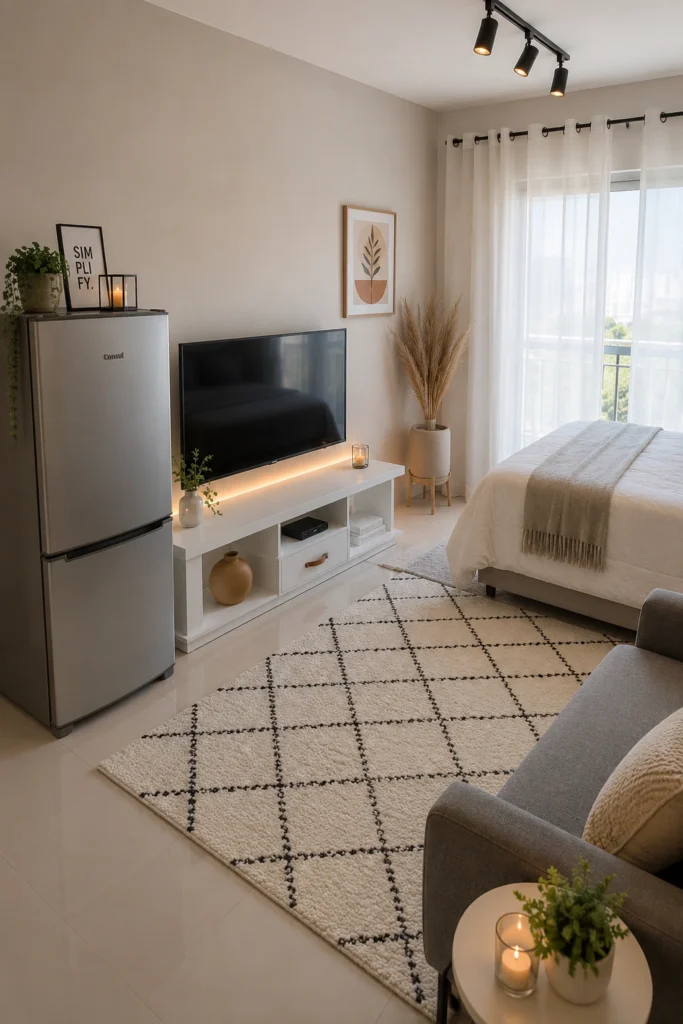
The fastest way to make a small space feel chaotic is to mix three different wood tones, two whites, and a beige nobody asked for. Pick one warm neutral — soft white, oat, greige — and commit. Walls, big furniture, curtains, and rug all stay in that family.
You’re not making the room boring. You’re making it quiet, which is what small spaces desperately need. Let your texture and one or two accent pieces (a candle, a terracotta vase, a black frame) do the talking.
Pro tip: If your walls are already a flat builder-white, soften them with cream or oat-colored curtains and a wool rug. The room will read “designed” instead of “rental.”
9. Zone the Room With a Rug, Not a Wall
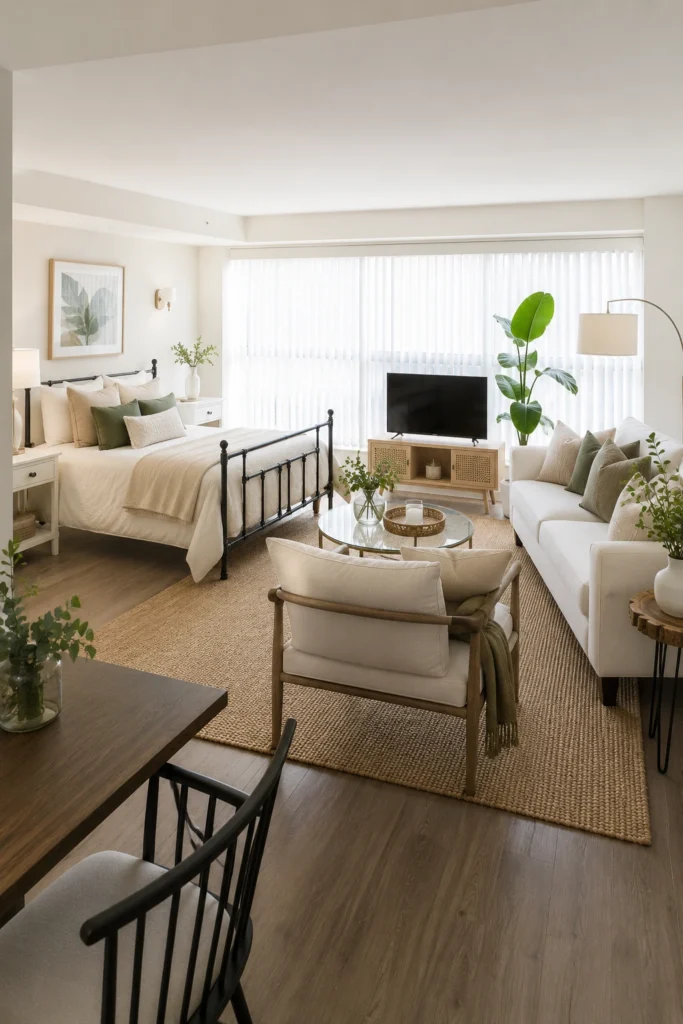
In a studio, you don’t have walls separating the bedroom from the living room — but you don’t actually need them. A large rug under your sofa and coffee table creates a visual boundary that says this is the living room. Your eye reads two rooms even though it’s one.
The rug needs to be big enough for at least the front legs of your sofa to sit on it. A tiny 4×6 rug floating in the middle of the floor makes the room look smaller, not bigger. Trust me on this one — go up a size from what you think you need.
A jute or wool rug in a neutral tone works in almost any studio. It anchors the seating area and visually pulls it away from the bed.
10. Bring In One Statement Plant (Not Twelve)
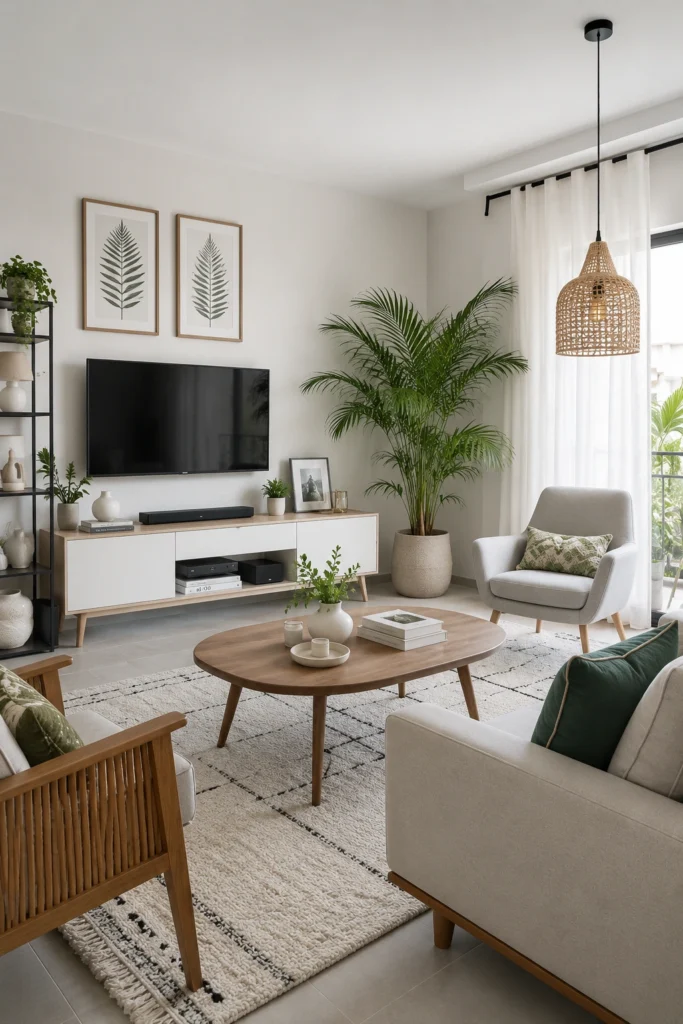
Small spaces and plants get tricky. A cluster of ten little succulents on a windowsill reads as visual noise — exactly what you’re trying to avoid. One generous, sculptural plant does so much more.
A palm, fiddle leaf fig, or bird of paradise in the corner gives you instant height, softness, and life without crowding any surface. It also draws the eye upward, which makes ceilings feel taller.
If you’re not great with plants, get a tall, well-made faux one. I have nothing against fake greenery in small apartments — a sad, dying real plant is way worse for the vibe than a good silk one.
11. Hang Things Higher Than You Think
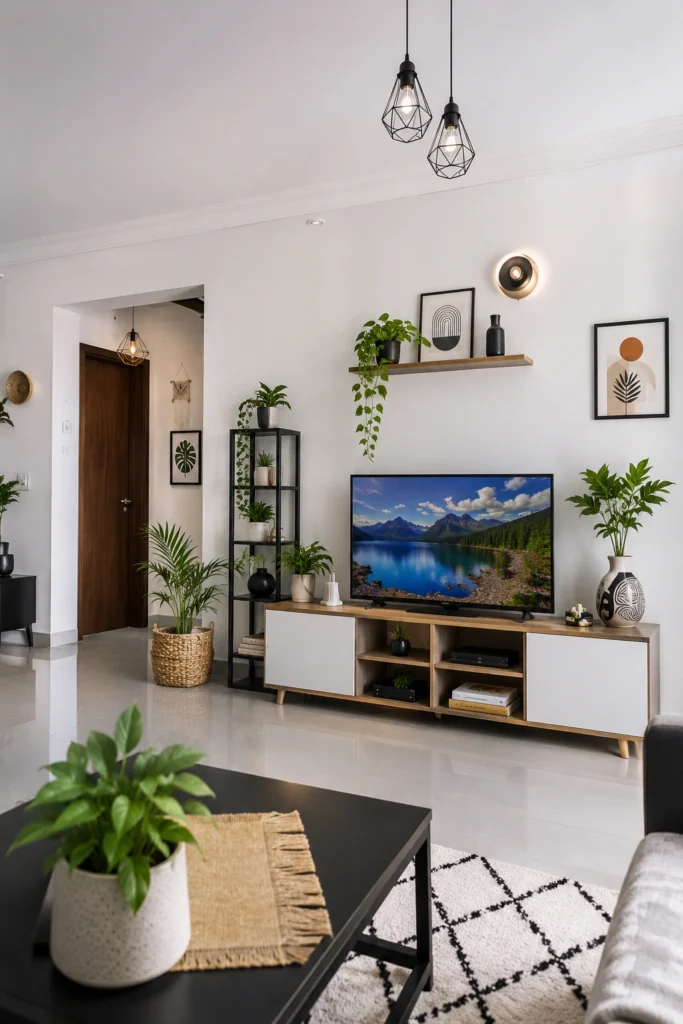
This is the part most people skip — and that’s exactly why their room feels off. In a small space, hanging art at standard “gallery height” can make the walls feel chopped up. Hang frames a little higher, and the eye travels up.
The same goes for shelving. A single floating shelf placed high above your TV unit (instead of right beside it) opens up the wall and gives you somewhere to tuck a plant, a small frame, or a candle. Combine that with one or two pendant lights hanging at a strong height, and suddenly the room reads taller.
You’re trying to give the eye somewhere to go above the furniture. That’s what makes a studio feel airy instead of compressed.
12. Go Vertical With Sheer Curtains From Ceiling to Floor
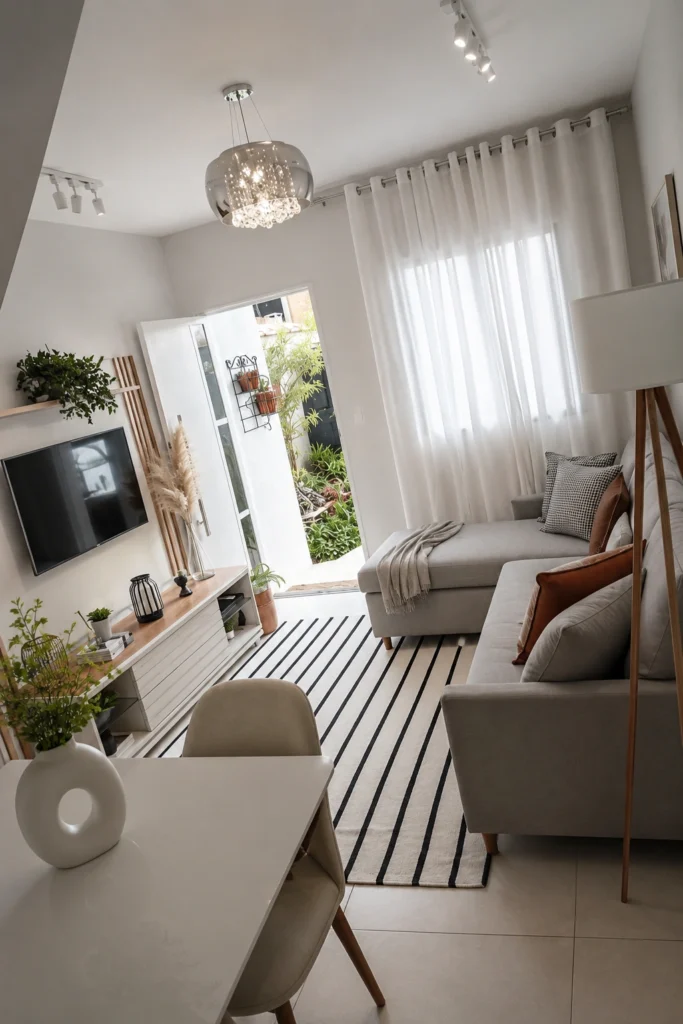
If your studio has one window, do not — please, do not — hang short curtains that stop at the windowsill. Mount the rod close to the ceiling and let the curtains drop all the way to the floor. The window will look twice as tall, and so will the room.
Sheer white or oat-colored curtains do double duty: they let light pour in during the day and soften the whole space. Pair with a blackout layer behind if you sleep in the same room (which, in a studio, you do).
Renter-friendly alternative: Use a tension rod or a no-drill curtain bracket — both are widely available and won’t put a single hole in your walls.
13. Multipurpose Everything (But Make It Pretty)
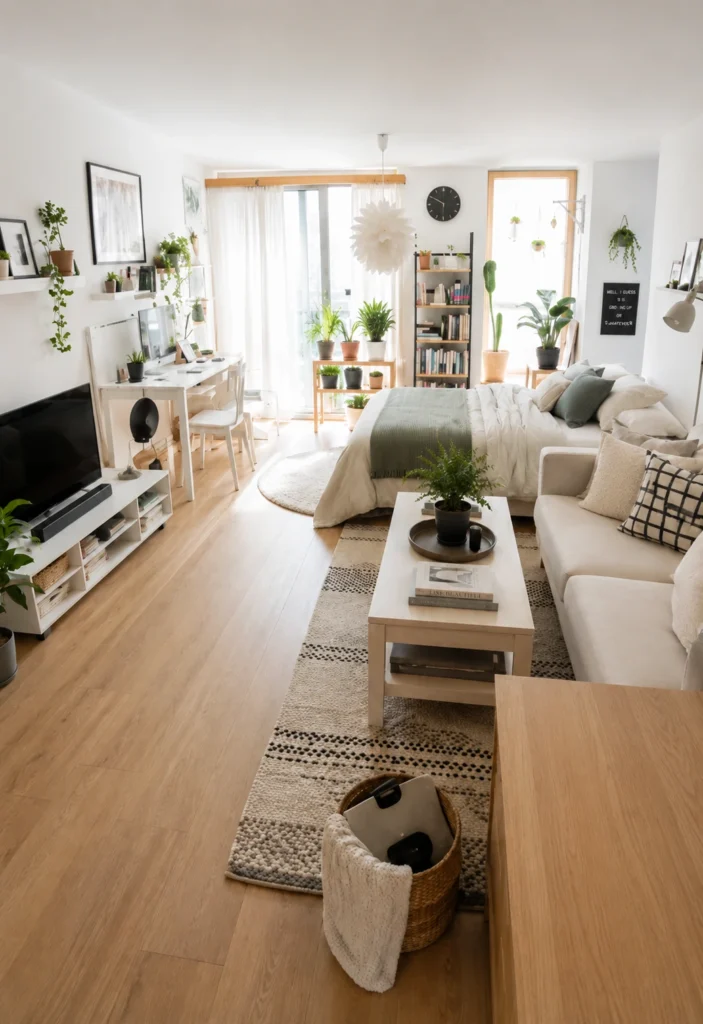
A studio asks every piece of furniture to work harder. Your coffee table should have storage. Your nightstand should fit a lamp, a book, and charge your phone. Your TV stand should hide the modem and a basket of stuff you don’t want guests to see.
But — and this is important — multipurpose doesn’t mean ugly. Skip the bulky black “storage cube” furniture from the 2000s. Look for clean-lined pieces with closed cabinets, woven baskets, or simple drawers. Linen storage bins, rattan baskets, and lidded boxes are your best friends.
The goal isn’t to hide that it’s a studio. It’s to make the small footprint feel intentional.
14. Layer Lighting — Three Sources, Always
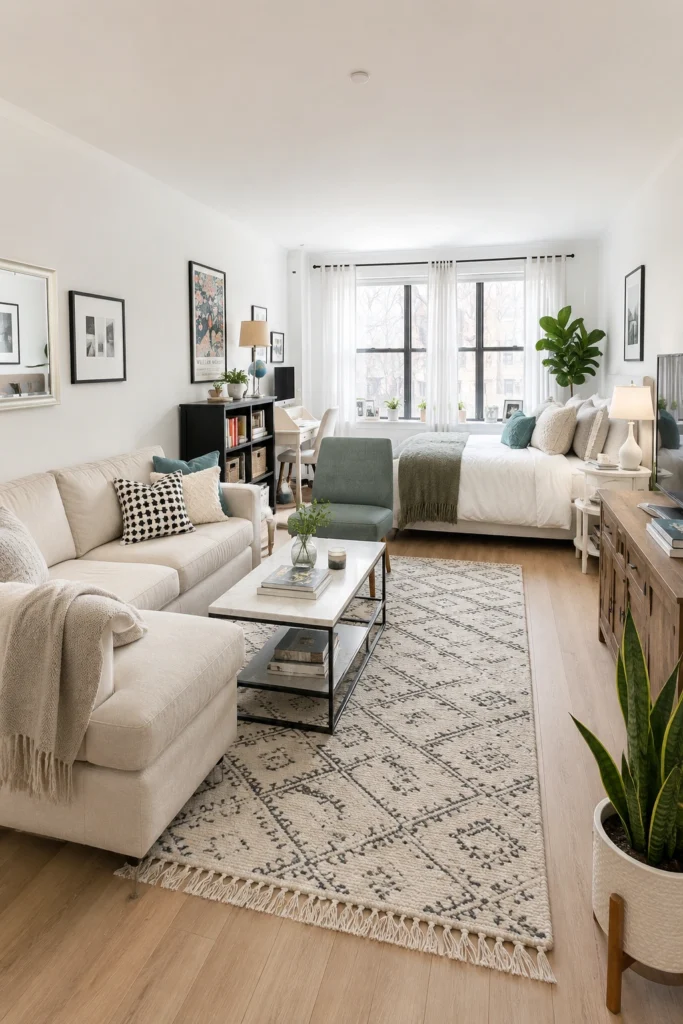
One overhead light is the fastest way to make a small apartment feel like a waiting room. You need at least three sources of light at different heights: one ceiling, one mid-level (table lamp), one floor or wall (floor lamp, sconce, or string lights).
This is layered lighting, and it’s the single biggest thing that separates a “decorated” apartment from a “I just moved in” apartment. Different bulbs at different heights create soft pockets of warmth instead of one flat glare.
My favorite: Warm-white bulbs (2700K is the sweet spot). Cool white makes any small space feel like a dentist’s office. Don’t waste your money on smart bulbs if you can’t get the color temperature right first.
15. Pick Furniture With Legs
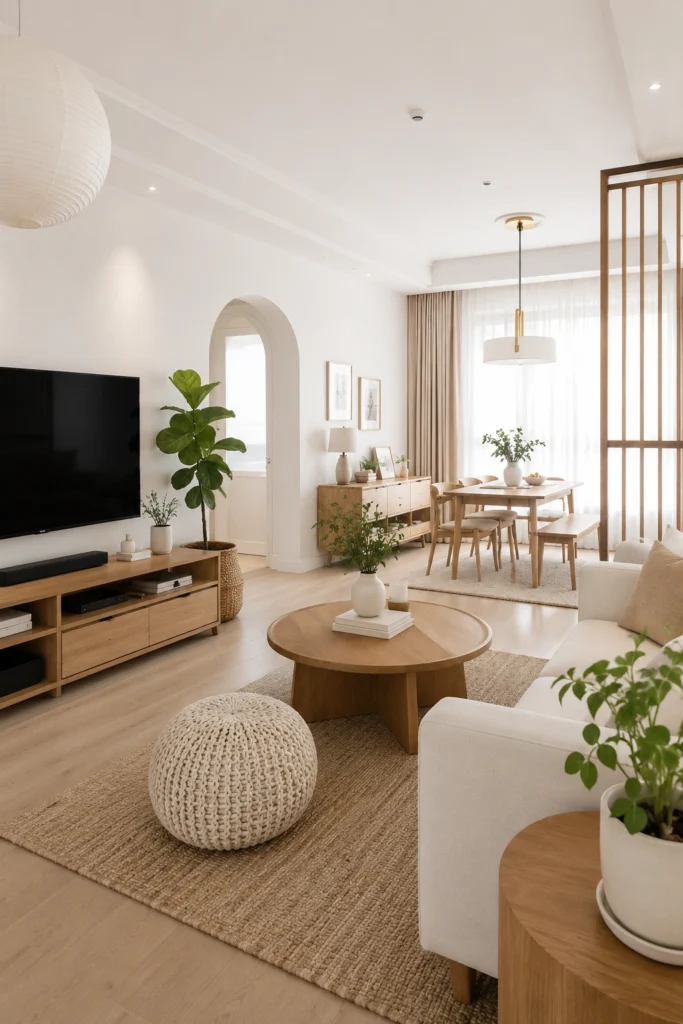
This is one of those small tricks that does heavy lifting. Furniture with visible legs — your sofa, your TV stand, your coffee table, your chairs — lets light and air flow underneath. The eye reads more floor, and more floor means more space.
A skirted sofa that sits flush to the ground? It blocks light and visually chops the floor in half. A sofa raised on slim wooden legs? You see floor underneath, and the room feels open.
Mid-century and Japandi furniture both lean into this on purpose. You don’t have to commit to a whole style — just keep the “legs > no legs” rule in mind when you’re shopping for the big pieces.
16. Use Low Shelving as a Room Divider
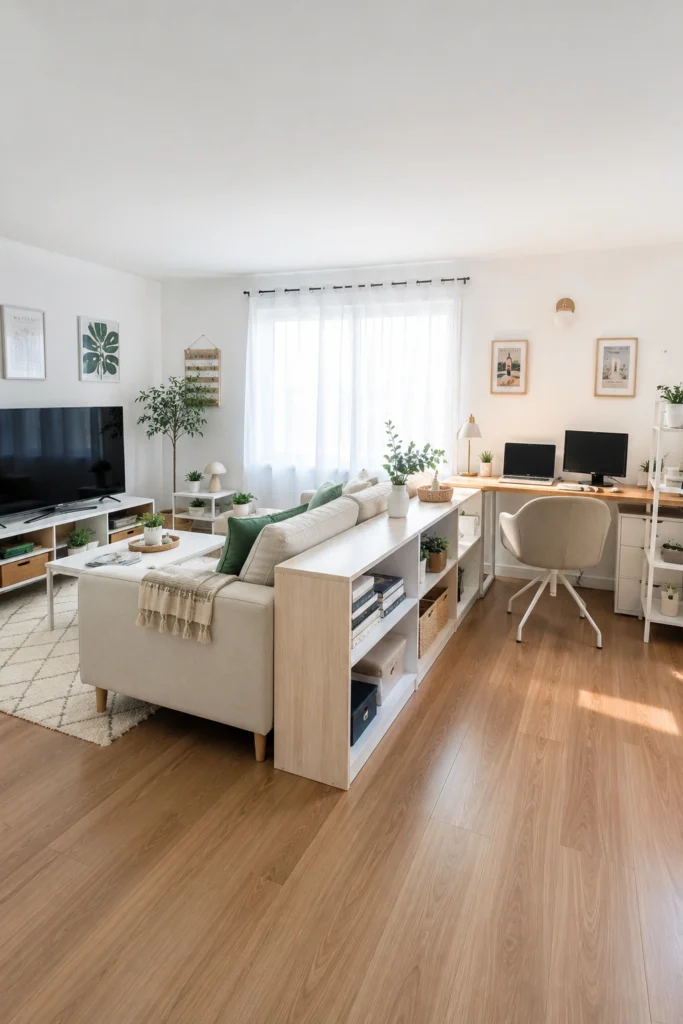
Want to actually separate your “work zone” from your “relax zone” without building anything? Use a low, open-back bookshelf as a soft divider. It defines space without blocking light or making the room feel smaller.
A waist-height bookshelf placed behind the sofa, perpendicular to the wall, magically creates a “back” to the living area and a “front” to whatever’s behind it (a desk, a dining table, a bed). You can decorate both sides — books and a plant on one side, picture frames and a lamp on the other.
This is the move I recommend most to renters who hate the “one big square room” feeling but can’t build anything permanent.
17. Edit, Then Edit Again
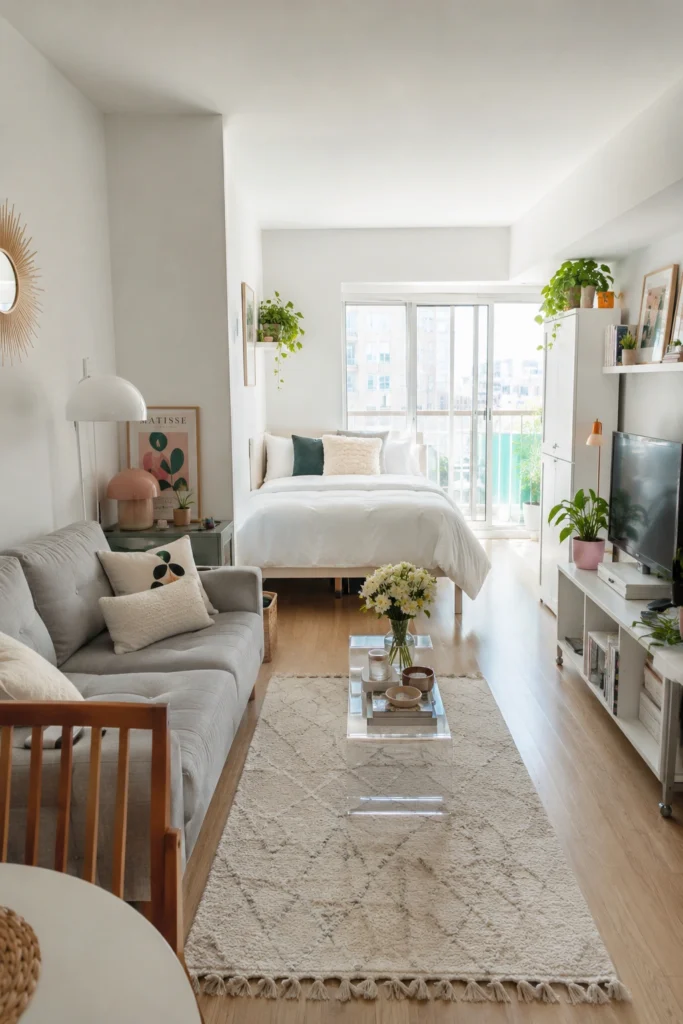
If I had to give just one piece of advice for studio living, it’d be this: less, but better. Every object in a small space takes up visual real estate, so anything that doesn’t earn its spot has to go.
Pick a few pieces you genuinely love — a sculptural lamp, one good art print, a beautiful throw — and let them breathe. Empty surfaces are not a problem in small spaces; they’re a feature. A clean coffee table with one stack of books and a small vase will always look better than a coffee table covered in five “styled” objects.
Budget vs. splurge: Save on decorative accessories (candles, vases, trays — thrift stores are full of beauties). Splurge on the one or two pieces you’ll see every day: your sofa and your lighting. Those two things alone shape how the whole studio feels.
Final Thoughts
Living in a studio isn’t a downgrade — it’s just a different design problem, and a fun one once you stop fighting it. The trick is to stop pretending you live in a bigger apartment and start designing the one you actually have.
Pick one of these ideas — just one — and try it this weekend. Move your rug, hang your curtains higher, swap out a bulb. You’ll feel the shift, and once you do, the next change will feel obvious.
Your studio doesn’t need to be bigger. It just needs to feel like yours — calm, lived-in, and a little bit beautiful.