19 Studio Apartments That Look Completely Different — And What Each One Gets Right
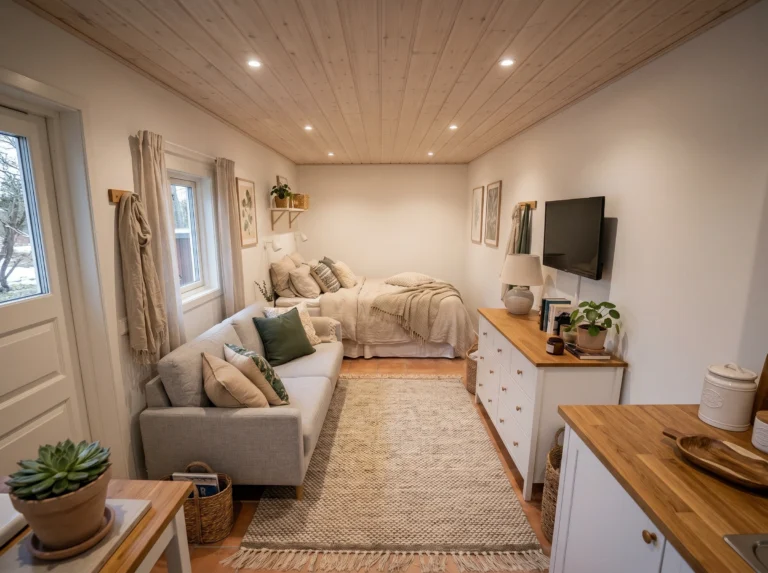
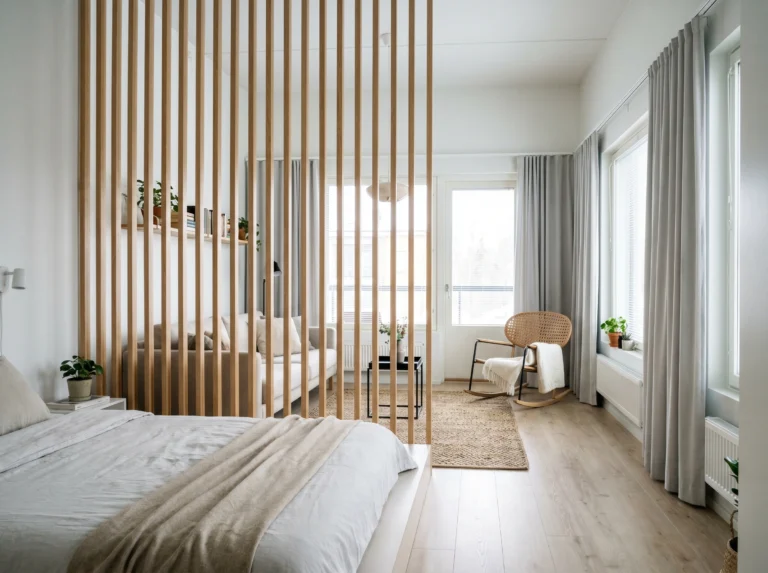
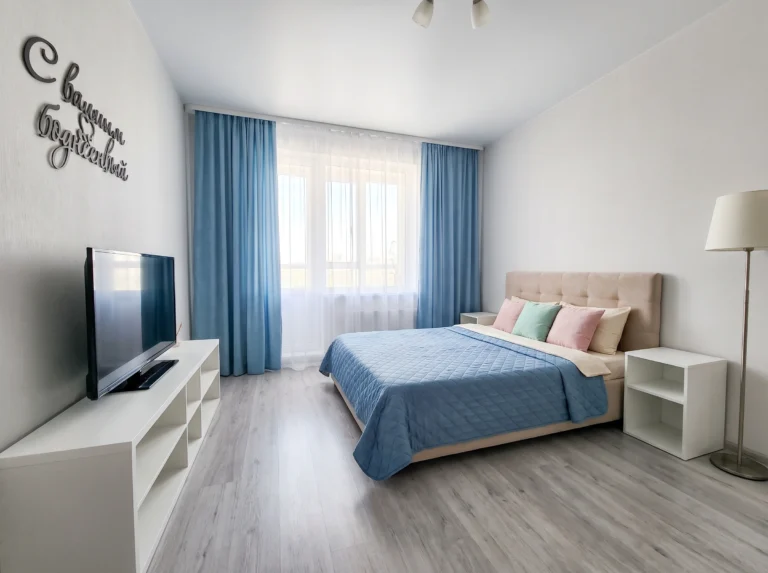
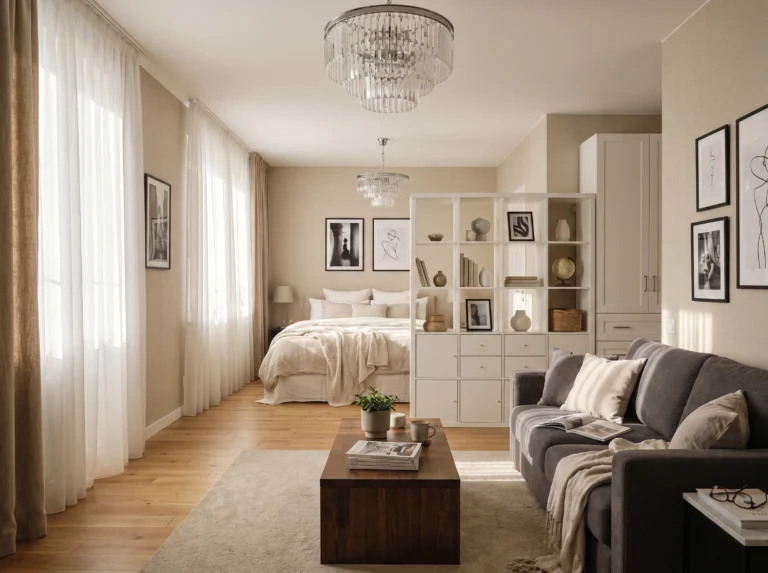
Same floor plan. Totally different feeling. That’s the magic — and the challenge — of a studio apartment. With everything in one room, the style choices you make aren’t just decorative, they’re functional. They define how the space breathes, how it feels at 7am vs. 10pm, and honestly, how you feel living in it.
I’ve pulled together 19 studio setups that each take a completely different approach. Some you’ll love. Some might not be your thing. But every single one has at least one idea worth stealing.
1. The Clean Modern Split: When Monochrome Actually Works
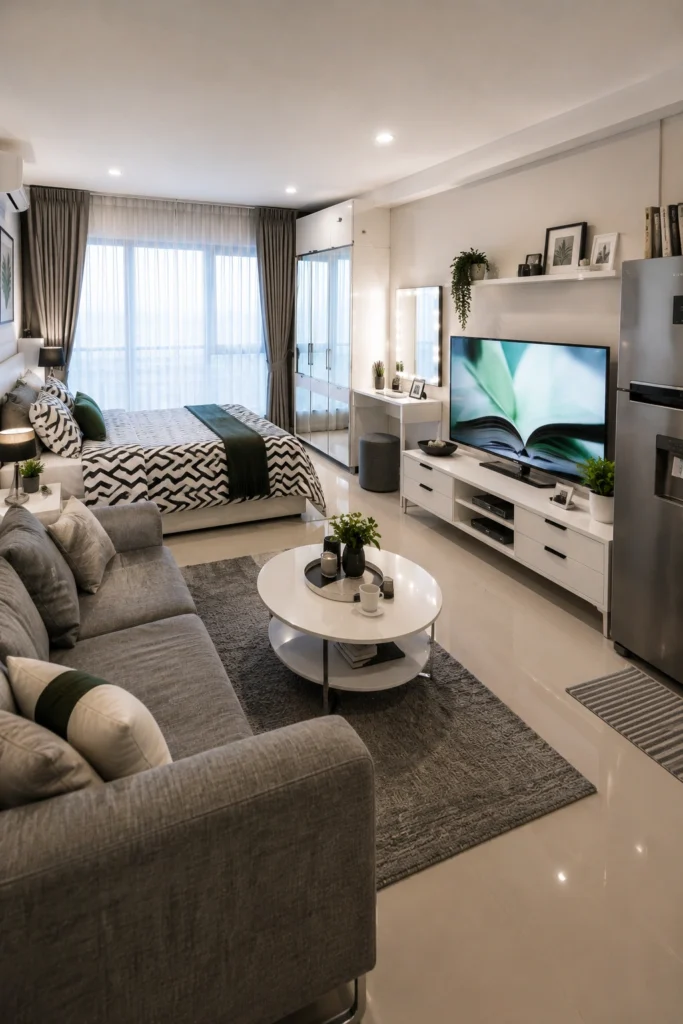
Here’s the thing about going all-gray and white in a studio — it only works if you layer texture hard. This space does it right: chunky geometric bedding, a plush sectional, a round coffee table that softens all the straight lines, and trailing plants on the shelves to add life. The recessed lighting keeps the ceiling clean, and the sheer curtains let in daylight without making it feel exposed.
What to steal: The round coffee table in a square-heavy room. It does more visual work than you’d expect — it stops the room from feeling like a box.
Pro tip: If you go monochrome, vary your textures. Matte, shiny, woven, fluffy — that contrast is what keeps a neutral palette from reading as flat or clinical.
2. The Bookshelf Room Divider: The Smartest Studio Trick I Know
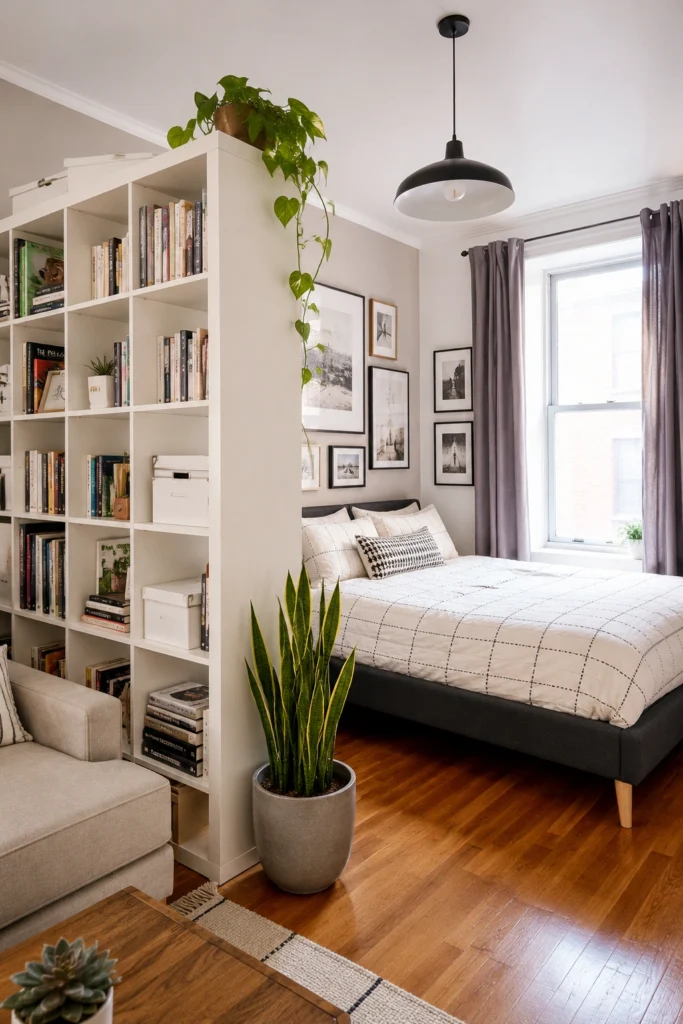
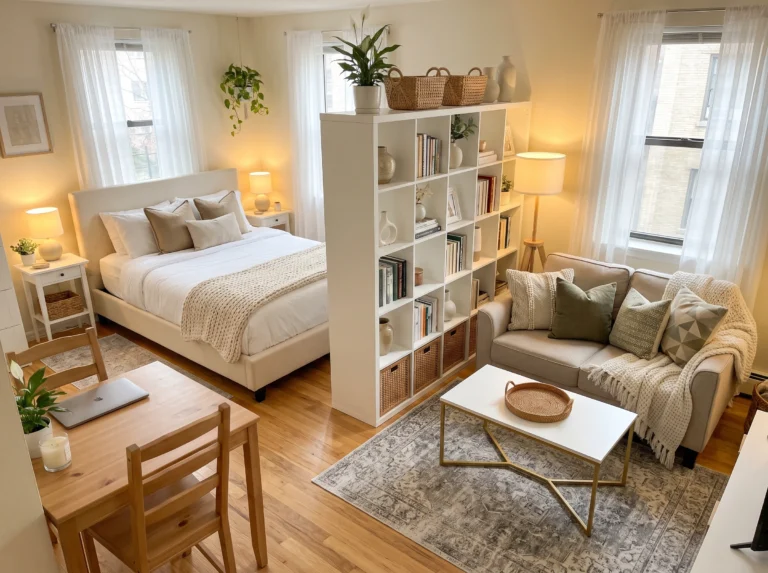
This is the part most people skip — and that’s exactly why their studio feels like one big blurry room. A tall open bookshelf used as a room divider (this looks like an IKEA Kallax or similar) creates a sleeping zone without closing it off completely. You still get the openness, but your bed isn’t staring you in the face the moment you walk through the door.
The wood floors are warm, the gallery wall above the bed is full of personality, and that massive snake plant in the floor pot is doing serious decorative work. The trailing pothos on top of the shelf? Perfect. Practical and beautiful.
Renter-friendly alternative: You don’t need to bolt anything to the wall. A freestanding bookshelf this size is heavy enough to stay put — especially once it’s loaded with books.
What to steal: The gallery wall behind the bed treated as a headboard alternative. Cheaper than an actual headboard, and way more personal.
3. The Soft Neutral With Candlelight: Quiet Luxury Without the Price Tag
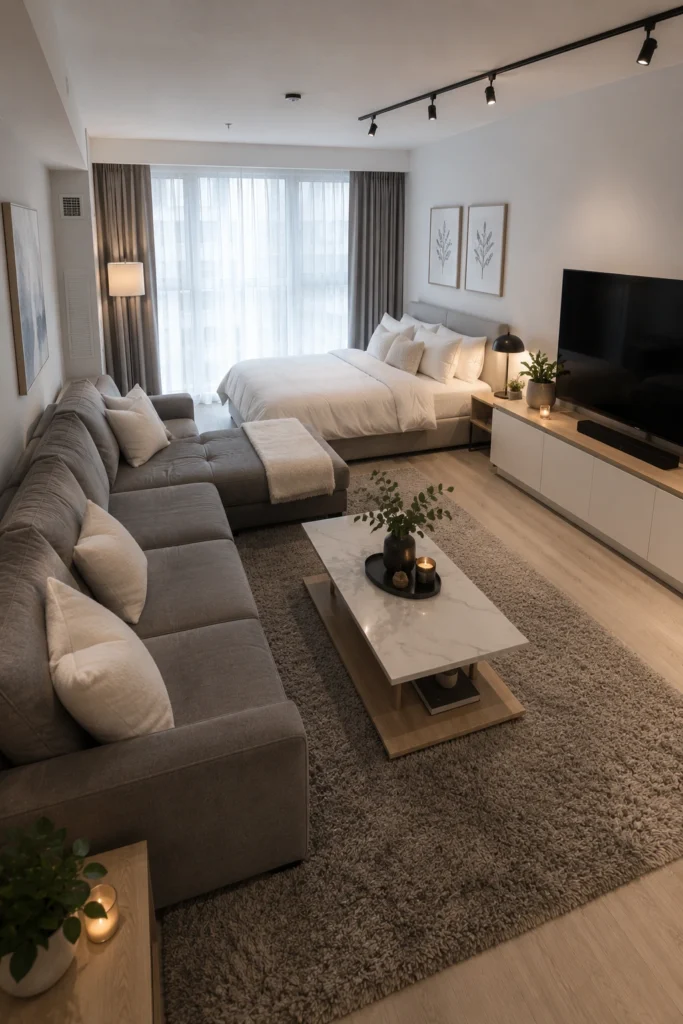
Track lighting overhead, sheer curtains pooling softly, a marble-top coffee table, and candles scattered on the side table. This room feels like a boutique hotel — but I’m guessing most of these pieces came from pretty accessible places. The key is the palette: warm whites, soft grays, natural wood tones. Nothing clashes. Nothing screams.
The bed is tucked behind the sofa with just enough separation that the living area feels like its own room. That shallow white media unit runs the full length of the wall and keeps the floor plan feeling open.
What to steal: The low-profile media unit as a “floor plan opener.” Keeping furniture close to the ground in a small space makes the ceiling feel taller and the room feel bigger.
4. The Industrial-Meets-Warm Studio: Concrete and Wood, Done Right
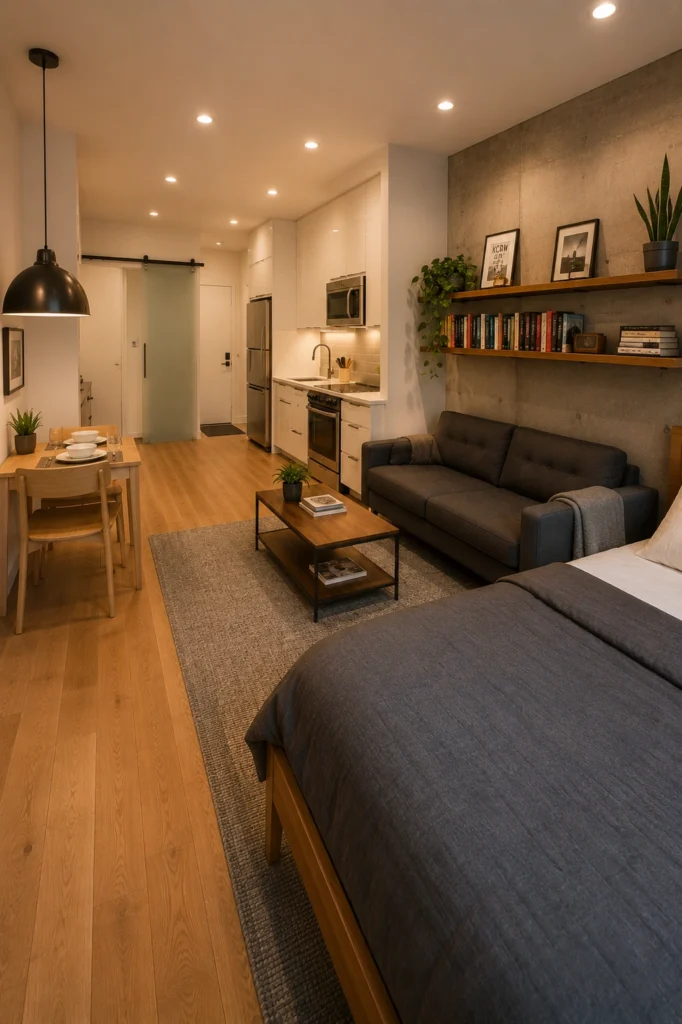
A concrete accent wall sounds cold. In practice — especially paired with honey-toned hardwood floors, a warm pendant light, and walnut floating shelves stacked with books and trailing plants — it reads as cozy and character-rich. The barn door separating a space (bathroom? closet?) is a smart move too: it slides instead of swinging, which saves floor space.
What makes this studio feel bigger than it is: everything stays low. The sofa, the coffee table, the bed. Keeping furniture below eye level is a small-space trick that works every time.
What to steal: The floating shelf as a headboard alternative and display surface. Mount it above your sofa or bed, fill it with books, a plant, and a framed photo. Done.
5. The Scandinavian Studio With a Home Office: Living, Sleeping, Working — All in One
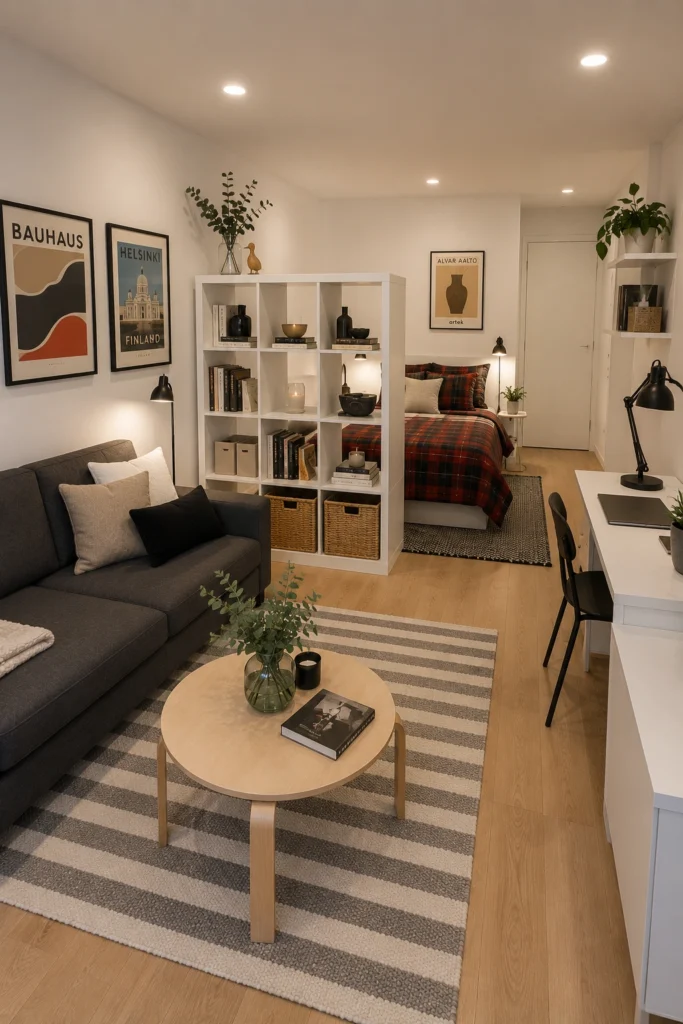
This one has three distinct zones — living area, sleeping area, and a proper desk setup — all in a single room that doesn’t feel chaotic. The grid bookshelf in the center does the zone-separation work again (a recurring theme among well-styled studios, and for good reason). The Bauhaus and Helsinki travel posters add color without requiring paint. The striped rug grounds the sofa area, and the warm desk lamp makes the workspace feel intentional rather than crammed.
Pro tip from someone who learned the hard way: If you work from home in a studio, put your desk behind a visual barrier — even a partial one. Seeing your laptop from your bed makes it very hard to mentally “leave work.”
What to steal: Art posters as your primary source of color and personality. Frame them properly and they look intentional. Skip the frame and they look like an afterthought.
6. The Feminine Cozy Studio: Pink Done With Restraint
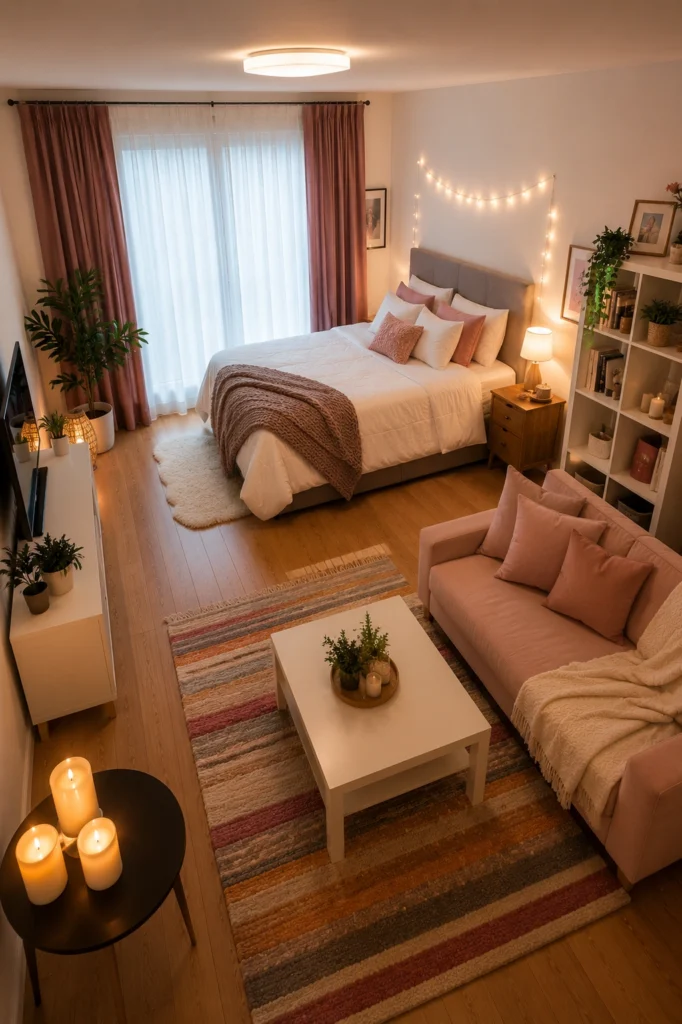
I know. Pink. But look at how it’s handled here — the blush sofa is the biggest commitment, and everything else supports it without fighting. White walls, warm wood floors, a multicolor striped rug that picks up the pink without amplifying it. String lights drape the wall above the bed (no drilling required — Command hooks), and the candles on the side table add that warm glow that makes any studio feel intentional and lived-in.
The knit throw blanket on the bed, the small white bookcase, the potted plants — it’s layered without being cluttered.
Renter-friendly alternative: String lights on Command hooks are genuinely one of the best low-commitment ways to add warmth and personality to a wall. No damage, easy to reposition.
Sofia’s honest take: A blush sofa is a commitment. It works beautifully here, but if you’re not ready for it, start with blush throw pillows on a neutral sofa. Same energy, reversible decision.
7. The Mid-Century Apartment With Warm Amber Light: A Masterclass in Layered Lighting
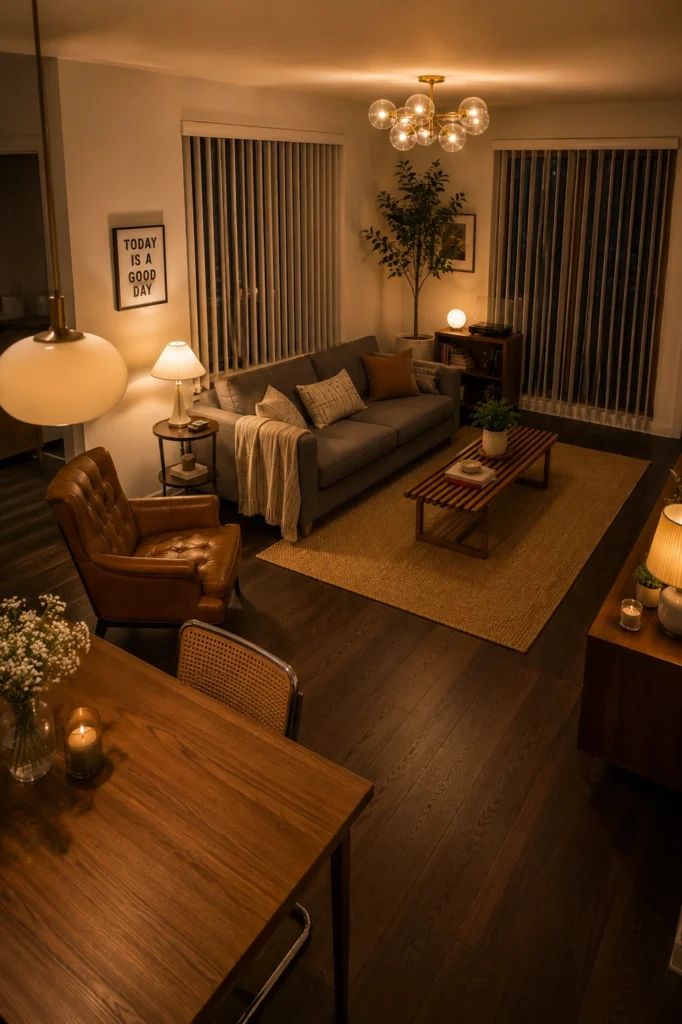
This isn’t a studio — it’s a small apartment — but the lighting lesson applies everywhere. Count the light sources: a globe pendant chandelier, a table lamp by the sofa, a globe-shaped floor lamp in the corner, candles on the dining table, and more candles on the console. That’s five sources of warm light, and the result is that amber, golden-hour glow that makes you want to pour a glass of wine and stay exactly where you are.
The cognac leather armchair, the slatted wood coffee table, the cane dining chairs — these are mid-century touches that feel timeless rather than trendy.
What to steal: Multiple small light sources instead of one overhead light. This is the single most impactful change you can make to any room’s atmosphere. One overhead bulb makes a room feel like a waiting room. Five warm lamps make it feel like a home.
8. The Plant-Lover’s Studio: Turning a Small Apartment Into a Living Space
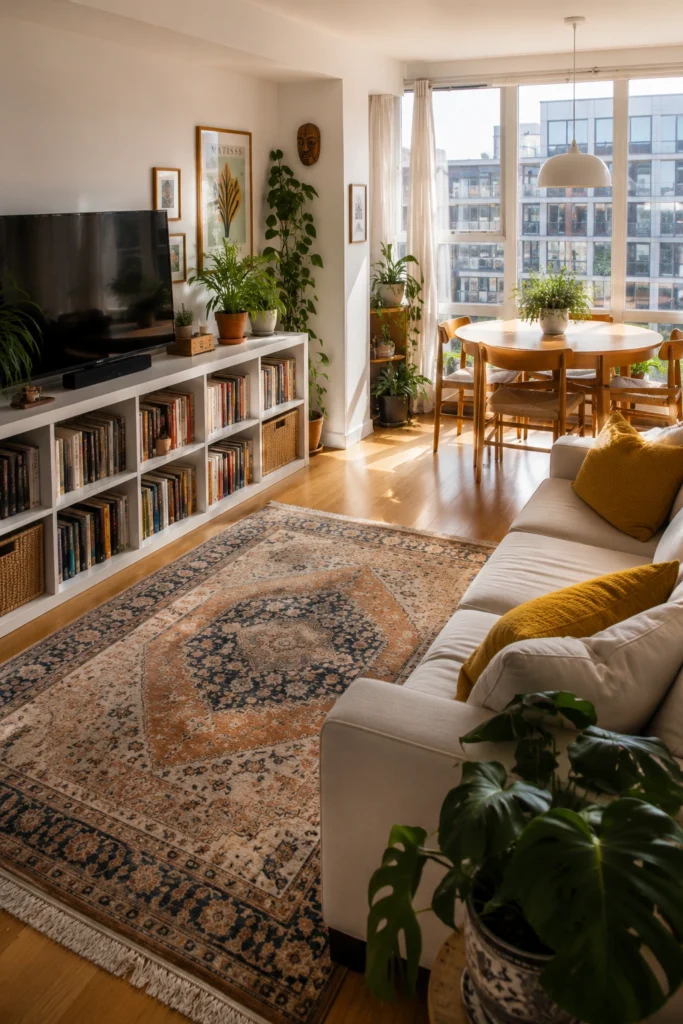
Every surface has a plant. The low white bookshelf along the wall doubles as a TV unit. A Persian-style rug (which you can find for very reasonable prices at HomeGoods or online vintage marketplaces) anchors the seating area. Mustard yellow pillows pop against the natural linen sofa. And the windows — floor-to-ceiling city views — are kept completely bare to let that natural light flood in.
Here’s the thing about plants in a small space: they don’t take up space, they add life. A monstera in the corner reads as architecture. A pothos trailing off a shelf reads as texture. A fiddle-leaf fig by a window reads as intention.
Budget tip: Don’t buy large plants new — they’re expensive. Check Facebook Marketplace, plant swaps, or your local nursery’s “clearance” section. A slightly sad pothos will bounce back with a little water and a good spot.
9. The Eclectic Late-Night Studio: When Personality Beats Perfection
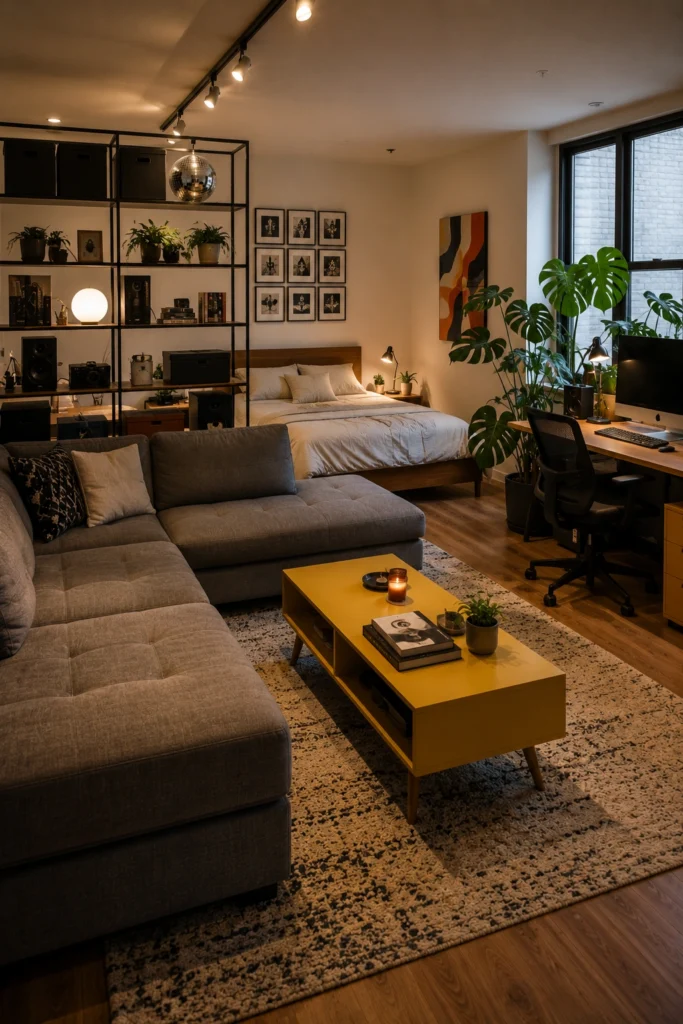
This one is doing everything at once — home office in the corner, gallery wall behind the bed, a full metal shelving unit acting as a room divider, a yellow coffee table as a statement piece, track lighting, and a monstera that’s clearly thriving. By all rules of minimalism, it should be too much. But it works, because everything in it is chosen. Nothing is here by accident.
The yellow coffee table is the risk that pays off. One bold piece in an otherwise dark, earthy space gives your eye somewhere to land — and makes the whole room feel curated rather than crowded.
What to steal: The deliberate accent piece in a muted palette. One yellow table, one rust-colored chair, one cobalt blue vase. Just one. Let it be the thing the room is “about.”
Sofia’s honest take: The disco ball on the shelf is a personality move I respect enormously. Your home should make you happy — not impressed strangers.
10. The Warm Earthy Studio That Does It All
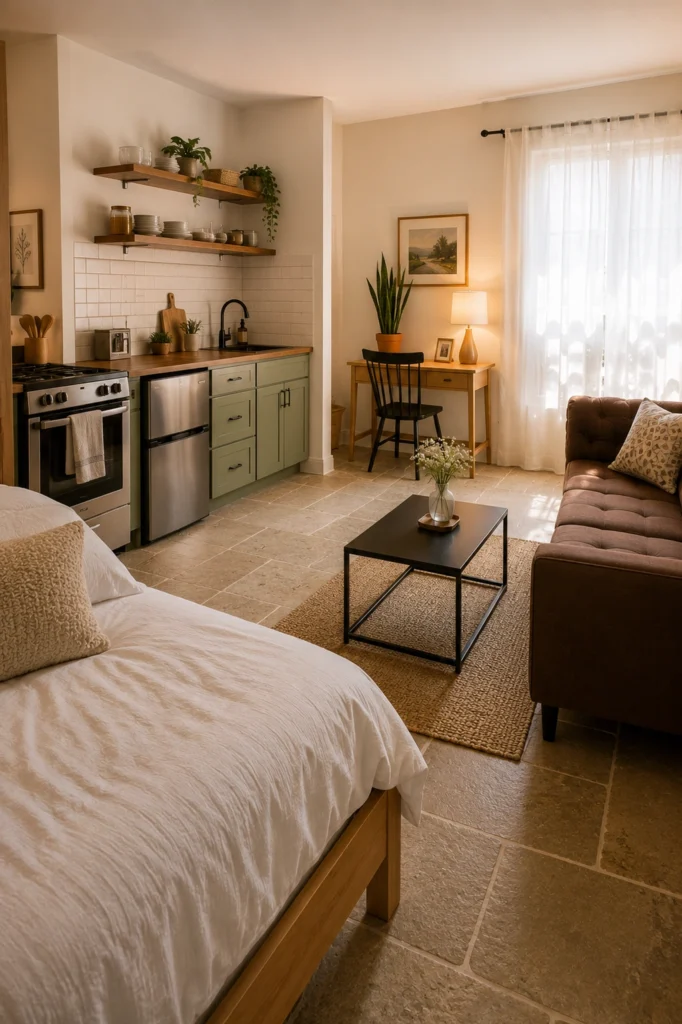
This one is doing a lot — kitchen, sleeping area, living space, and a little desk nook — and it doesn’t feel chaotic for a second. The secret? A consistent warm color palette. Every element, from the sage green kitchen cabinets to the jute rug to the linen bedding, sits in the same family of warm, muted tones. Nothing fights for attention.
Notice the open shelving in the kitchen: it’s styled, not stuffed. A few plants, some grouped ceramics, a trailing pothos. That’s intentional breathing room — called negative space in design terms — and it’s doing a lot of heavy lifting here.
Pro tip: If your studio has a kitchen visible from the living area, paint or style it in a color that ties into your main palette. Mismatched kitchens are the number one thing that makes studios feel choppy.
11. The Layered, Light-Filled Open Plan
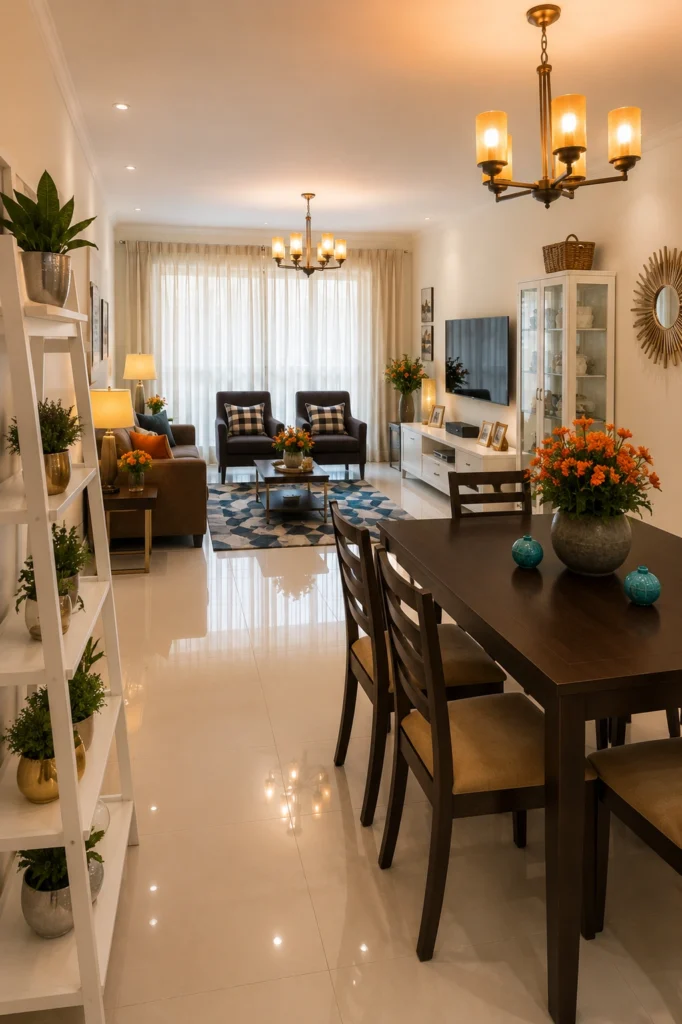
This space proves that “small” and “layered” aren’t mutually exclusive. There’s a full dining setup, a proper living room arrangement, and a wall of styled shelving — all working together because the lighting ties it all together. Two chandeliers, multiple table lamps, and recessed ceiling lights create warmth at every level. That’s called layered lighting, and it’s the difference between a space that feels alive and one that feels like a waiting room.
The pops of orange in the flowers and throw pillows add energy without overwhelming the neutral base. You could swap those flowers out seasonally and completely change the mood of the room without touching a single piece of furniture.
Budget vs. splurge: Splurge on one good light fixture — it anchors the whole room. Save on seasonal accents like flowers and cushion covers.
12. The Moody Studio With a Smart Zone Split
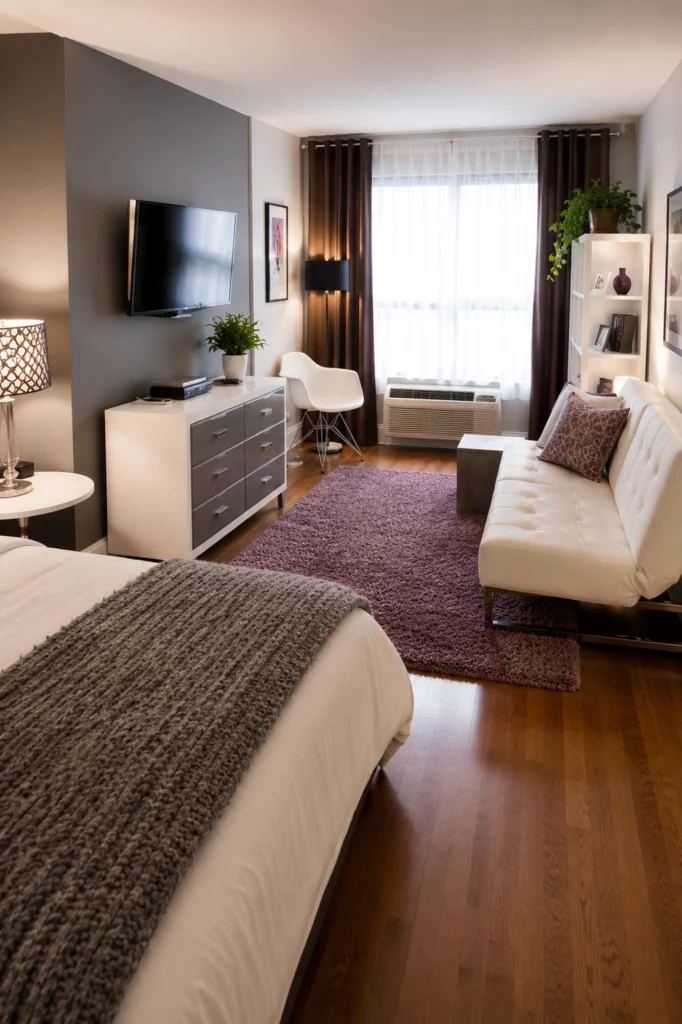
Here’s the thing about studios that feel like two separate rooms: it’s almost never about the square footage. It’s about deliberate zoning. This studio uses a dark grey accent wall to anchor the sleeping area, then draws an entirely separate living zone on the other side with a white tufted sofa and a deep plum rug.
The color story here is bold — charcoal, white, eggplant, warm wood — but it holds together because each zone gets its own anchor piece and its own rug. Rugs are the cheapest way to visually “build walls” in an open space. I cannot overstate this.
Renter-friendly alternative: Can’t paint that accent wall? A large piece of art or a temporary peel-and-stick wallpaper panel behind the bed achieves almost the same effect.
13. The Fresh Green and Natural Wood Living Room
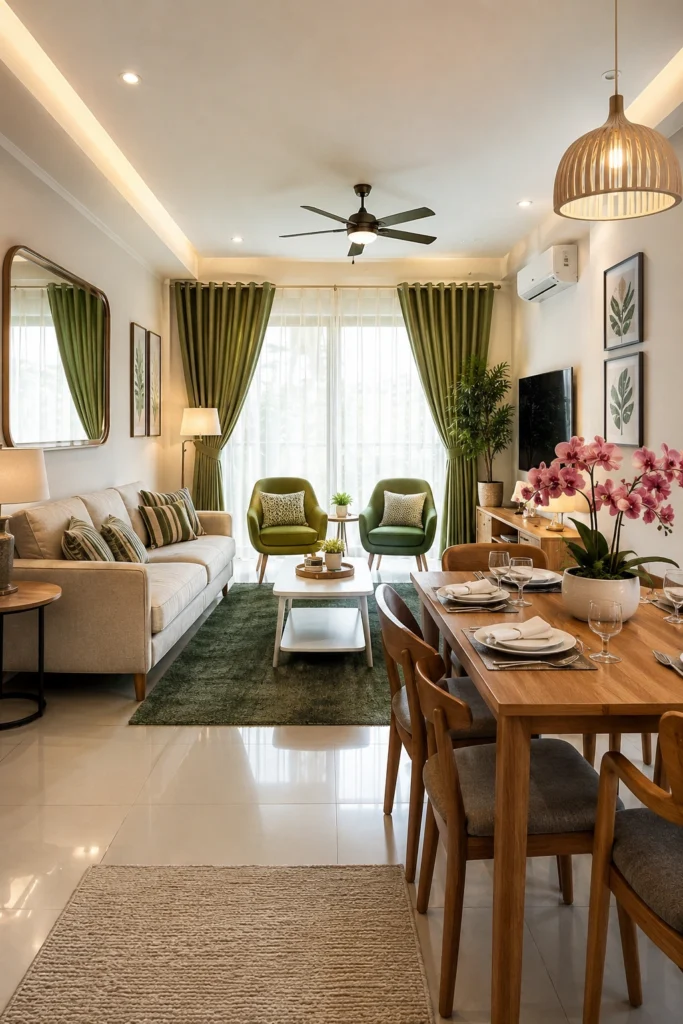
Sage green is having a moment, and this space shows exactly why it works so well. The green-cream-natural wood trio is one of those combinations that just feels good — fresh but not cold, natural but not boring. Two matching olive green armchairs opposite a cream sofa creates a proper conversational arrangement that makes the room feel intentional and generous, even if the square footage isn’t.
The ceiling detail — cove lighting and a ceiling fan — does something most people forget entirely: it pulls the eye up. In a small space, drawing attention to vertical height is one of the smartest tricks you can use.
My favorite detail here: The botanical prints above the TV. Simple, framed, consistent. You can find sets like this at IKEA or print your own on cardstock and frame them for under $20.
14. The Bookshelf Room Divider Studio
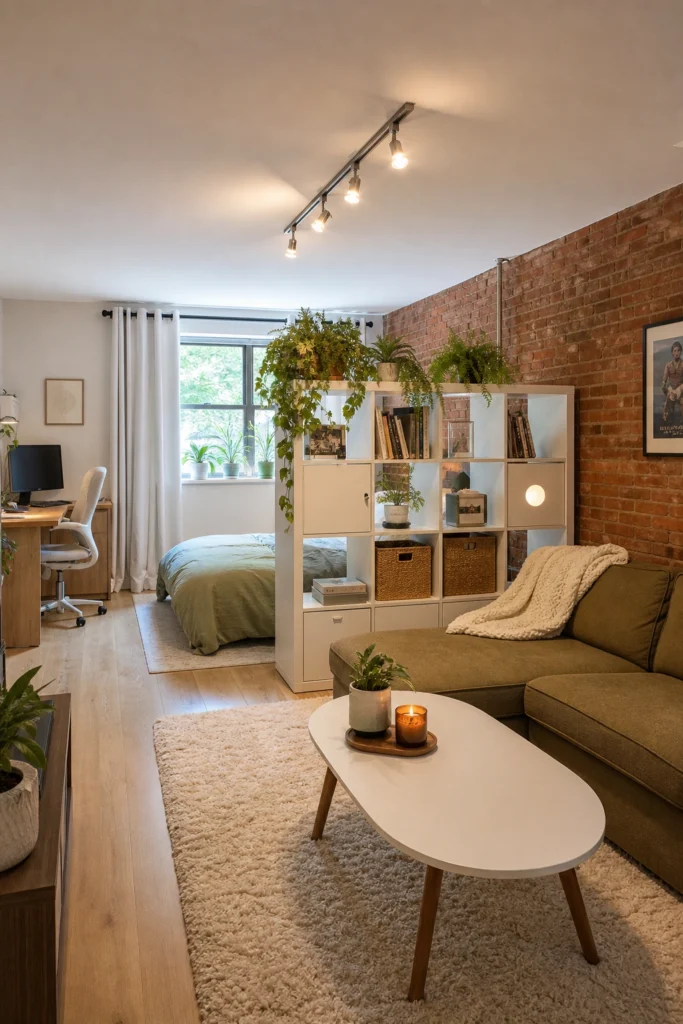
This is the studio that made me want to rethink every open-plan space I’d ever seen. An IKEA Kallax unit — loaded with books, plants, and baskets — acts as a full room divider between the sleeping zone and the living area. It’s not a wall, but it functions like one. And because it’s open on both sides, it doesn’t eat light.
The exposed brick wall does something nothing else can replicate: it gives the space texture and soul you can’t buy. But if you don’t have brick, the layering of plants, earthy tones, and natural materials (that cream shag rug, the woven coffee table) creates a similar warmth.
Pro tip from someone who learned the hard way: Style your room divider shelf from both sides. The bedroom-facing side matters as much as the living room side.
15. The Clean, Gallery-Wall Studio
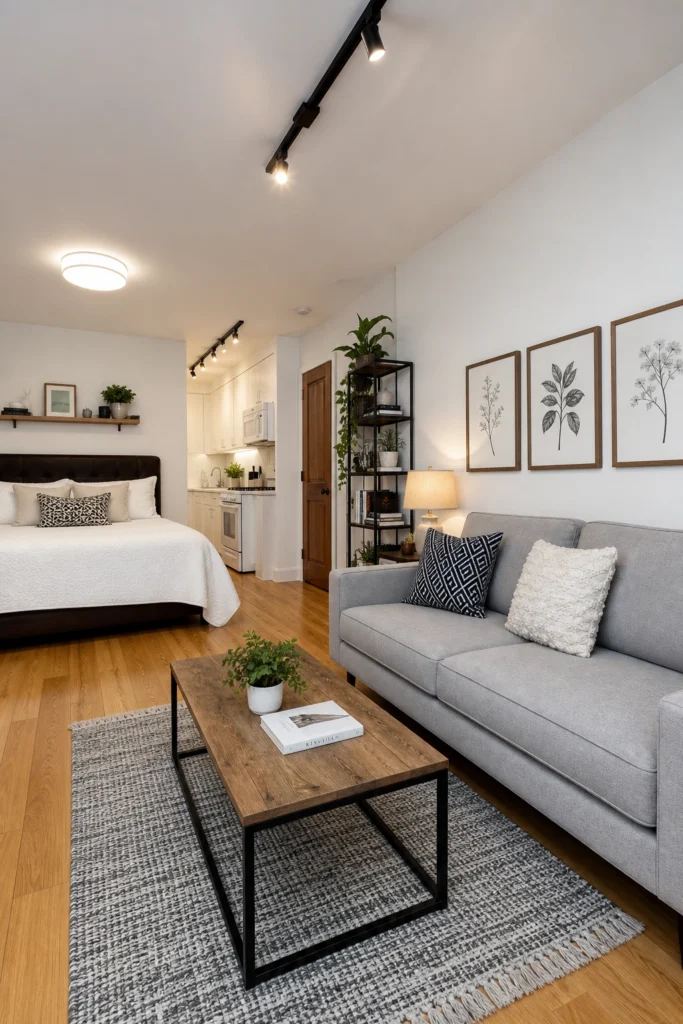
Not everyone wants cozy-maximalist. Some people want clean, calm, and uncluttered — and this studio delivers that without feeling cold or empty. The trick is intentional minimalism: every object earns its place. The botanical gallery wall above the sofa adds personality without visual noise. The dark etagere shelf in the corner adds height and breaks up the white walls. One small plant on the coffee table. Done.
Track lighting along the ceiling keeps it modern and practical — it can be aimed precisely where you need it, which is genuinely useful in a multi-function studio.
Sofia’s honest take: This style only works if you’re actually a tidy person. If you’re not, all that white and negative space will just highlight your mess. Know thyself.
16. The Golden-Hour Studio
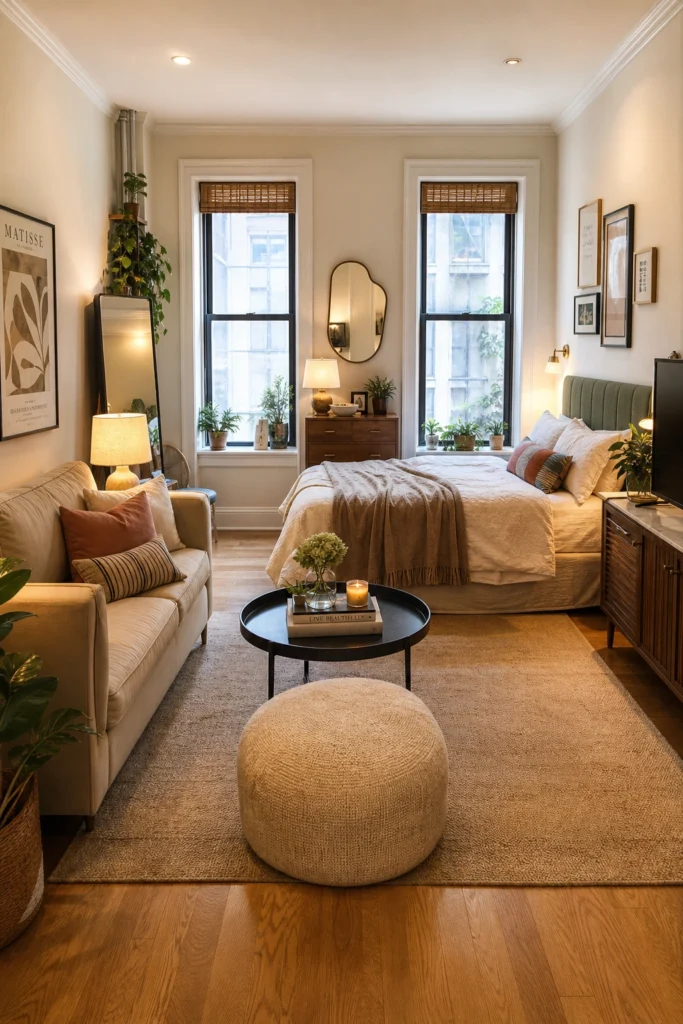
This one stopped me mid-scroll. The warm, golden light in this studio isn’t from a sunset — it’s layered lamp light hitting creamy walls and warm wood floors. That feeling? You can actually recreate it. All it takes is: a warm-toned lamp (color temperature around 2700K), light linen curtains that let ambient light filter through, and walls in a warm white or soft cream rather than a stark, cool white.
The round coffee table and woven pouf add softness and movement to what could’ve been a boxy room. Rounded furniture in small spaces almost always works better than sharp corners — it keeps the eye moving rather than getting caught on edges.
Pro tip: Swap your overhead bulbs for warm-toned ones (2700K–3000K). It costs almost nothing and changes the entire feeling of a room.
17. The Scandinavian Apartment With a Dining Nook
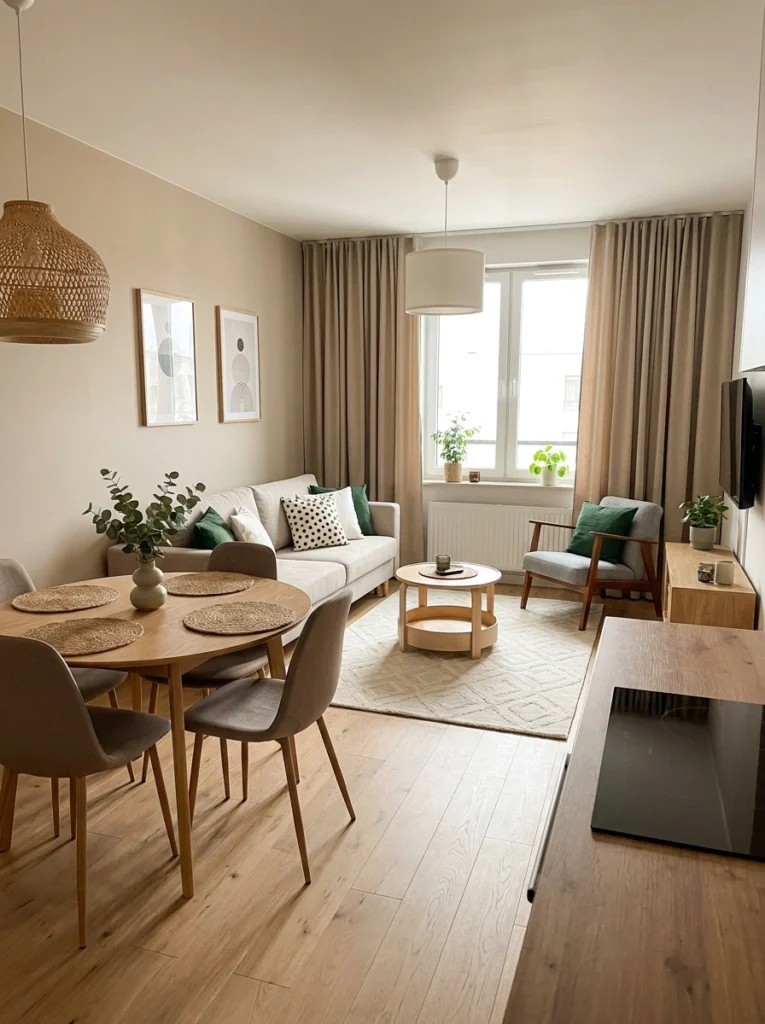
This is the style that never goes out of fashion for a reason. Natural oak furniture, a cream palette, green accents, and a rattan pendant light — it’s calm, warm, and effortlessly put together. The round dining table is a smart choice for a small space: no sharp corners to navigate around, and it seats four without dominating the room.
What makes this feel Scandinavian rather than just “beige” is the texture play: a textured cream rug, woven placemats, the rattan light shade, and the subtle patterned cushions. No color drama needed when you have this much tactile interest.
Budget vs. splurge: Splurge on a solid wood dining table — it’s the piece everyone sees first. Save on the chairs, which you can always update later.
18. The Boho-Coastal Light Studio
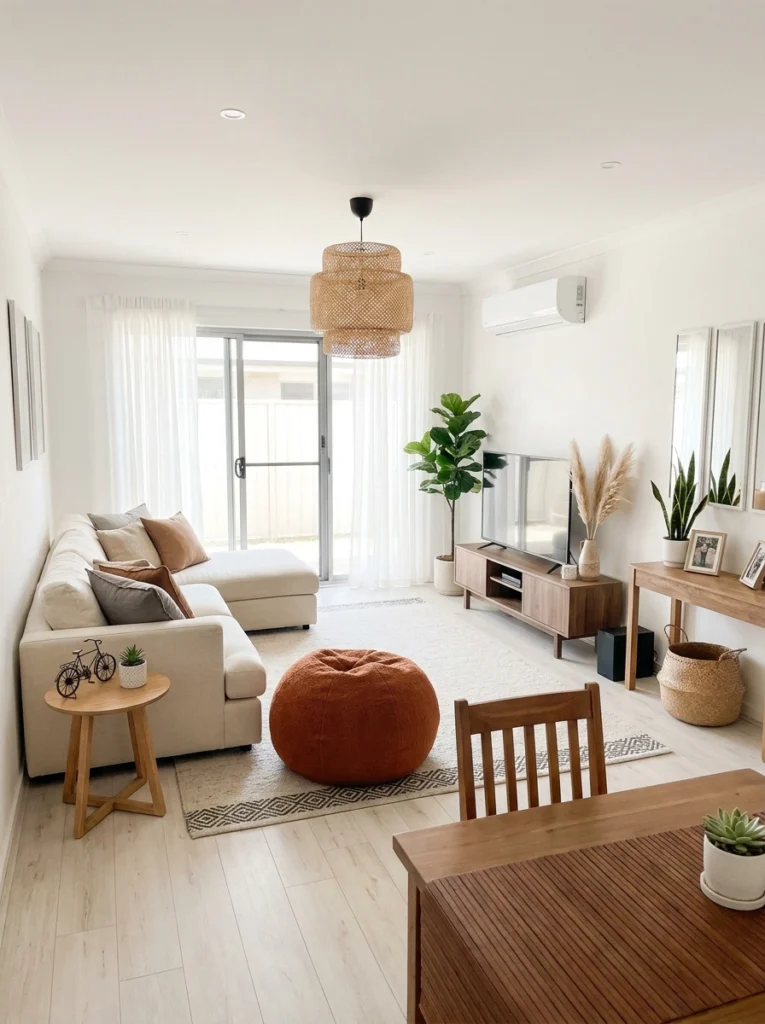
White walls, light wood floors, a cream sectional, a rattan pendant, and a fiddle leaf fig — this is the studio equivalent of taking a deep breath. It’s light, airy, and genuinely calming. The terracotta pouf is the only real pop of color, and it’s doing a lot: grounding the rug zone and adding the warmth the all-cream palette needs.
This kind of space photographs beautifully and lives beautifully — because there’s enough visual breathing room to actually relax in it. Pampas grass in a tall vase, a woven basket, a few small plants on a console table: these are the cheap finishing touches that pull the whole look together.
My tip: Pampas grass lasts for months (sometimes years) and costs almost nothing at HomeGoods or a garden center. It’s the easiest way to add that tall, sculptural element a room needs.
19. The Warm Neutral Studio: Every Detail Earns Its Place
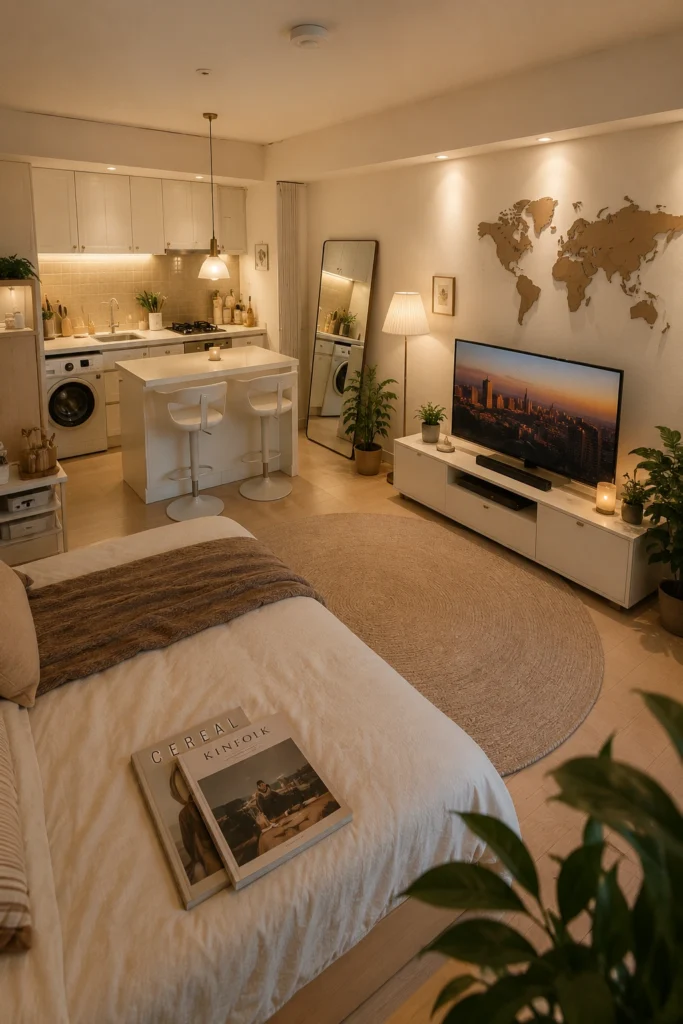
This one stops me every time. Warm-toned lighting, a round woven rug anchoring the living area, a floor lamp doing heavy lifting in the corner, and that cork world map on the wall — which is doing something interesting: it’s personal, textural, and doesn’t cost much. The open kitchen with pendant lighting and bar stools makes the whole thing feel like a proper apartment, not a shoebox.
What I love most is the restraint. There’s a plant here, a candle there, a book on the bed. Nothing is fighting for attention, and that’s exactly why the room feels so calm.
What to steal: Layered warm lighting instead of overhead fluorescents. That amber glow at night makes any studio feel like a proper home.
Budget vs. splurge: Save on the world map (cork + push pins, very affordable). Splurge on one good floor lamp with a warm-toned bulb — it’ll do more for your evenings than almost anything else in the room.
Final Thoughts
Ten studios, ten completely different feelings — and every single one of them achieves something the others don’t. That’s the beauty of a small space done right: the constraints actually force you to make decisions, to commit to a vibe, to stop hedging.
You don’t need a bigger apartment. You need a clearer sense of what you want the space to feel like — and the willingness to make even a few intentional choices to get there. Pick one idea from this list. One rug, one shelf, one lamp. Start there.
A studio apartment isn’t a compromise. In the right hands, it’s an edit — and an edit always says more than clutter.