14 Studio Apartment Ideas for Living Simplicity
Studio apartments have a bit of a reputation problem. People hear “studio” and think cramped, cluttered, or compromised. But here’s the thing — some of the calmest, most intentional homes I’ve ever walked into are studios. The tight footprint forces you to make real choices about every piece, every color, every corner. Nothing gets to hide.
Below are 14 studios that get simplicity right — and the small, specific decisions that make each one actually work in real life.
1. Lean Into a Cream-and-Beige Palette
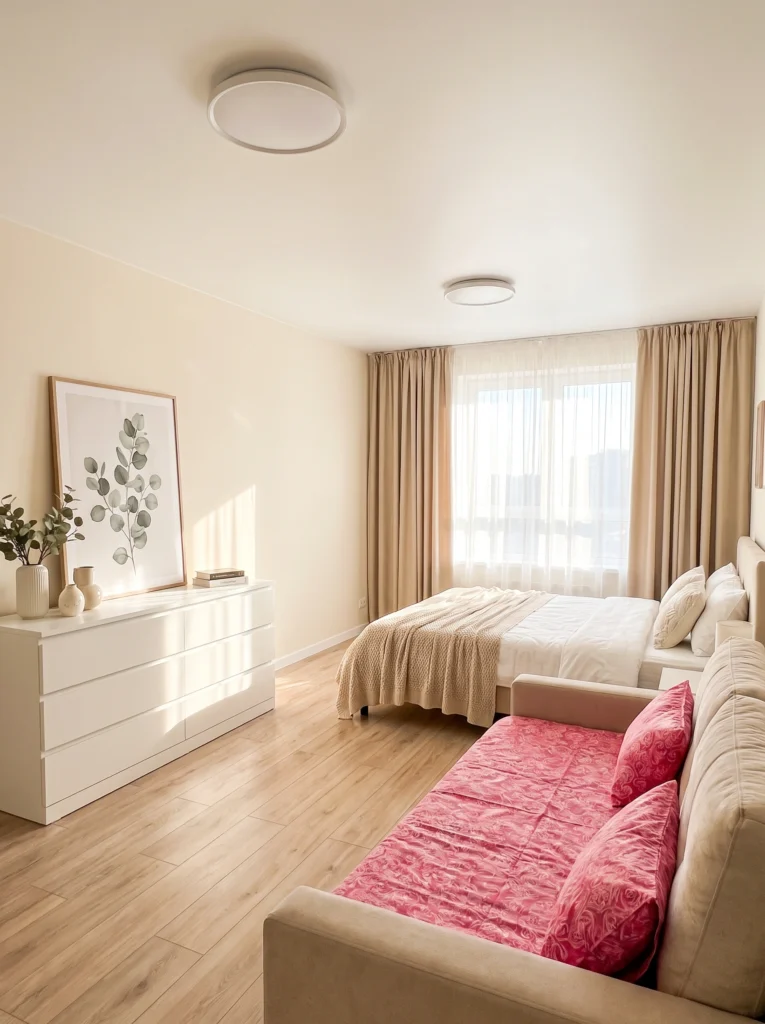
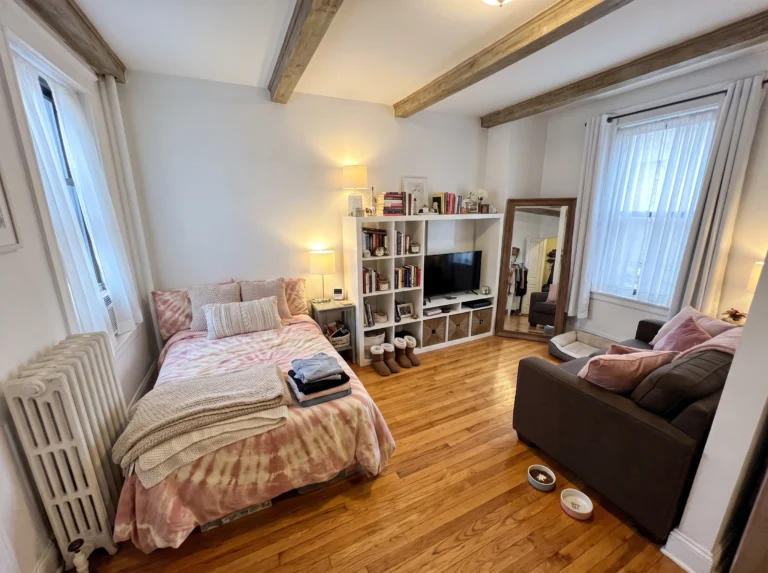
This is what soft looks like. Warm cream walls, a white MALM dresser, wood floors, and beige curtains create a wash of quiet color that makes the whole studio feel bigger and calmer. The eucalyptus print adds the smallest touch of green without breaking the mood. When your palette is this restrained, you don’t need much decor — the light itself becomes the star. Simplicity through color restraint.
My favorite: A single botanical print in a warm wood frame does more work than three trendy posters. Trust me on this.
2. Add Personality with a Two-Color Palette
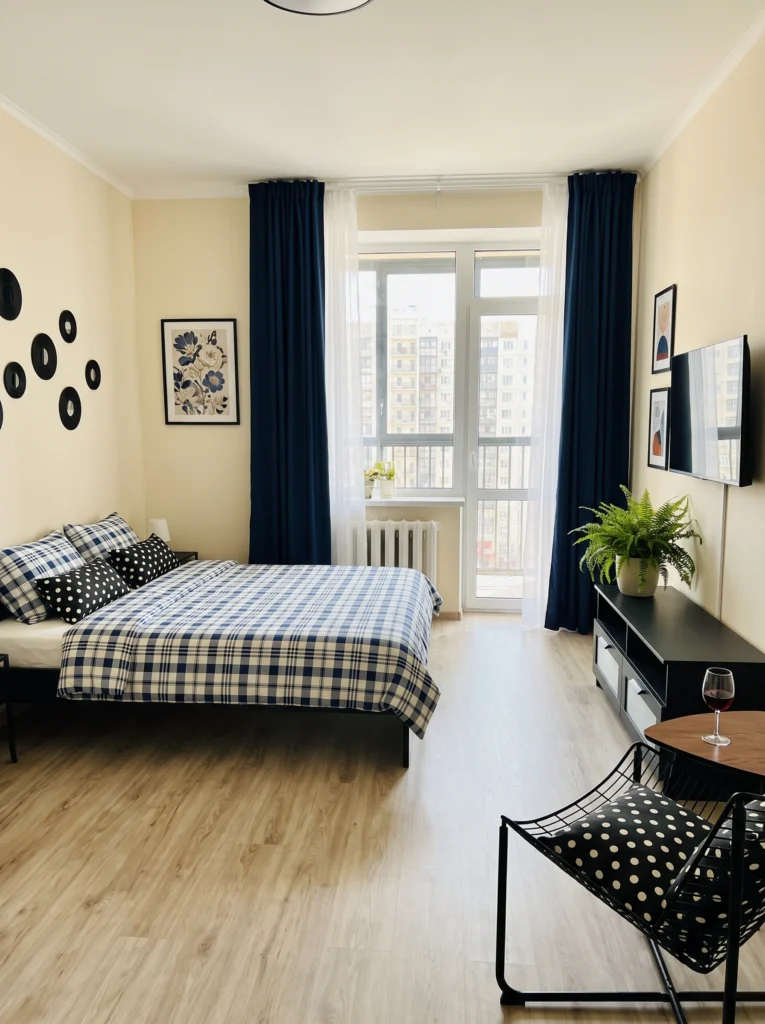
Here’s a studio that proves you don’t need ten colors to make a room interesting. Navy blue plus warm cream does all the heavy lifting — deep curtains, plaid bedding, polka-dot pillows, and a chair that echoes the same pattern. The circular black wall art and small fern break up the flatness. It feels curated but not fussy. Two colors, repeated with intention, is a simplicity cheat code most people miss.
Pro tip: Pick your two colors before you shop for anything else. Everything you buy after should either be one of the two, or a neutral.
3. Let One Wall Do the Talking
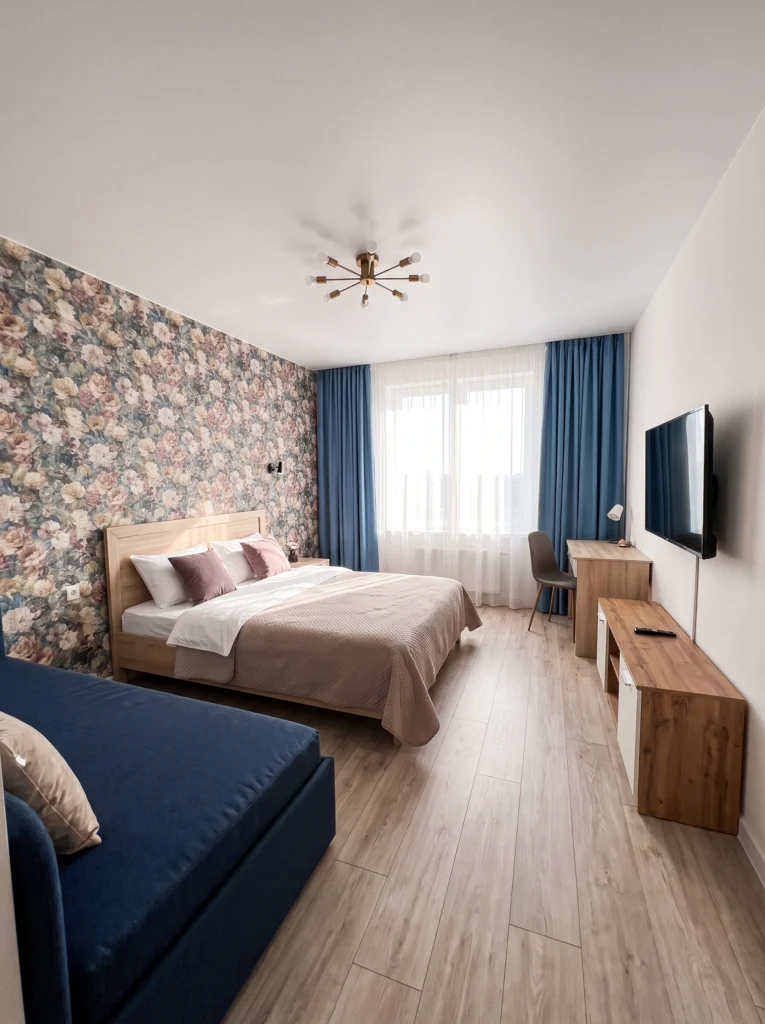
The floral wallpaper here is doing all the work. Every other surface stays quiet — pale walls, wood floor, simple bed, plain sofa — so the pattern reads as a feature, not chaos. That’s the rule with statement walls in studios: one bold move, then everything else steps back. Blue curtains echo the flowers just enough to feel intentional. This is how you get personality without visually crowding a small space.
Renter-friendly alternative: Peel-and-stick wallpaper on one wall gives you the same drama without a security-deposit war. Removes cleanly if you love your future self.
4. Build a Compact Studio Around One Anchor Rug
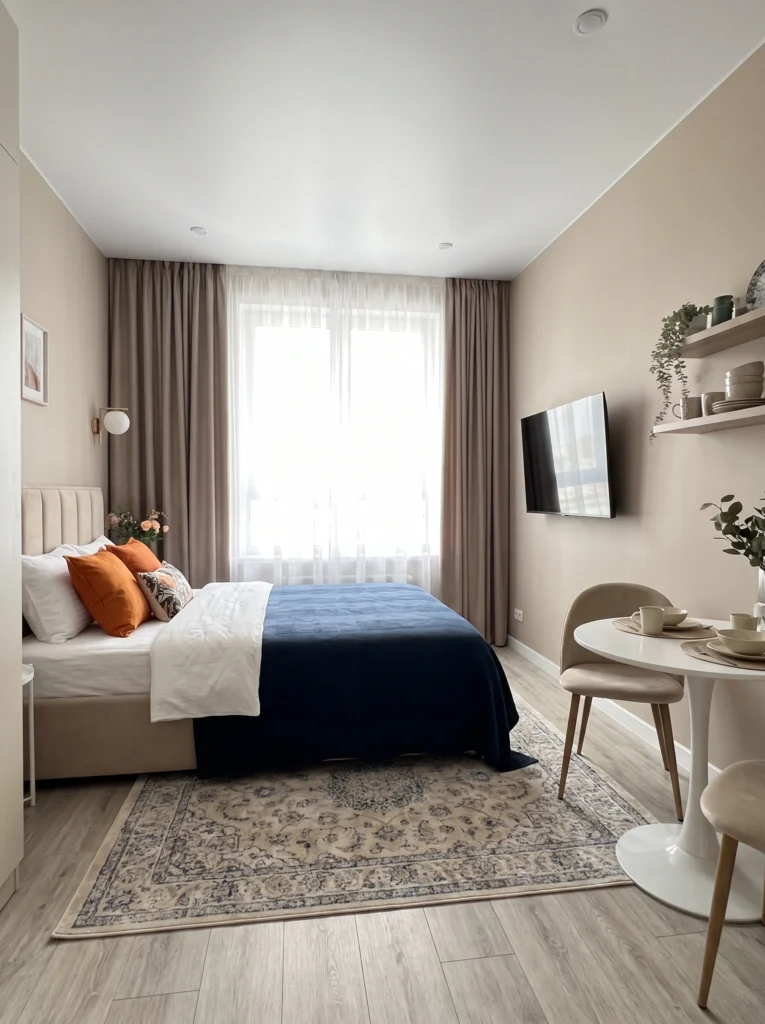
Small studios need one thing to anchor them, and here it’s a beautiful vintage-style Persian rug. Everything else stays simple: a tufted headboard, a couple of orange pillows, a small round dining table with two chairs, floating shelves for kitchen bits. That’s it. The rug pulls the eye down, softens the wood floor, and makes the whole space feel intentional instead of thrown together. One good rug does more than ten accessories.
Budget vs. splurge: Save on the bed frame and the dining chairs. Splurge on the rug. You’ll walk on it every day for years.
5. Give Your Sofa Zone Its Own Warm Glow
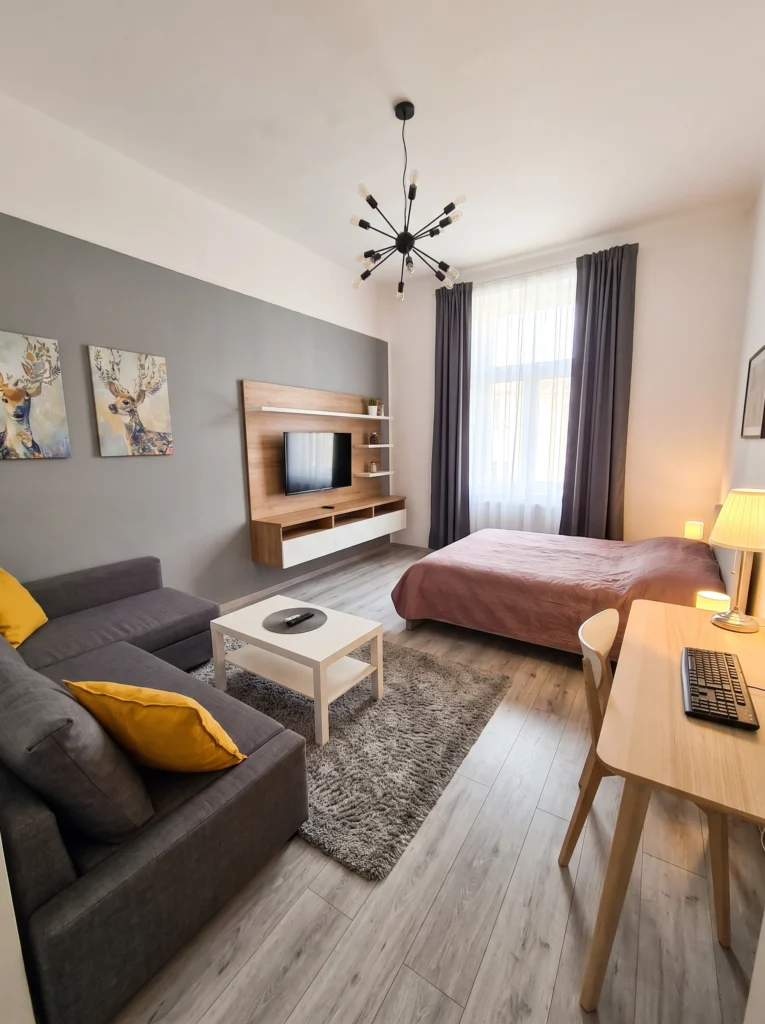
Same layout as many small studios — sofa across from the TV, bed by the window — but the small warm lamp on the desk changes everything. It creates a second light source separate from the ceiling fixture, which instantly makes the sofa corner feel like its own room. Warm bulbs matter here. Skip cool white in a studio; it flattens everything. One small pool of amber light is worth three cold ones.
My tip: Get bulbs in the 2700K range. Anything higher and your cozy studio starts to look like a dental office at 9pm.
6. Use an Open Bookshelf as Your Only Divider
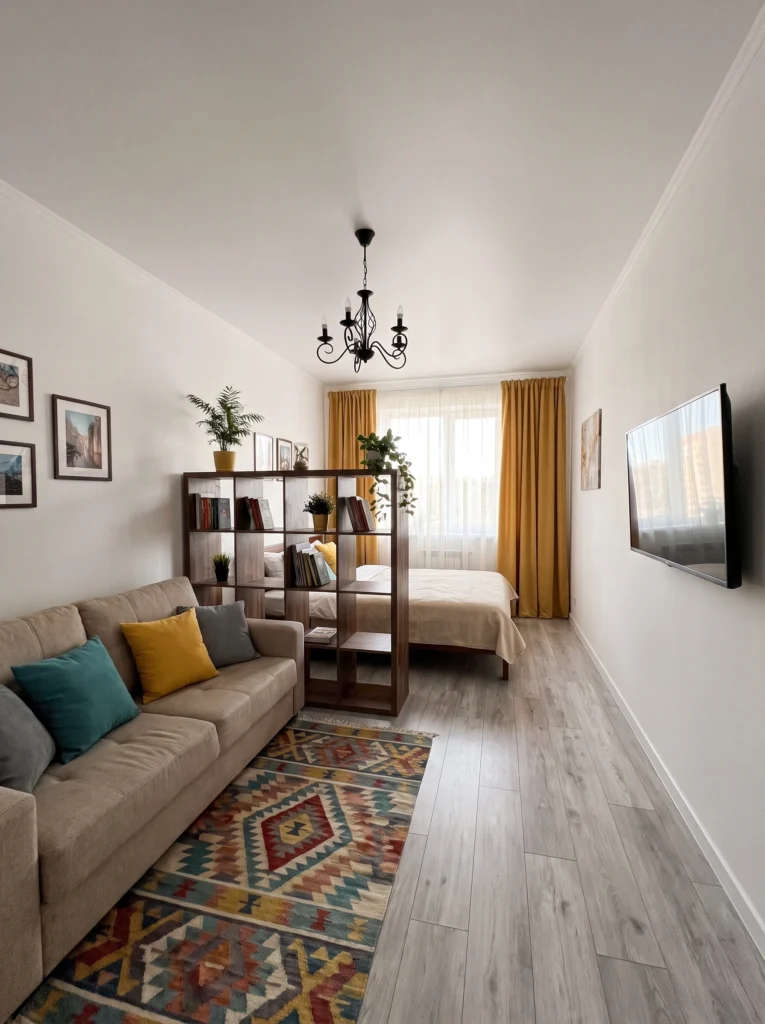
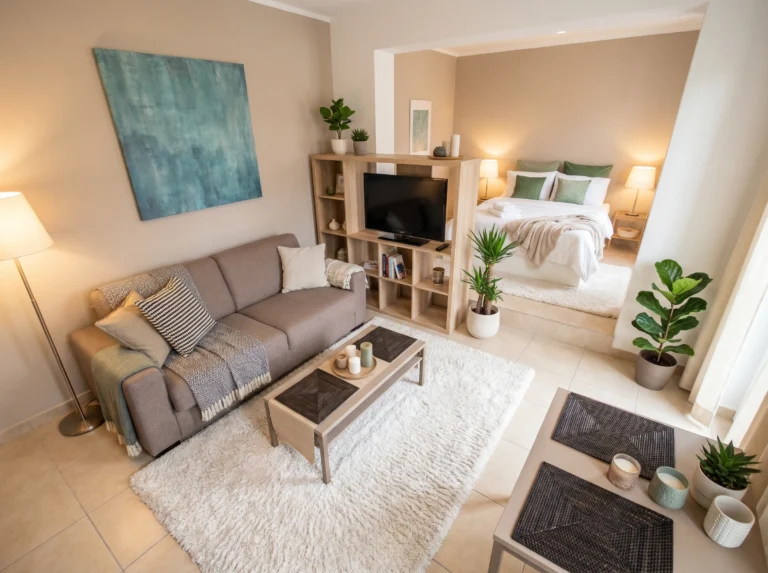
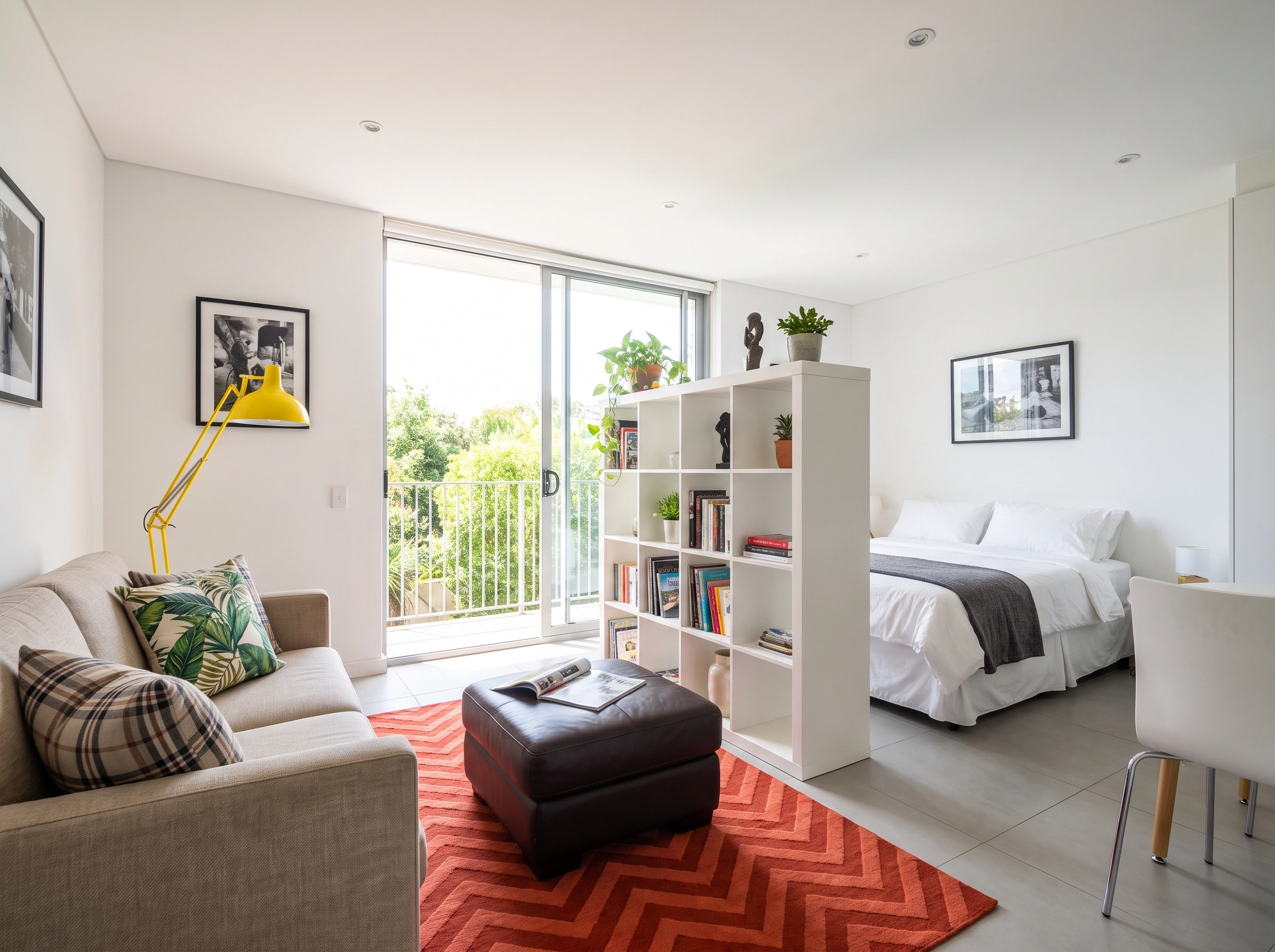
If you can’t stand seeing the bed from the sofa, an open cube shelf is the simplest fix. Here, a tall walnut-tone unit splits the room into “living” and “sleeping” without blocking light. Books, plants, and a few frames fill it — practical storage doubling as decor. Behind it, the bed feels tucked away; in front of it, the sofa area feels focused. No permanent construction, no drilling, no drama.
Renter-friendly alternative: Skip the wall build-out and use an IKEA Kallax or a similar open cube unit. Cheap, movable, and doubles as bookshelf.
7. Add Cheerful Color Through Just the Pillows
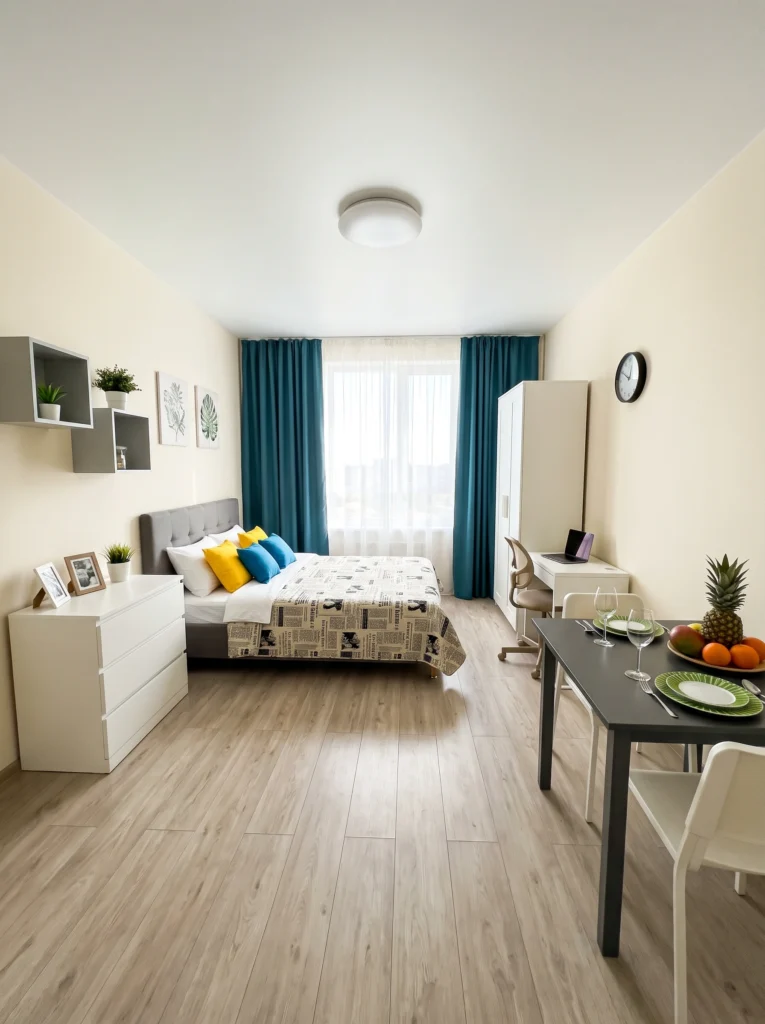
This is the smart way to bring color into a studio without commitment: keep the walls, floors, and big furniture neutral, then let cheerful pillows (yellow and teal here) do the personality work. Swap them next year and the whole room feels new. The botanical prints, the fruit bowl on the table, the little planters on the shelves — small joyful touches. Simplicity doesn’t have to mean beige-on-beige boring.
Pro tip: Buy pillow covers, not whole pillows. Same insert, four different looks per year for the cost of one throw pillow set.
8. Try a Bold, Grown-Up Color Pairing
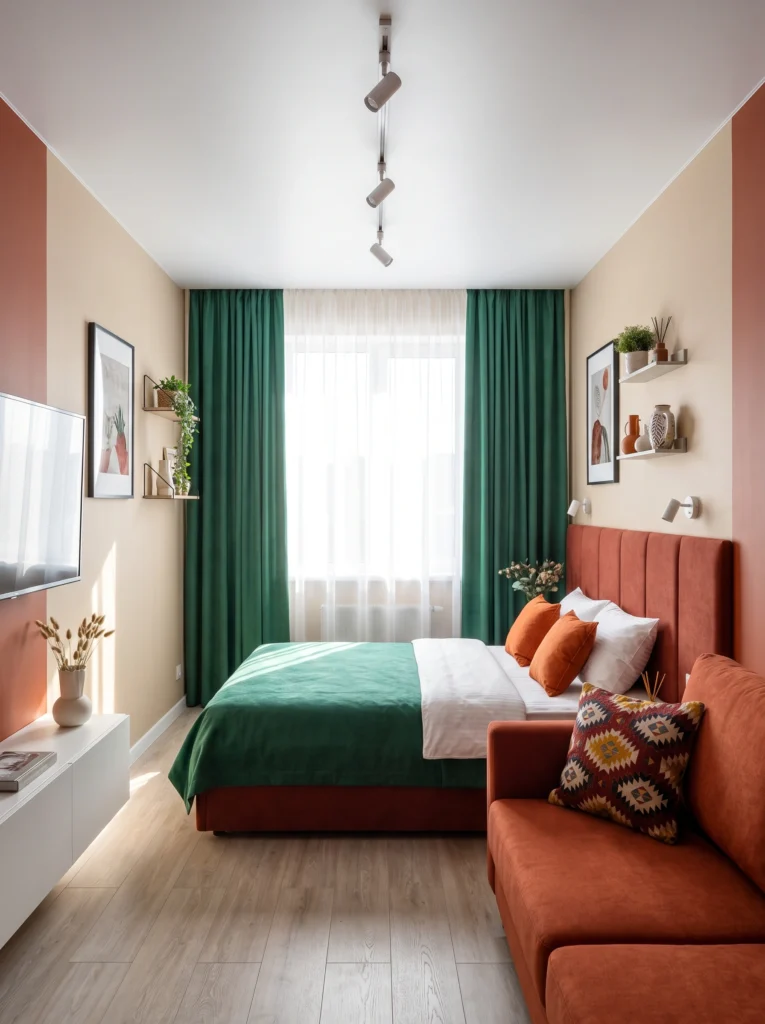
Green curtains, a rust-colored headboard, and an orange sofa should not work — and yet they absolutely do. The trick is that everything else is deeply neutral: cream walls, wood floor, white media console. So the three warm-and-cool tones read as a curated palette instead of a mess. Choose two saturated colors you love, then let the neutrals do the mediating. It’s simplicity with a strong point of view.
Sofia’s honest take: Grown-up color doesn’t mean muted. It means confident. Pick colors that make you happy, then commit hard to them.
9. Keep It Almost Entirely Grey and Wood
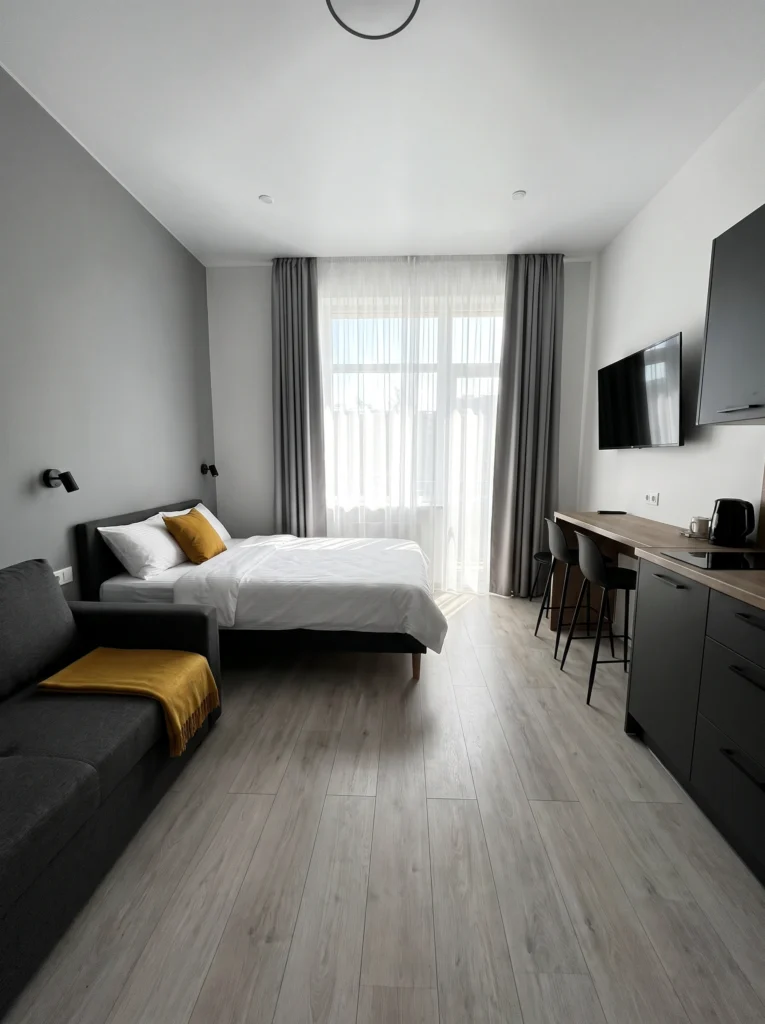
Some of the calmest studios I’ve seen use only two materials: soft grey and pale wood. Grey sofa, grey headboard, grey cabinetry, wood floor, wood counter. One mustard throw is the only accent. That’s it. It photographs quiet, it lives quiet, and it never gets visually tiring. If you overwhelm easily in busy rooms, this is your template. A single warm accent is all the color the eye needs.
I’ve tested this: I lived with a two-material palette for a year. Cleaning felt easier, decisions felt easier, and my brain thanked me.
10. Layer Warm Terracottas for a Cozy Retreat
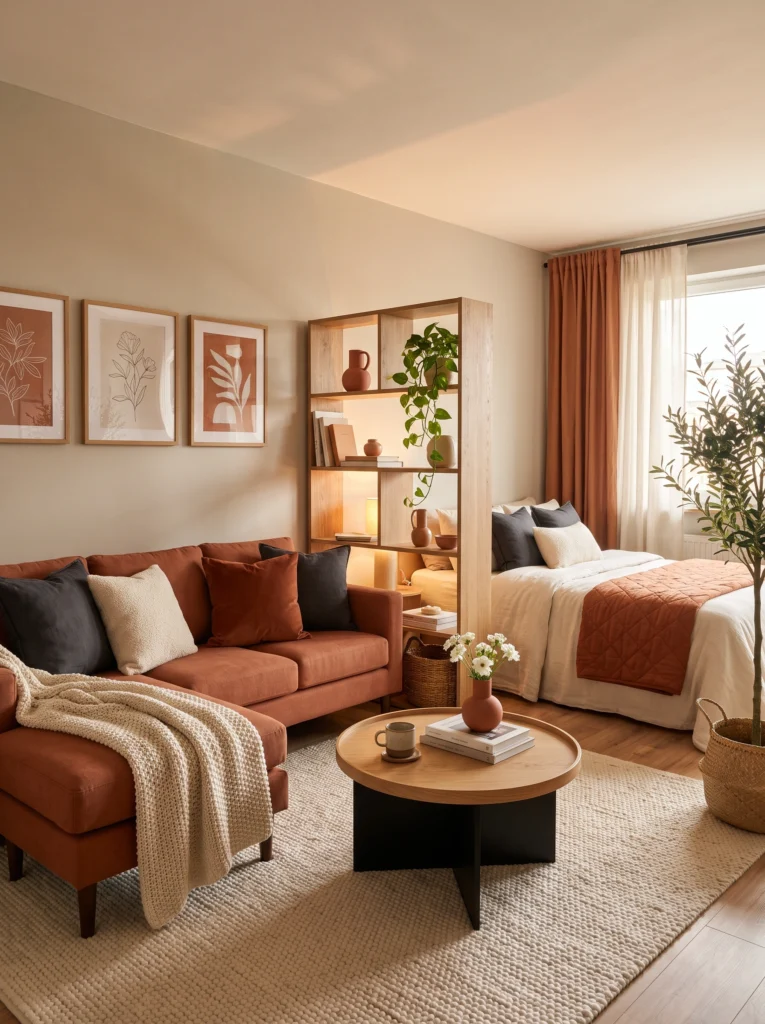
If your definition of simplicity is warmth, not minimalism, this is the studio for you. Terracotta sofa, terracotta quilt, terracotta curtains — repeated three times across the room. Then a wooden shelf divides the living from the sleeping space, a chunky cream rug softens the floor, and an olive tree grounds the corner. It’s simplicity through repetition. Pick a color you love, then commit to it fully.
My favorite: A real (or convincing faux) olive tree in a woven basket. Instant warmth, zero fuss, works in almost any palette.
11. Keep the Floor Plan Airy and Uncluttered
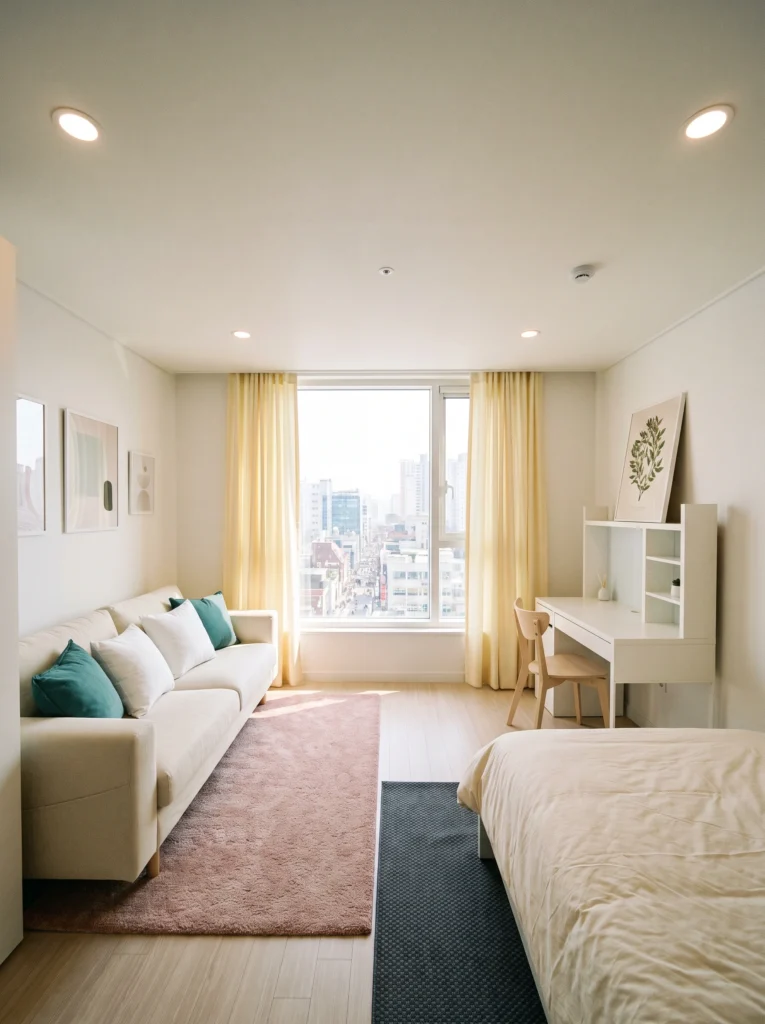
This studio’s superpower is what isn’t in it. The bed sits far from the sofa, the walls are almost bare, the desk holds only what it needs. Two rugs mark the living zone and the sleeping zone without any actual barrier. Pale yellow curtains catch afternoon light beautifully. When you feel tempted to fill every corner, remember this room — empty floor is a design choice, not a failure.
Don’t waste your money on: Extra “accent furniture” to fill awkward corners. Empty corners aren’t a problem to solve. They’re breathing room.
12. Build a Scandinavian-Style Neutral Studio
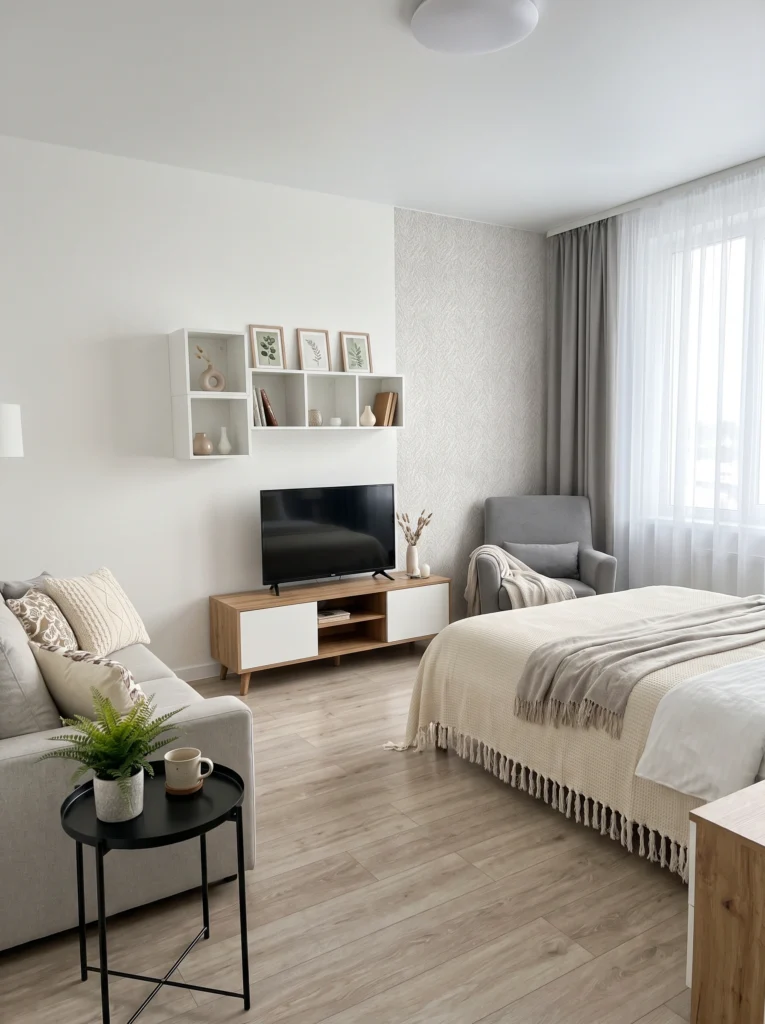
Scandinavian style translates beautifully to studios because it’s built around simplicity: soft neutrals, natural wood, one small pop of green. Cream sofa with textured pillows, a wood-and-white TV console, botanical prints tucked into floating cubes, and a grey armchair angled toward the window. The tasseled throw on the bed is the softest touch in the room. Nothing loud, nothing wasted, and every piece earns its place.
Pro tip: In Scandinavian setups, texture is your color. Chunky knits, woven throws, tasseled cotton — that’s where the warmth comes from.
13. Anchor a Modern Studio with One Piece of Art
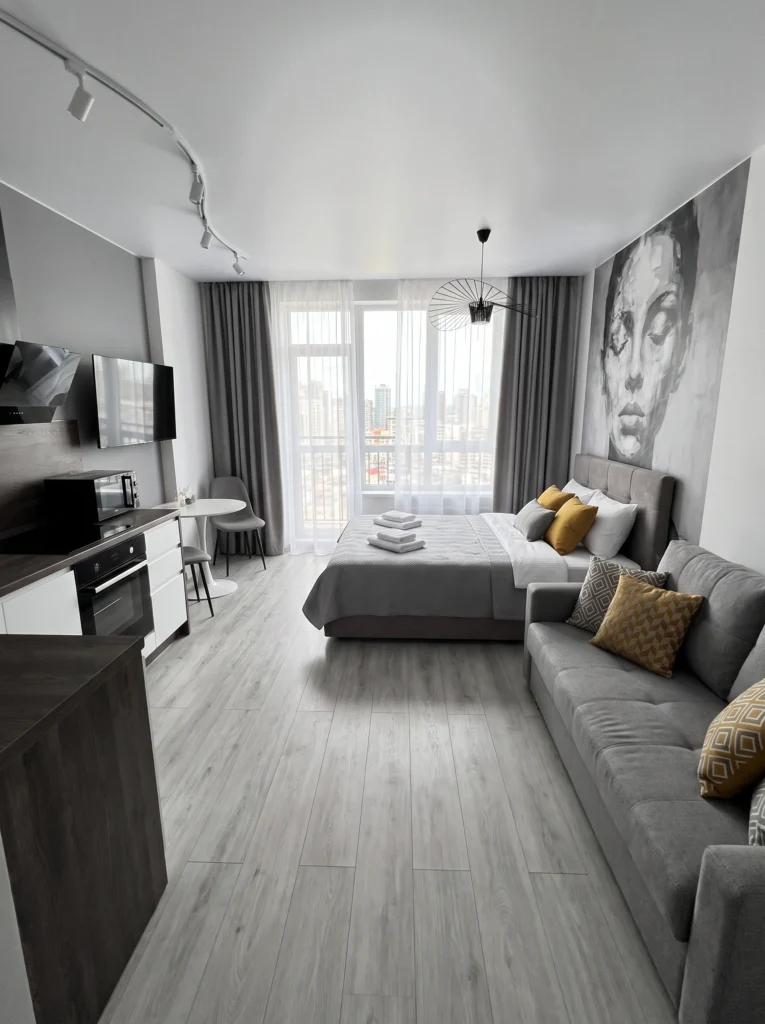
The oversized black-and-white portrait above the bed is what makes this whole studio feel designed. Everything around it stays quiet — grey sofa, grey bed, white kitchen, wood floor — so the art dominates without competition. Track lighting and a spider pendant add a modern edge. If your studio feels too vanilla, don’t buy more furniture. Buy one large piece of art you love. It’ll do more than five small ones.
Sofia’s honest take: Most studios are under-arted, not under-furnished. A single big piece changes a room more than a whole new sofa ever will.
14. Zone Every Corner Without Building a Single Wall
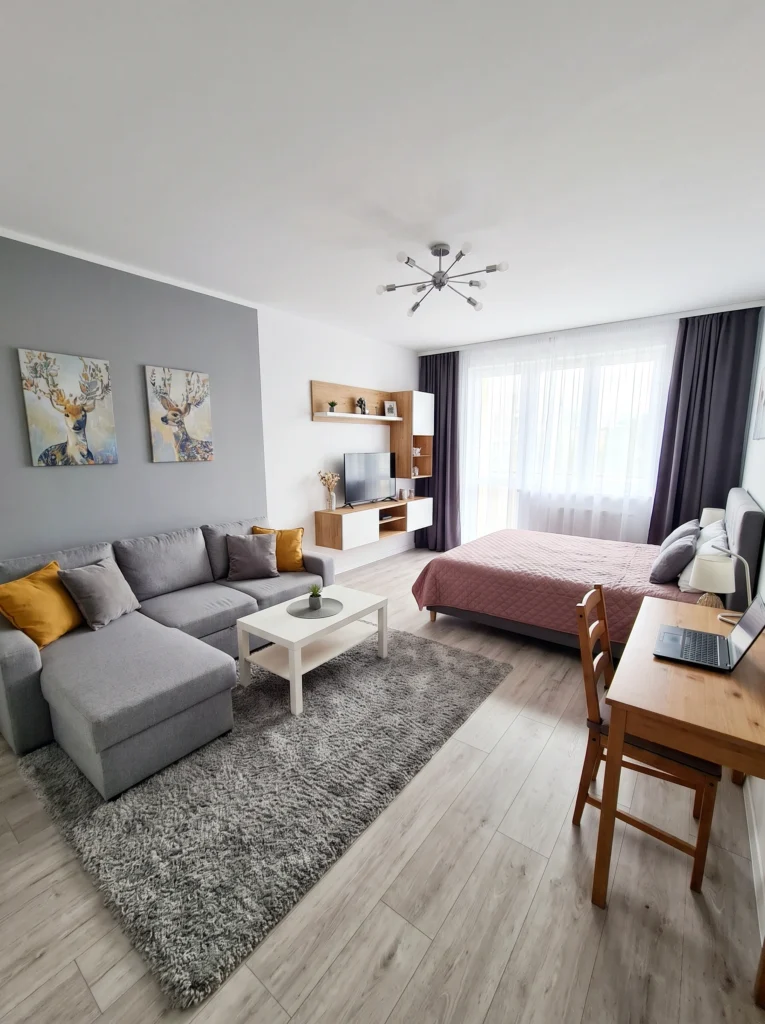
This studio does it all — sofa zone, sleep zone, work zone, TV zone — and still feels open. The trick? A large area rug anchors the living space, the media unit floats to save floor space visually, and the desk faces the window. Mustard pillows warm up all that grey, deer prints add unexpected personality, and the sputnik chandelier ties the whole room together from above. Simplicity through smart zoning.
Sofia’s honest take: You don’t need dividers to zone a studio — you need one clear rug per activity area. That’s it.