12 Space-Saving Studio Apartment Furniture Ideas You Need to See
Living in a studio means making one room do the work of four — and most decor advice for small spaces is written by people who clearly have a guest bedroom. Here’s the thing: a studio can feel calm, beautiful, and entirely yours without endless storage hacks or a Pinterest-perfect aesthetic. It just needs the right choices in the right places.
Below are 12 ideas pulled from studios that get it right. Some are layout moves, some are styling tricks, all of them are doable this weekend.
1. A Built-In Desk Nook Makes Any Studio Feel Custom
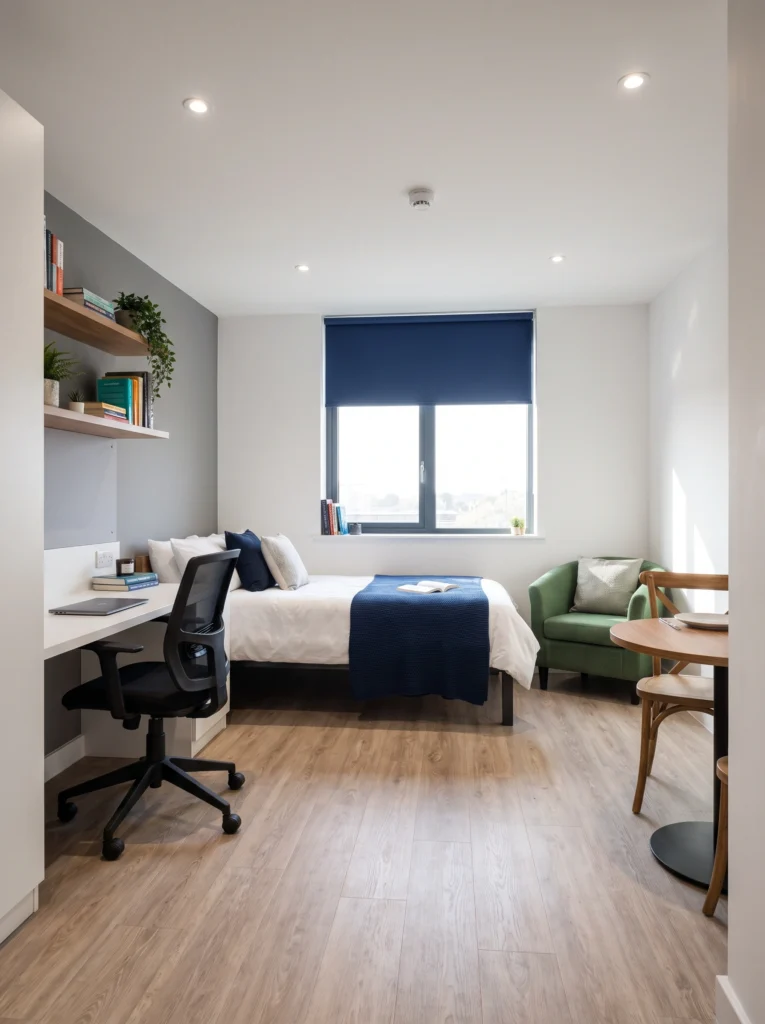
A built-in desk tucked into a recessed wall nook — with floating shelves above for books and plants — turns what would otherwise be dead corner space into the most functional zone in the room. The grey accent wall behind it frames the workspace visually so it reads as its own room-within-a-room. Navy blue accents on the blind, bed throw, and cushions tie the workspace to the sleeping zone without a single additional decorating move. Purposeful, practical, and genuinely good-looking.
I’ve tested this: A wall-mounted desk shelf (just a deep floating shelf at desk height) replicates this exact built-in look for about $40. Add a floating shelf above it for books and plants and the whole nook feels intentional and custom.
2. A Ladder Shelf Between Sofa and Bed Is a Room Divider That Also Stores Things
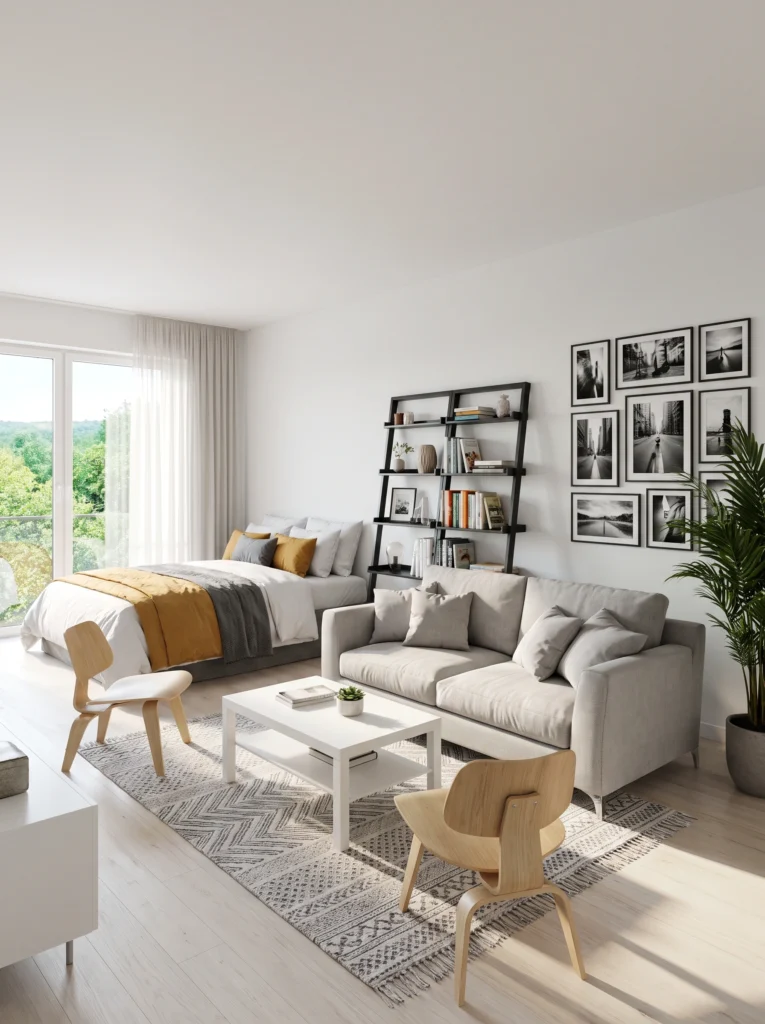
A black metal ladder shelf placed between the sofa and the bed does what a full bookshelf divider does — separates zones, holds things, looks designed — but takes up a fraction of the footprint. The leaning angle keeps it light and open rather than blocking. The nine-print gallery wall of B&W city photography beside it fills the wall without requiring any furniture beneath it. Two blonde Eames-style chairs complete the living zone without crowding it. This is a very clever room that looks effortless.
My tip: A ladder shelf works best when you vary the object heights across each rung — tall vase bottom, medium books middle, small ceramics top. Uniform heights make it look like a storage unit; varied heights make it look styled.
3. Use Color on the Bed Itself as Your Main Statement
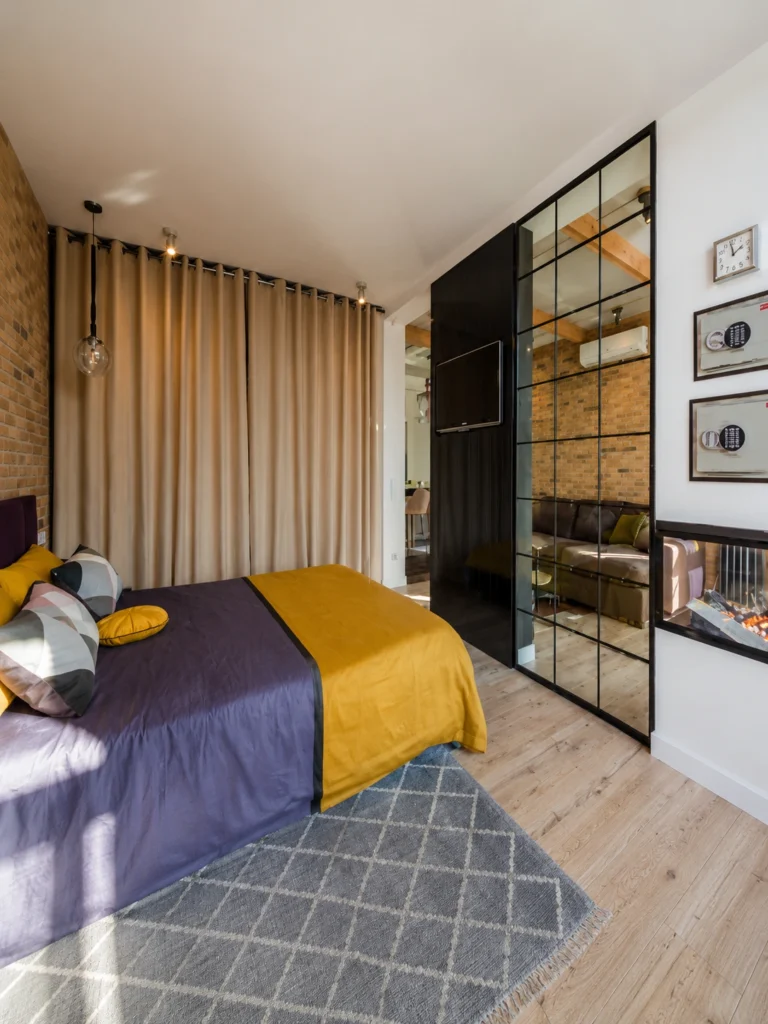
In a studio, the bed is roughly 40% of your visual field. So if you treat it like an afterthought — beige duvet, no contrast, “just somewhere to sleep” — you’re wasting your biggest piece of real estate.
This bed is the whole personality of the apartment. Mustard yellow and deep aubergine purple. That’s it. Everything else around it (the brick, the wood floor, the neutral curtains) is calm on purpose so the bed can sing.
The principle: Pick one piece of furniture you see constantly and turn that into your statement. In a studio, that’s almost always the bed. New bedding is the cheapest, easiest decor upgrade you can possibly do — and the most visible one.
4. Carve Out a Real Work Zone (Even if It’s Tiny)
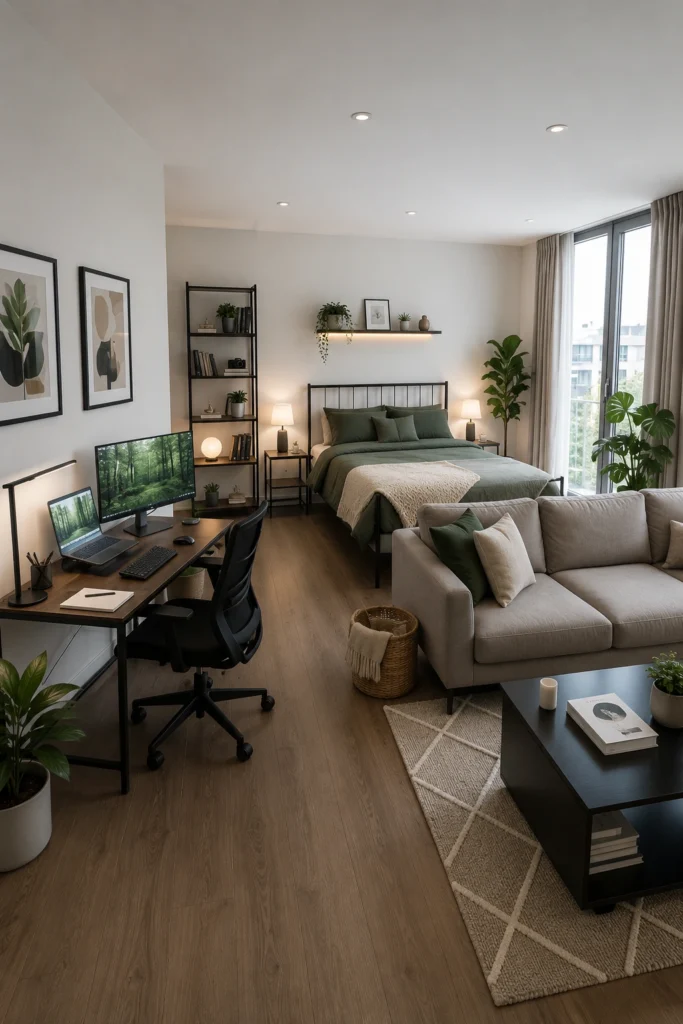
Working from your bed sounds romantic until your back is wrecked and your sleep is ruined. Even in 300 square feet, you can claim a corner for a proper desk.
Look for the longest stretch of wall and slide a narrow desk against it — 100 cm deep is plenty. Add a real chair (no, your dining stool doesn’t count), a small lamp, and one piece of art directly above. That’s your “office.”
The visual separation matters as much as the physical one. When your eye registers a distinct work zone, your brain stops mixing rest and work in the same square foot. The bed in the photo above sits five feet from the desk, and the space still reads as two rooms because each zone has its own light source, its own rug, and its own purpose.
5. Use a Single Bold Color to Tie It Together
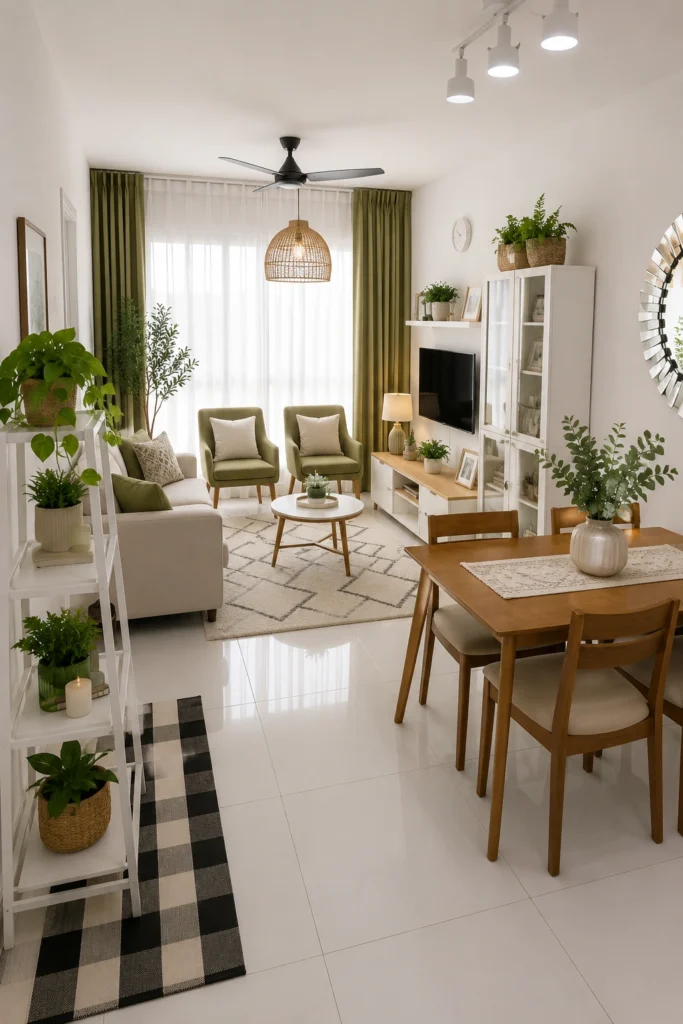
One of the easiest mistakes in a small space is treating every zone like its own room with its own color story. The result is chaos in 30 square meters.
Pick one accent color and let it travel through the apartment. Olive green in the curtains, on a chair, in a vase, on a few plant pots. Terracotta on a rug, a cushion, a ceramic bowl. Black in the picture frames, a lamp base, a side table.
That repetition is what makes a space feel cohesive without feeling matchy. Your eye follows the color from corner to corner and reads the whole studio as one designed room, not three disconnected ones.
Don’t paint a feature wall in a studio. You don’t have the breathing room for it, and it usually makes the space feel smaller. Use textiles and decor for color instead.
6. Divide the Space With an Open Shelf
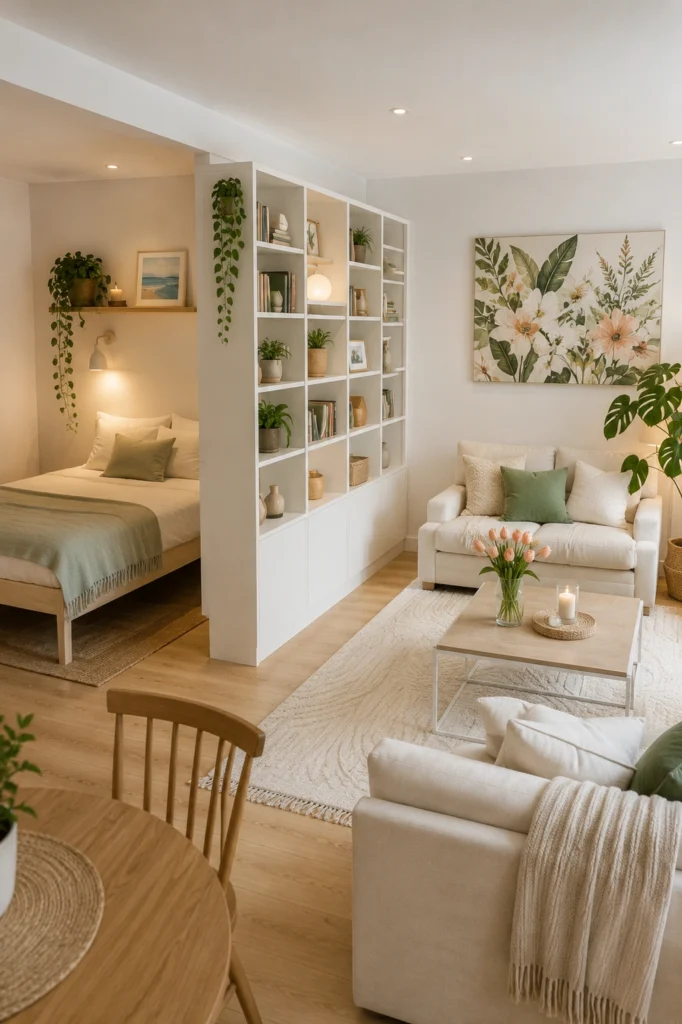
A solid wall would kill the light. A curtain feels like college. The middle path is an open shelving unit used as a room divider — IKEA’s Kallax is the obvious choice, but any open cube shelf works.
It separates the sleeping zone from the living zone visually, doubles your storage, and still lets light pass through both sides. Style it from both directions: books and a lamp facing the living room, baskets and personal items facing the bed.
A few things to keep in mind:
- Leave the top two cubes mostly empty or use sheer items so light still flows.
- Anchor it to the wall if you can — even open shelves tip.
- Style only about 70% of the cubes. Stuffing every shelf makes the whole thing look like storage, not styling.
7. Choose Furniture With Legs
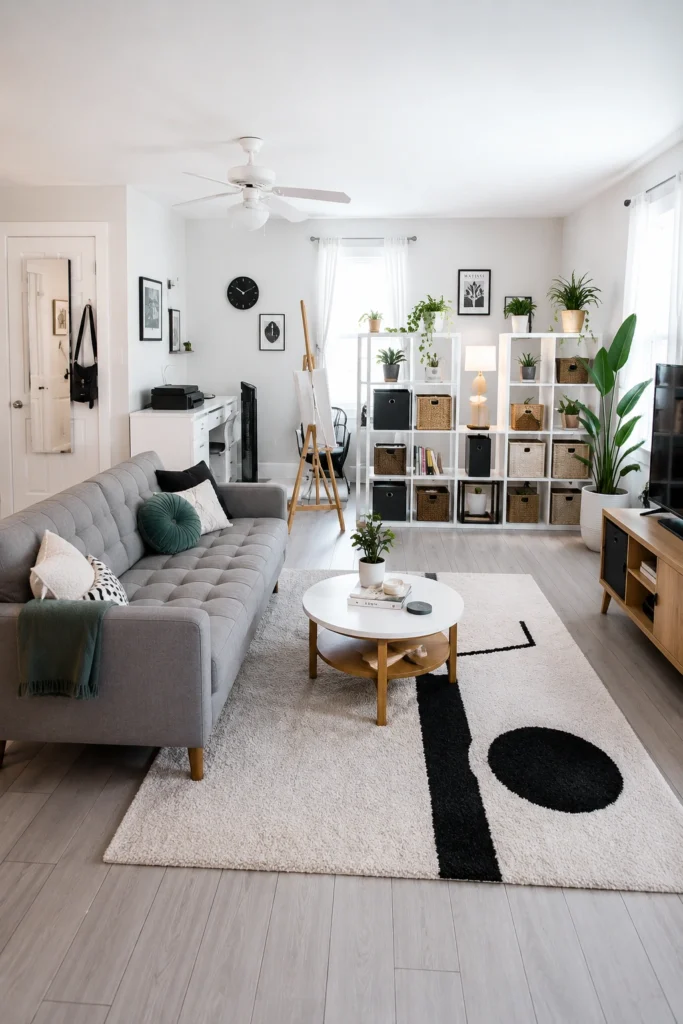
This is the part most people skip — and that’s exactly why their studio feels cramped. Furniture that sits flush on the floor (think upholstered ottomans, boxy storage sofas, big chunky beds) makes a room feel heavy and stuck.
Furniture with visible legs lets your eye travel under it, and your floor reads as bigger. A sofa raised on tapered wood legs, a coffee table with a slim metal base, a bed frame with airy supports underneath — all of it adds up to a room that breathes.
Budget vs. splurge: Save on side tables and the coffee table — they’re easy IKEA wins. Splurge on the sofa, because it’s the biggest thing in the room and the one piece you’ll see (and touch) every single day for years.
8. Layer Lighting So You Can Change the Mood
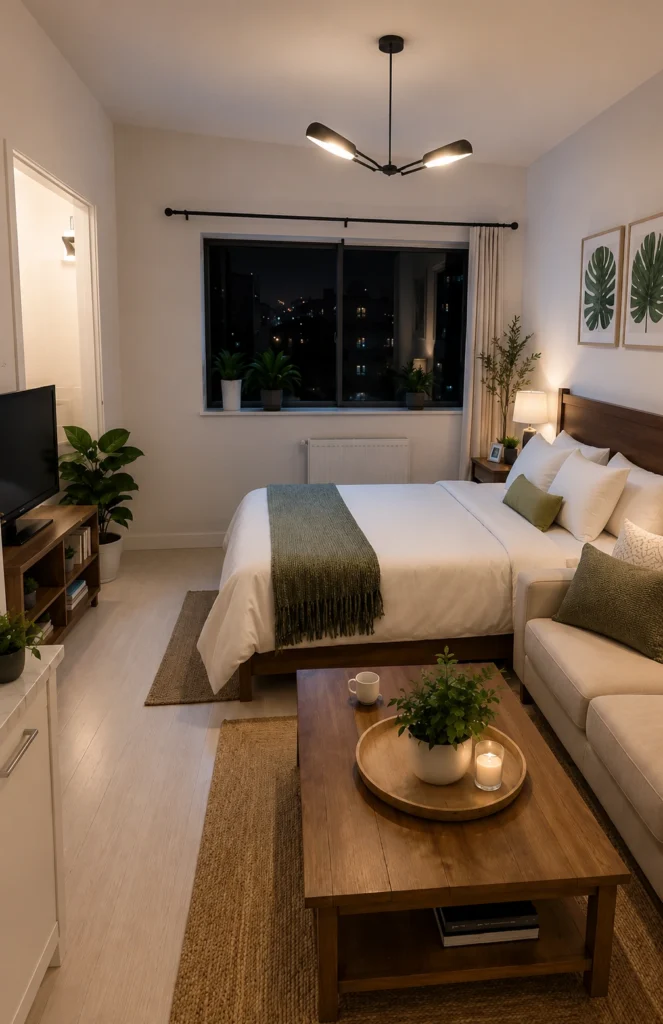
A single overhead light is studio death. It flattens everything, makes the room feel like a waiting area, and gives you exactly one mood: “fluorescent.”
The fix is layered lighting — three or more light sources at different heights, all on warm bulbs (2700K, not the bluish 4000K that comes pre-installed in most rentals).
For a small studio, that means:
- One ceiling fixture for general light (use it less than you think).
- A floor lamp near the sofa for evening reading.
- A bedside lamp on a dimmer or low-watt bulb.
- A candle or two for ambient warmth on the coffee table.
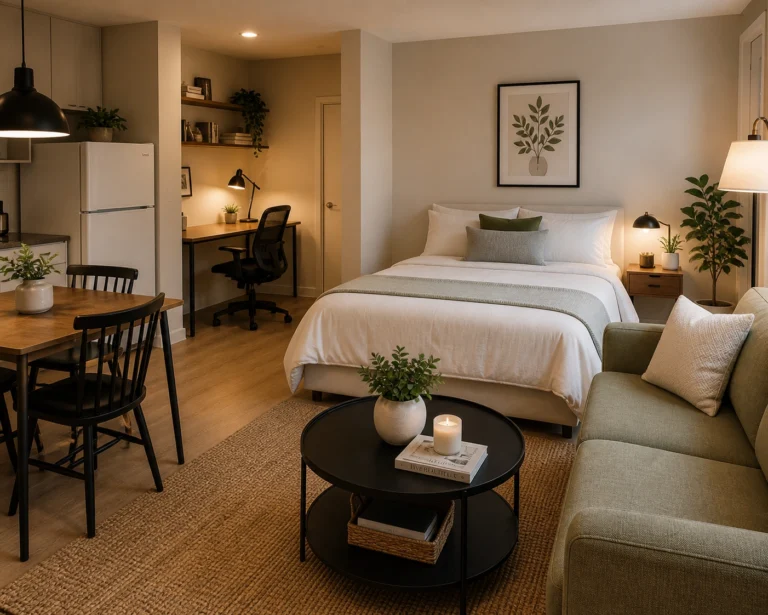
Turn off the overhead at 7 p.m. Switch on the lamps. The apartment in the photo above is doing exactly this, and the difference between daytime and nighttime in that space is night and day. Pun intended.
9. Build in Smart Storage Without Losing Square Footage
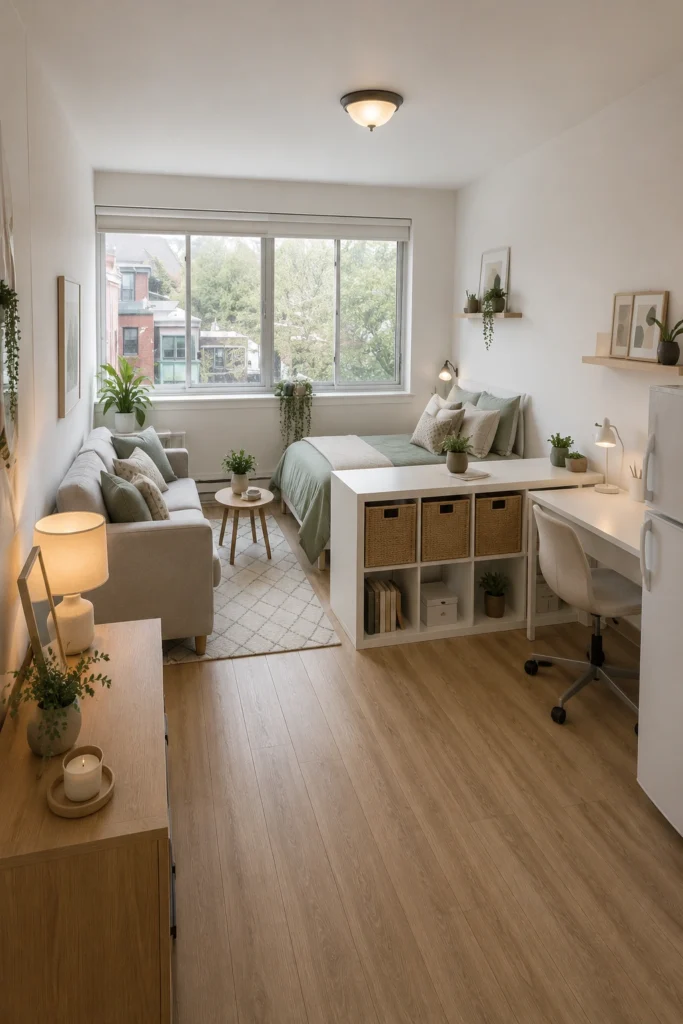
Storage in a studio has to earn its keep twice. It has to actually hold your stuff and it has to look good doing it, because every piece is on display.
A low cube unit running perpendicular to the wall (like the one above) doubles as a soft room divider, a TV stand, and storage for books, baskets, and that tangle of cables nobody talks about. Add three or four matching woven baskets in the lower cubes — instant tidy.
What to avoid: stacks of plastic bins, exposed shoe piles, cords running across the floor. None of it is the end of the world, but in a small space these things scream louder than they would in a bigger room.
Renter-friendly alternative: If you can’t add furniture, use lidded boxes that match your color palette and stack them as side tables. Function plus styling in one move.
10. Let the Plants Do the Work
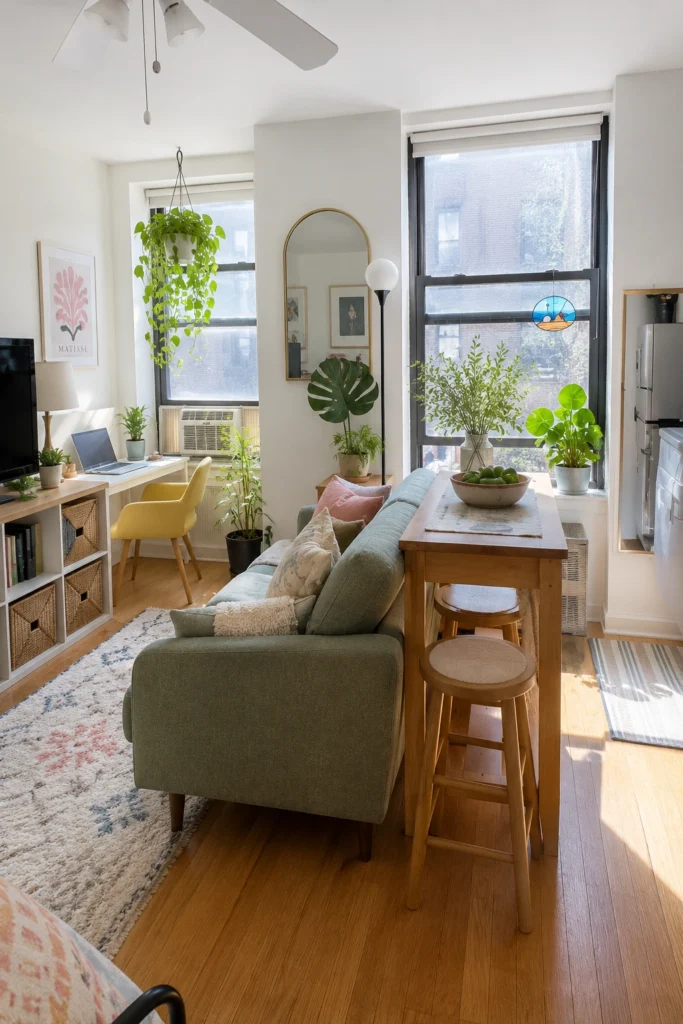
Nothing softens a small apartment like a few good plants. They add height, color, and life — three things hard surfaces and rental-beige walls cannot give you.
A few that genuinely thrive in low-light studios with neglectful watering schedules (mine, for example):
- Pothos — almost indestructible, grows fast, loves hanging from a shelf.
- Snake plant — survives on basically nothing, perfect for dark corners.
- ZZ plant — slow-growing, glossy leaves, forgives missed waterings.
- Monstera — needs a bit of light, but rewards you with huge architectural leaves.
Group plants in odd numbers (three is the magic number) at varying heights. One on the floor, one on a shelf, one hanging. That’s it. That’s the trick the studios that look “Pinterest” are using.
Pro tip: Skip the white plastic nursery pots. Spending fifteen dollars on a textured ceramic or woven planter makes even a cheap supermarket plant look intentional.
11. Make the Bedroom Zone Feel Like a Hotel
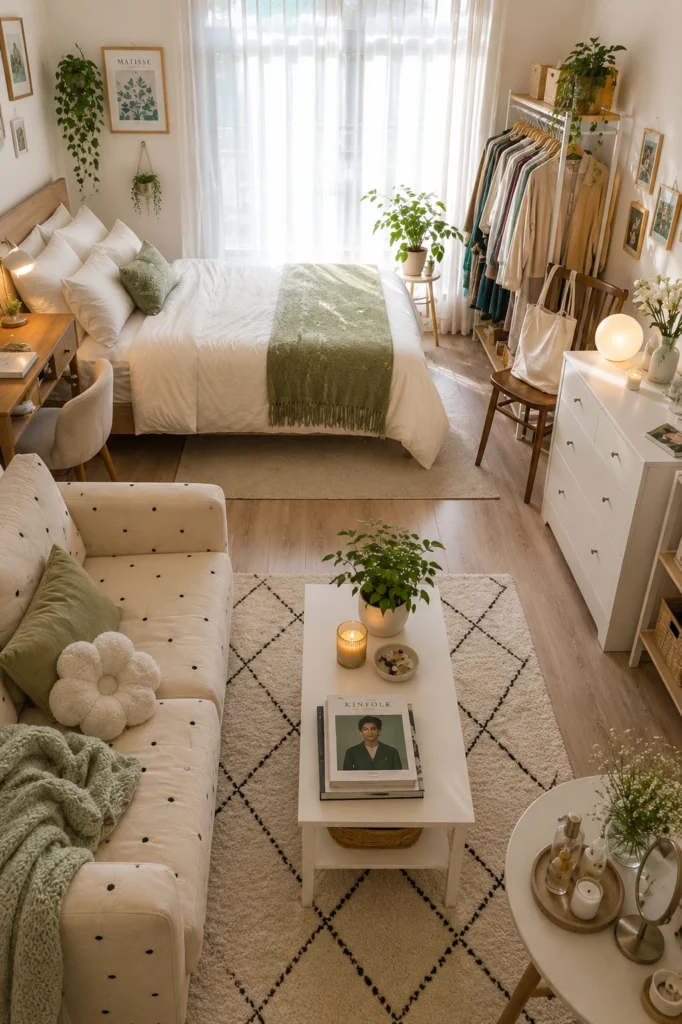
The bed in a studio is going to be seen from your couch, your desk, and the front door. Treat it that way.
The hotel-bed look isn’t complicated:
- White or cream bedding as your base — it always reads clean and elevated.
- One textured throw at the foot in your accent color (sage green, terracotta, mustard — pick one).
- Two or three pillows in mixed textures: linen, knit, a small lumbar.
- Make the bed every morning. Yes, really. It’s the single highest-impact thing you can do for how your studio looks and how you feel walking back into it at 6 p.m.
If you don’t have a closet, a freestanding clothing rack with curated pieces (not all your laundry shoved on hangers) becomes a styling element. Use wooden hangers, all matching. It looks deliberate instead of desperate.
12. Embrace the Bed-as-Furniture Layout
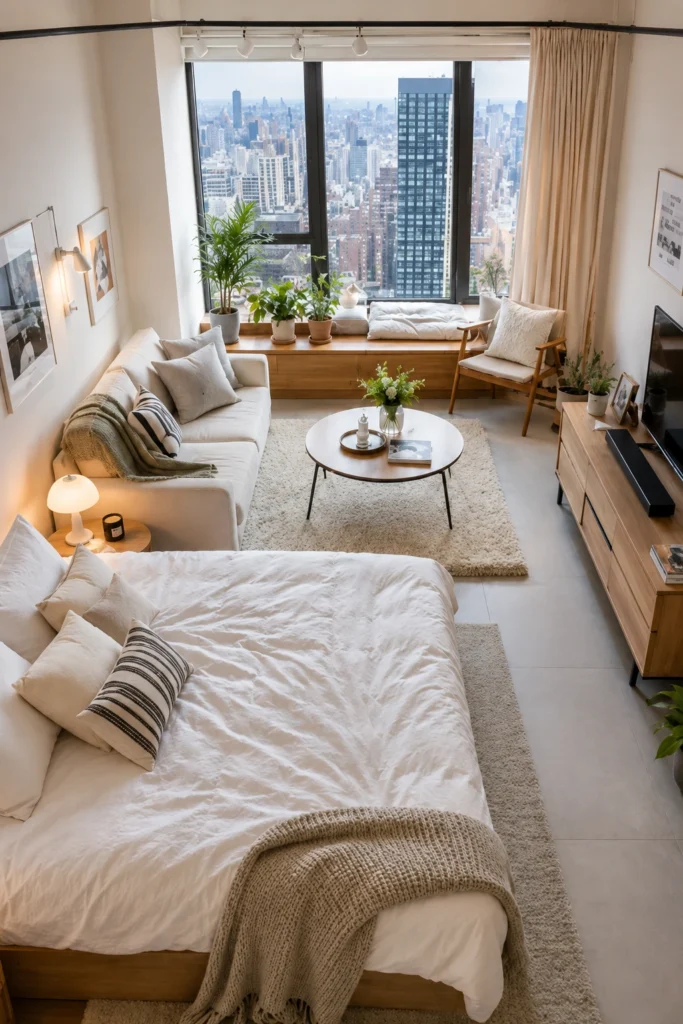
The hardest thing about a studio is the bed. It’s huge, it’s always there, and pretending it isn’t a major design element is how rooms end up looking like a hotel that ran out of money.
Lean in instead. Treat the bed like a daybed, sofa, or extra seating zone. Use crisp white linens, two or three pillows in different textures, and a chunky knit throw at the foot. Suddenly it’s not “the bed in my living room” — it’s a feature.
I lived with this setup in a 400-square-foot place for two years. Friends sat on the bed. I worked on the bed. It was the most-used surface in the apartment, and styling it like furniture made the whole space feel intentional instead of apologetic.
Final Thoughts
A studio isn’t a smaller version of a “real” apartment — it’s its own thing, with its own rules, and the best ones don’t try to hide what they are. They lean into the openness, the light, the closeness of every zone, and turn it into the whole point.
Pick one idea from this list. Just one. Try it this weekend. Move your sofa, swap a bulb, buy a plant. You’ll feel the difference, and once you do, the rest will follow without much effort at all.
A small home isn’t a limitation — it’s a permission slip to keep only what you actually love.