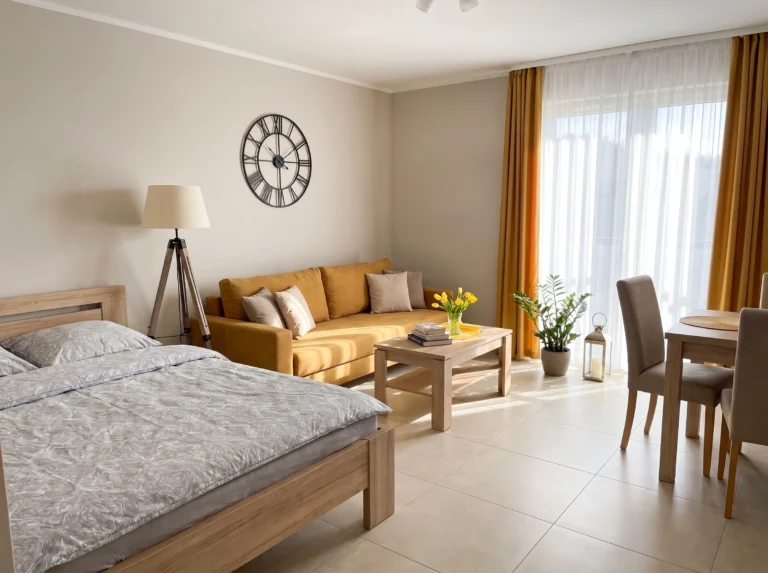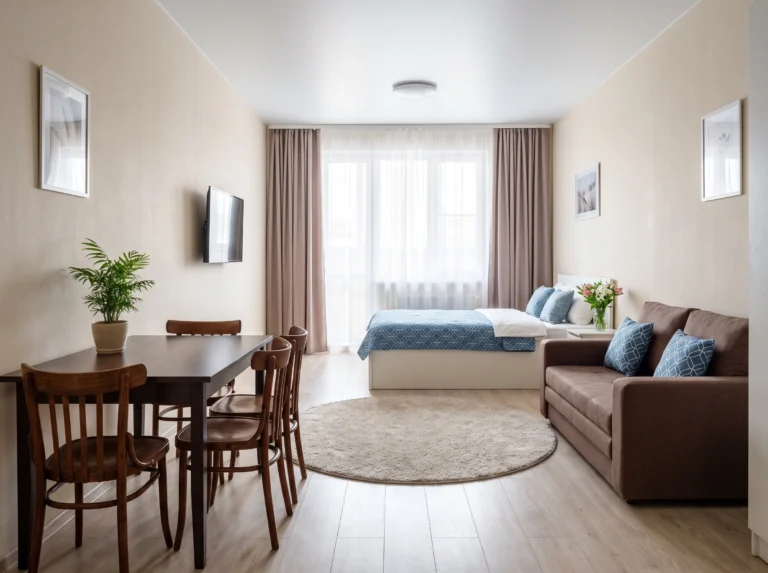
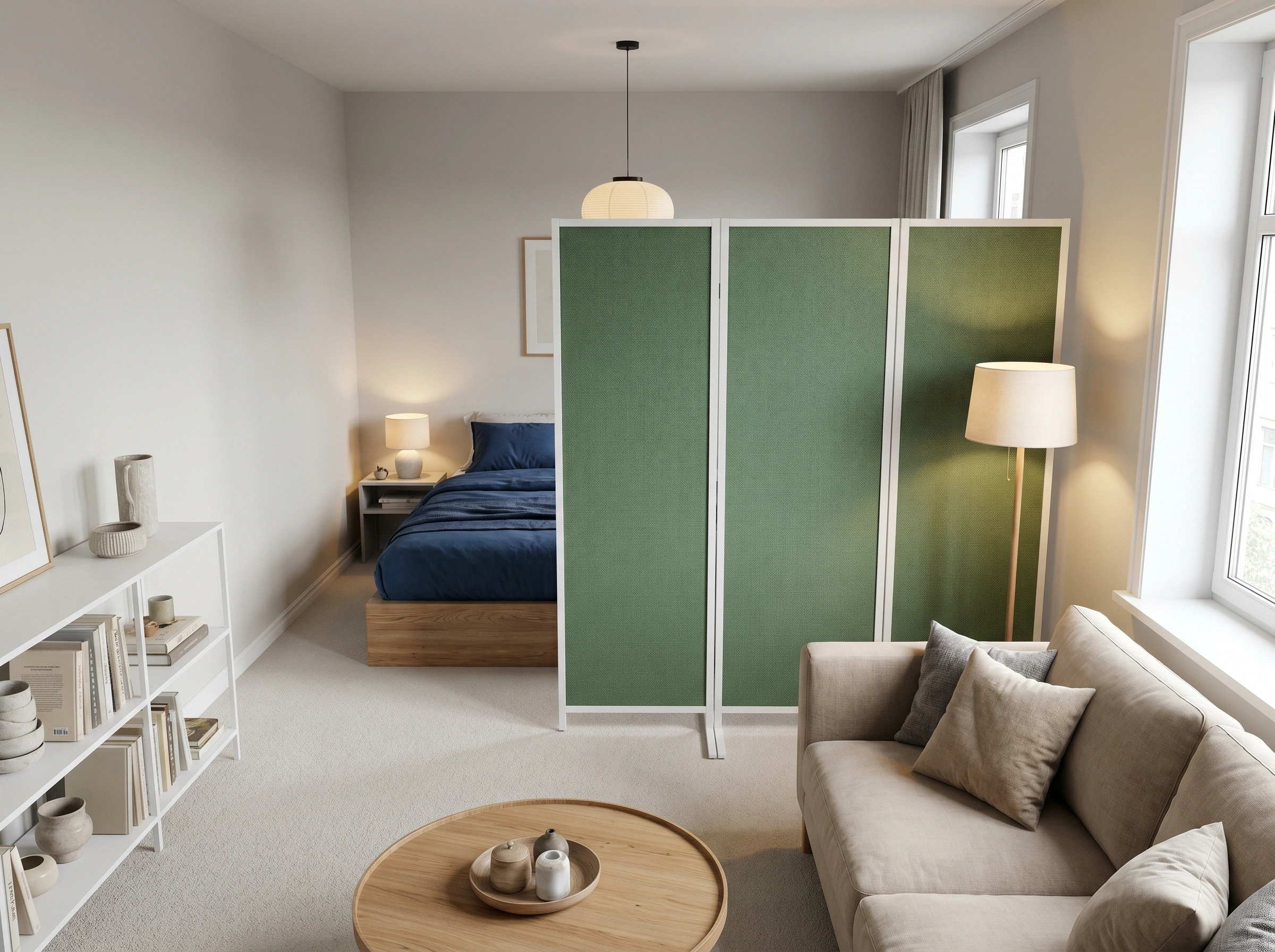
17 Studio Apartment Temporary Divider Ideas That Create Privacy Without Commitment
Living in a studio means every square foot pulls double duty — your bedroom is your living room is your office is your everything. The problem isn’t the space itself. It’s the way it all bleeds together, so you never quite feel like you’ve left work or arrived home. A good divider fixes that. No contractors, no landlord drama, no permanent holes in the walls. Just a boundary that lets different parts of your life breathe.
Here are 17 Studio Apartment Temporary Divider Ideas.
1. The Classic Lattice Screen That Does Everything
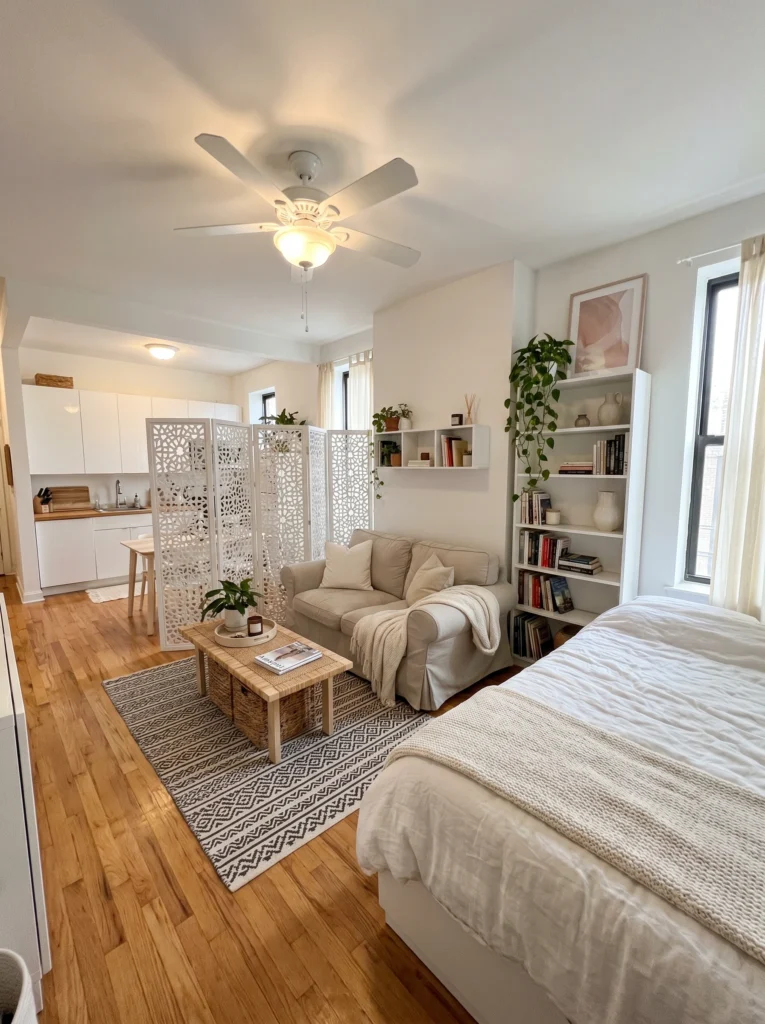
This is the one that started it all for me. A white lattice folding screen like this costs anywhere from $60 to $150 and takes about two minutes to set up. It separates your kitchen from your living zone without blocking light — those cut-out patterns do real work. The bonus: it doubles as a backdrop for plants, wall art, or a trailing pothos. It’s also easy to move and reconfigure as your needs change.
Pro tip: Angle it slightly rather than placing it flat — it’s more stable and looks intentional.
2. The Ceiling-Track Curtain That Looks Like Architecture
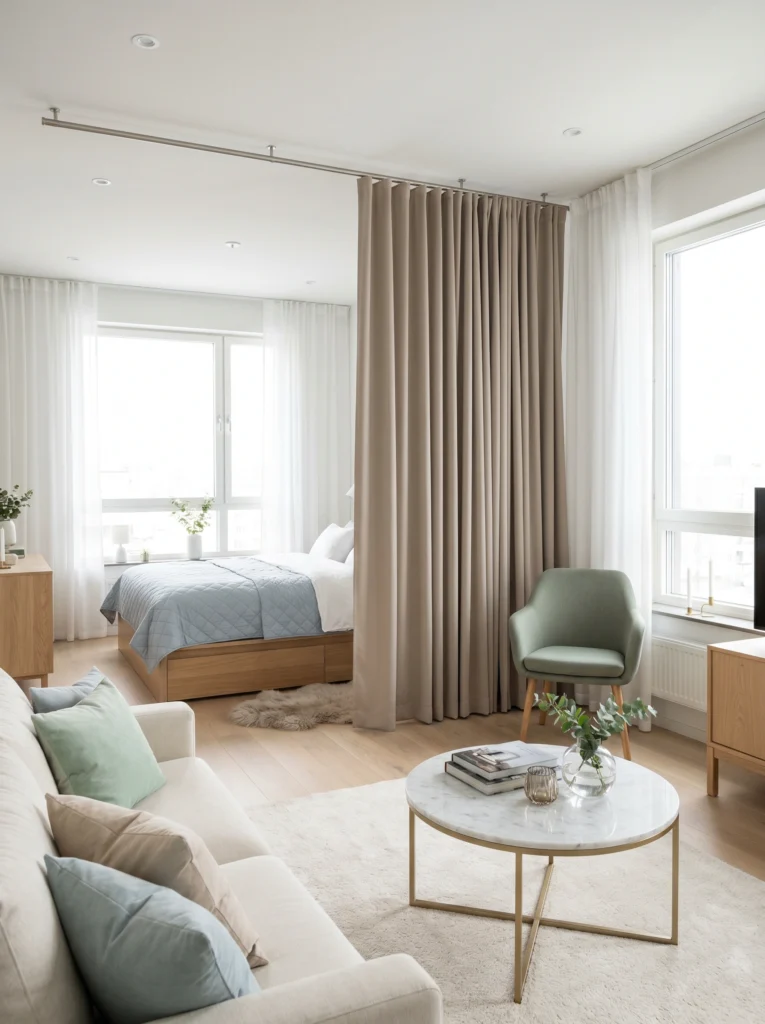
Floor-to-ceiling curtains on a ceiling track are the closest thing to a real wall without actually building one. The taupe linen here does something smart — it matches the bedding, so the division feels designed, not improvised. You can find ceiling curtain track systems for around $40–$80 at most home stores. When the curtain is open, the space feels enormous. When it’s closed, you have a proper sleep enclosure.
Sofia’s honest take: This is my top recommendation for renters who want a long-term solution.
3. The Grey Curtain Alcove With a Statement Wall Behind
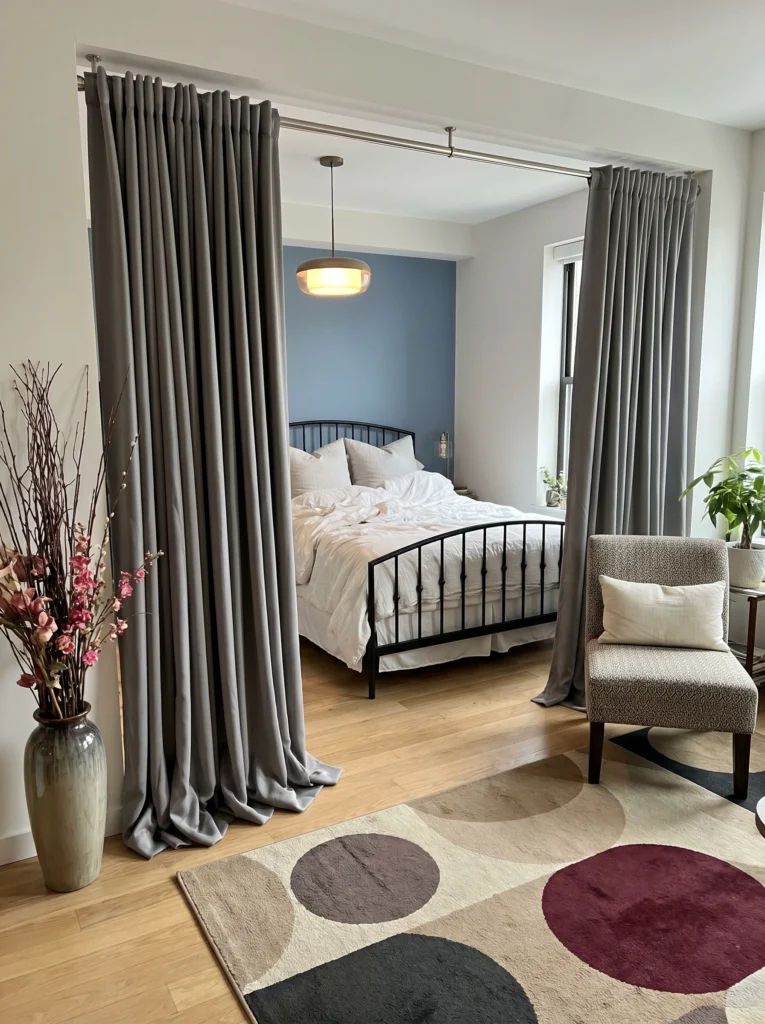
Here’s what happens when you commit to the curtain-as-wall concept: you get to do something interesting with the wall inside the alcove. The blue accent wall in this setup would feel overwhelming in an open studio — but tucked behind grey curtains, it becomes a whole mood. Blackout fabric means the sleep zone stays dark even when light floods the rest of the apartment. Using two curtain panels instead of one also adds fullness and structure.
Renter-friendly alternative: Use peel-and-stick paint panels inside your alcove for color without the commitment.
4. The Lattice Screen as Office Divider
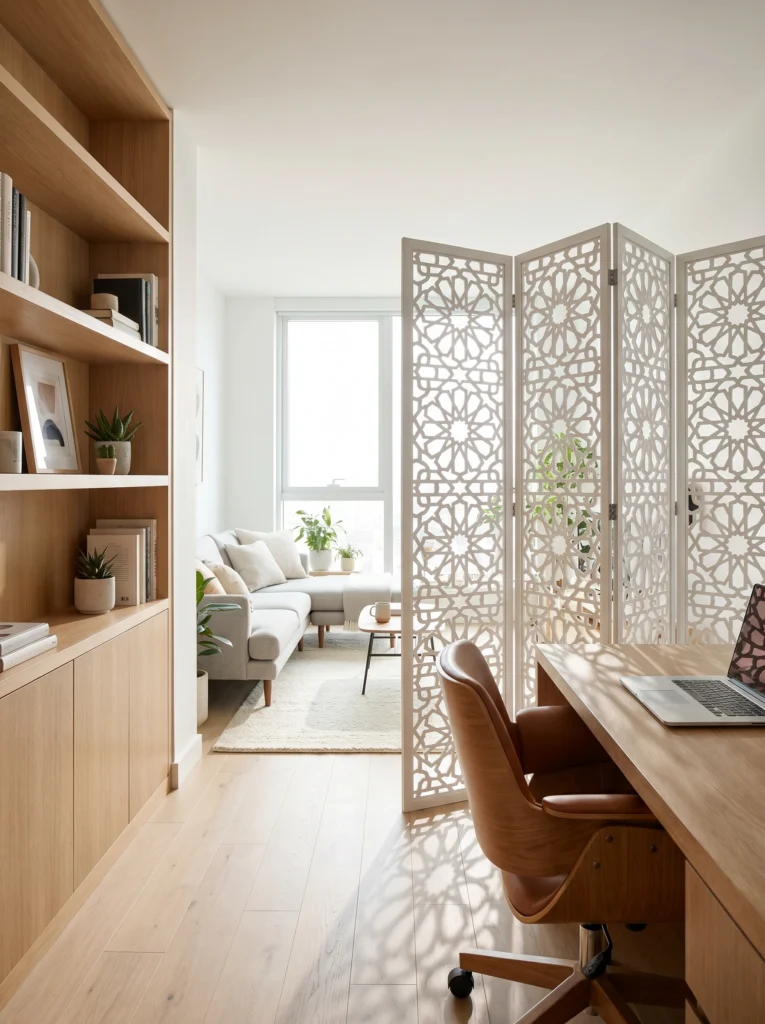
Working from home in a studio is brutal without a boundary. This carved lattice screen does the job beautifully — it says “this is the office side” without shutting out natural light or making the space feel divided in half. Notice how the screen’s shadow patterns fall across the floor: that’s not a flaw, it’s a feature.
Pro tip: Position the screen so your back is to it when you work, not your monitor — you’ll feel more focused and less like you’re on display.
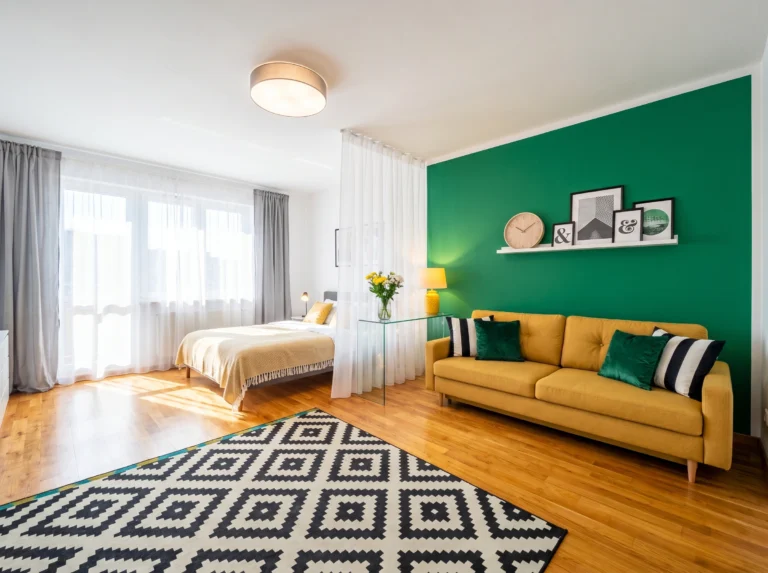
5. The Sheer White Curtain That Keeps Things Airy
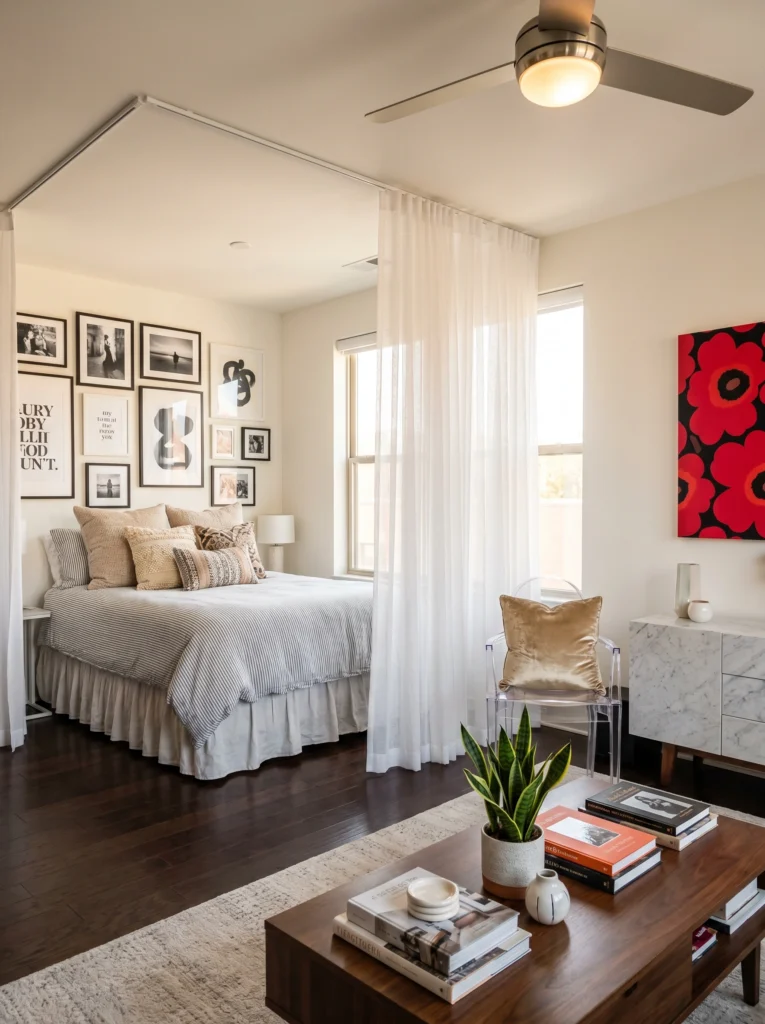
Sheer curtains give you the idea of separation without actually cutting light or sightlines. In a small studio, that matters more than you’d think. The trick this space pulls off perfectly: two completely different visual personalities — a gallery wall and quiet bedding on one side, bold graphic art on the other — and the sheer curtain is what lets them coexist without competing. It’s proof that privacy doesn’t always mean blocking the view entirely.
Save vs. splurge: IKEA HILJA sheers are $15 and hang beautifully. No need to spend more.
6. The Arched Wood Screen With Bohemian Credentials
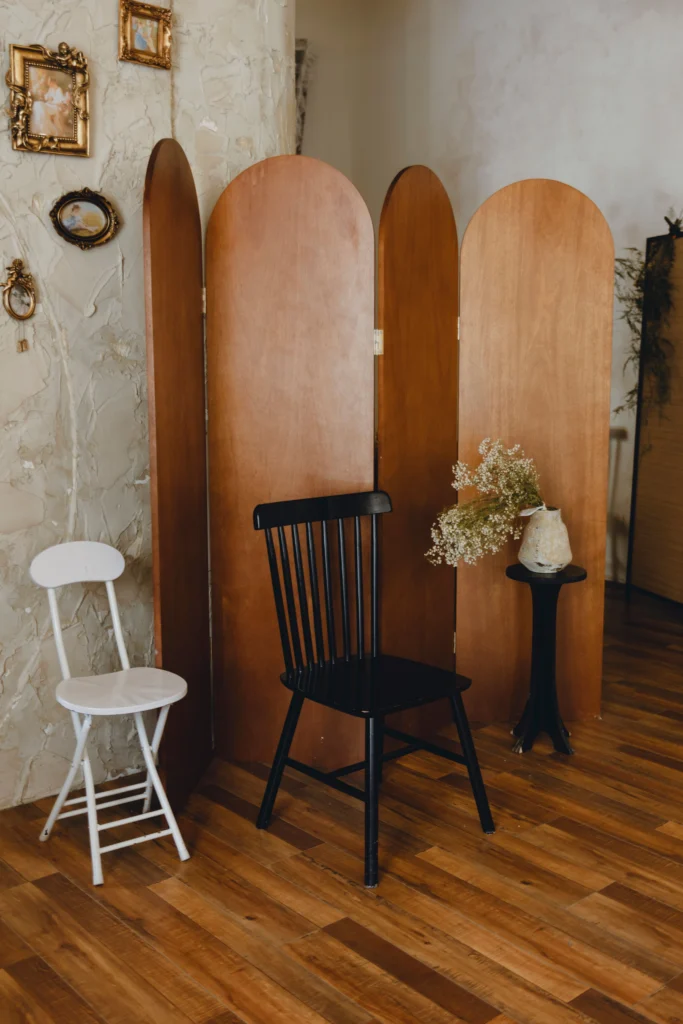
Solid arched wood panels like these bring a sculptural presence that most dividers can’t match. They’re not just functional — they’re the focal point. The rounded tops soften what could otherwise feel like a harsh barrier, and the warm walnut-adjacent tone works with almost every palette from Japandi to maximalist eclectic. These range from $80–$200 depending on height and panel count.
Sofia’s honest take: If you’re only buying one divider, make it a beautiful one. This style earns its floor space every single day.
7. The Upholstered Screen for a Feminine, Romantic Look
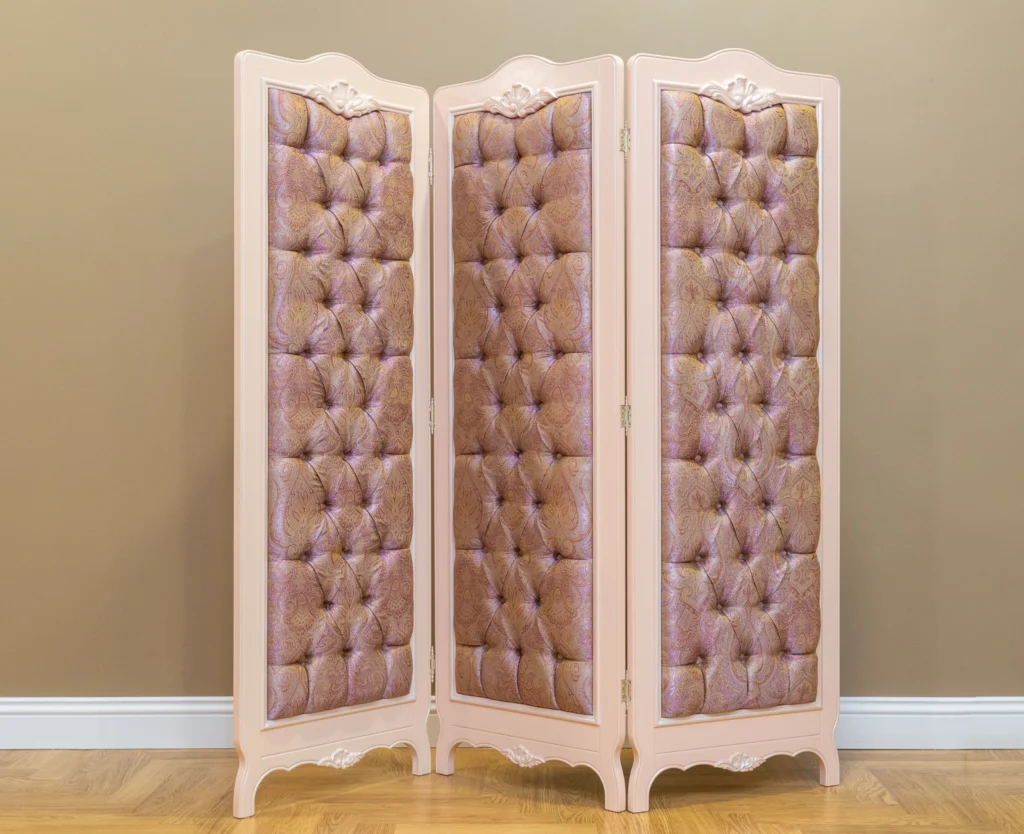
Tufted, upholstered folding screens have a very specific energy — old Hollywood, maximalist boudoir, “I don’t care what’s trending.” If that’s your aesthetic, lean into it completely. The pink lacquer frame with paisley velvet panels here is unapologetically decorative. It won’t give you blackout privacy, but it creates a visual boundary that feels intentional and deeply personal.
Pro tip: Use this type of screen near a dressing area or vanity corner — it earns its visual weight there better than anywhere else in the room.
8. The All-White Sheer Studio Look
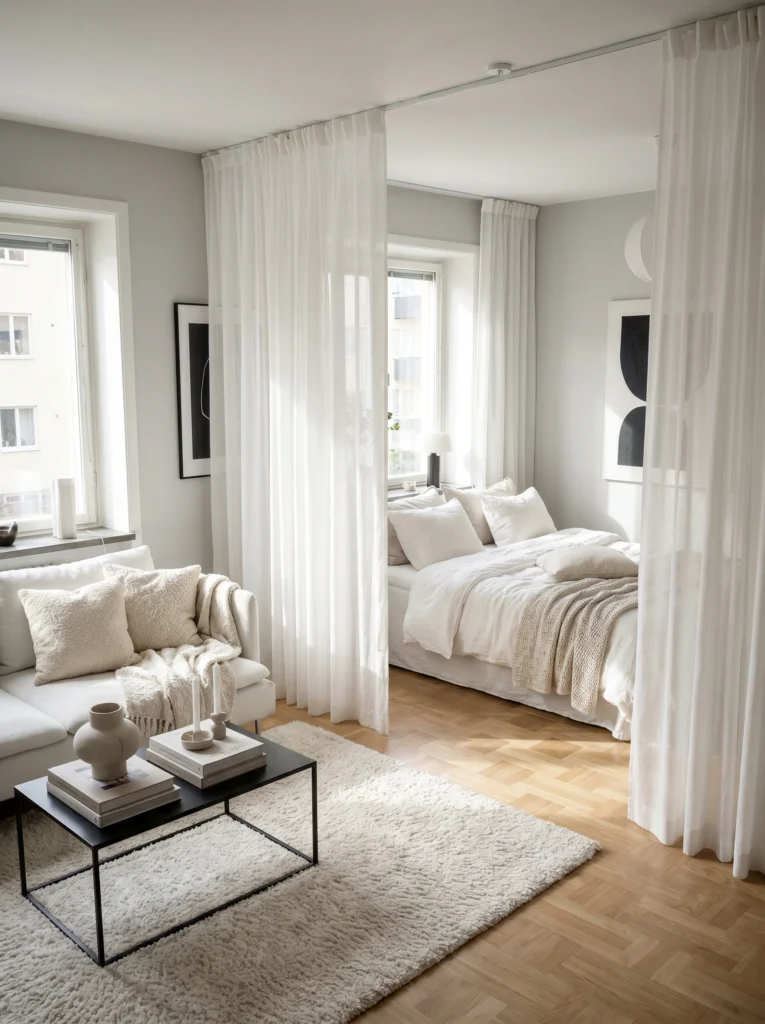
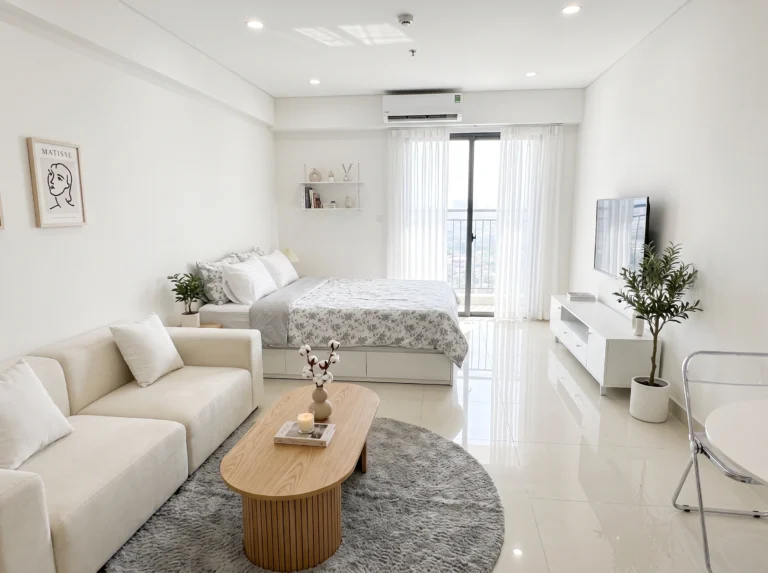
When your whole palette is white and soft grey, a sheer white curtain divider disappears into the space — and that’s exactly the point. This Scandinavian setup uses the curtain not as a feature but as a quiet organizational tool. The bed is visible, softly, through the fabric, which keeps the space from feeling segmented.
Budget vs. splurge: You can recreate this entire look with a $40 KVARTAL ceiling track from IKEA and two panels of white voile fabric. Seriously, this doesn’t have to be expensive.
9. The Rattan Arched Screen That’s Having a Moment
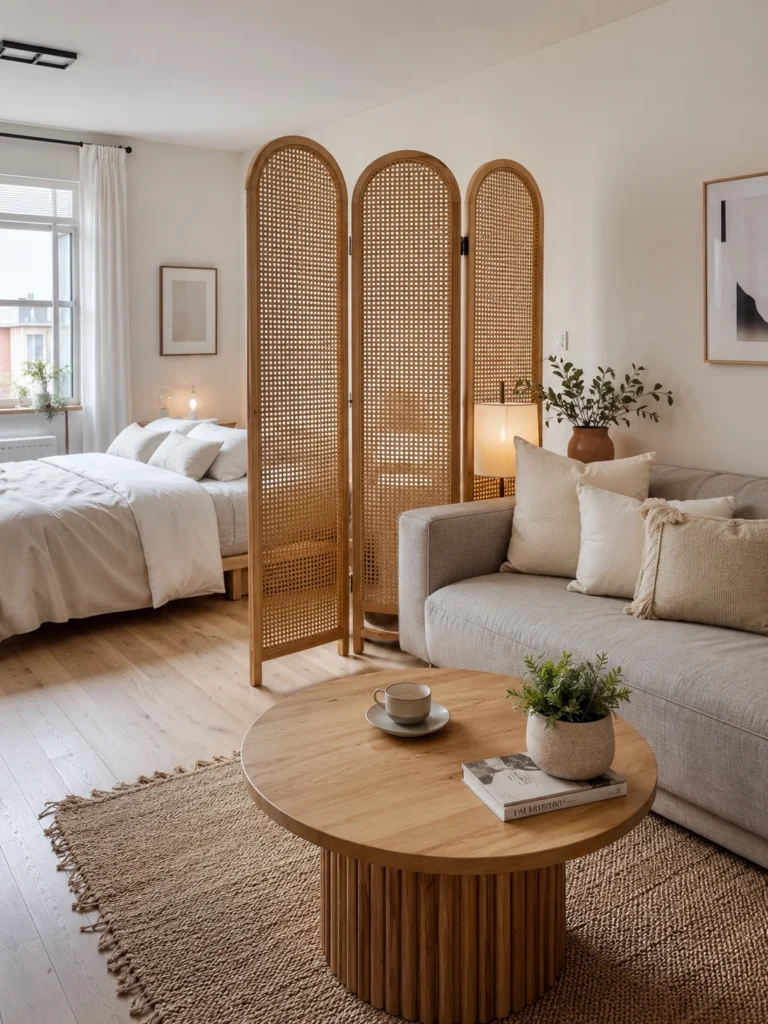
Rattan and cane folding screens are everywhere right now, and honestly, the hype is earned. The arched tops feel more architectural than a standard rectangular screen, and the woven panels let light filter through in a warm, dappled way that feels almost like being outdoors. In this studio, the rattan screen bridges the natural wood coffee table and the linen sofa perfectly. Expect to spend $100–$180 for a quality version.
Pro tip: Position a lamp just behind the screen to cast warm shadows through the weave at night.
10. The Soft Curtain Divider for a Cozy Evening Look
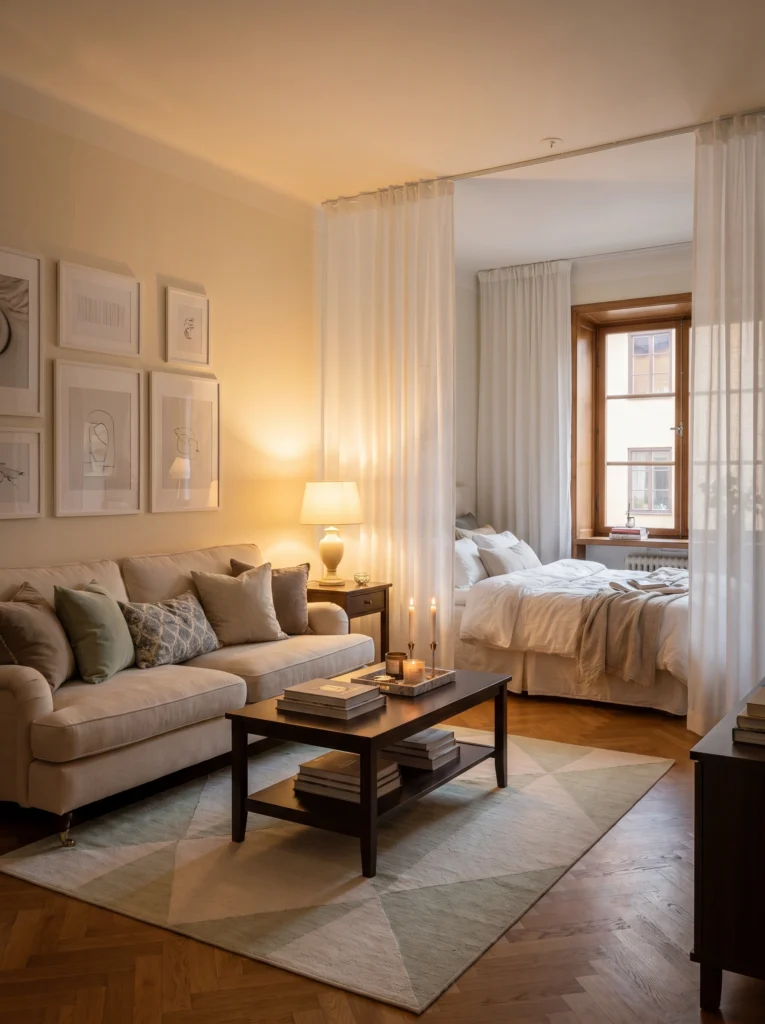
There’s something about a sheer curtain glowing in warm lamplight that makes a studio feel like a proper home. This setup proves it: the curtain here isn’t doing heavy lifting in terms of privacy, but it signals a transition between living and sleeping that matters psychologically. Combined with a gallery wall and candlelight, the living side feels complete on its own terms.
Sofia’s honest take: Half the battle of studio living is mental. A divider tells your brain the spaces are different, even when they’re not.
11. The Dark Curtain That Divides Two Sleep Zones
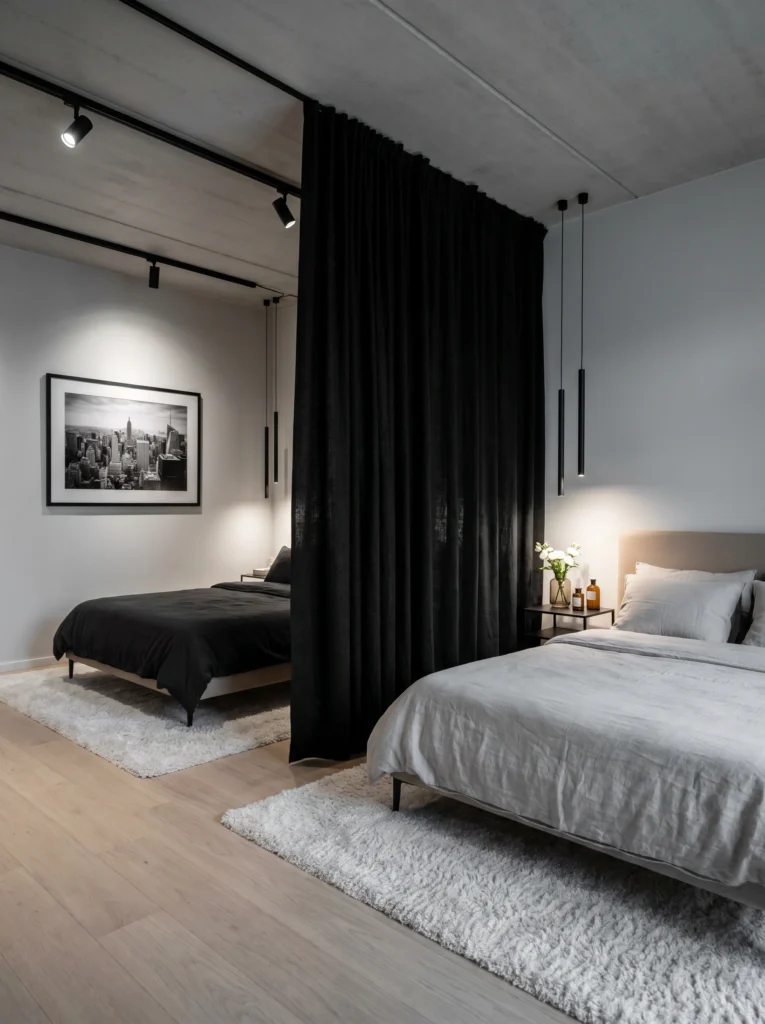
Roommates in a studio? This one’s for you. A single black curtain on a ceiling track creates two genuinely private sleep zones in an open loft — completely without construction or landlord permission. The industrial track lighting here works with the dark fabric to make the division feel deliberate and cool, not desperate. Blackout curtains on a ceiling track run about $50–$120 total.
Pro tip: Each side gets its own rug to reinforce the visual separation even when the curtain is open during the day.
12. The Luxury Curtain Wall in a High-Rise Studio
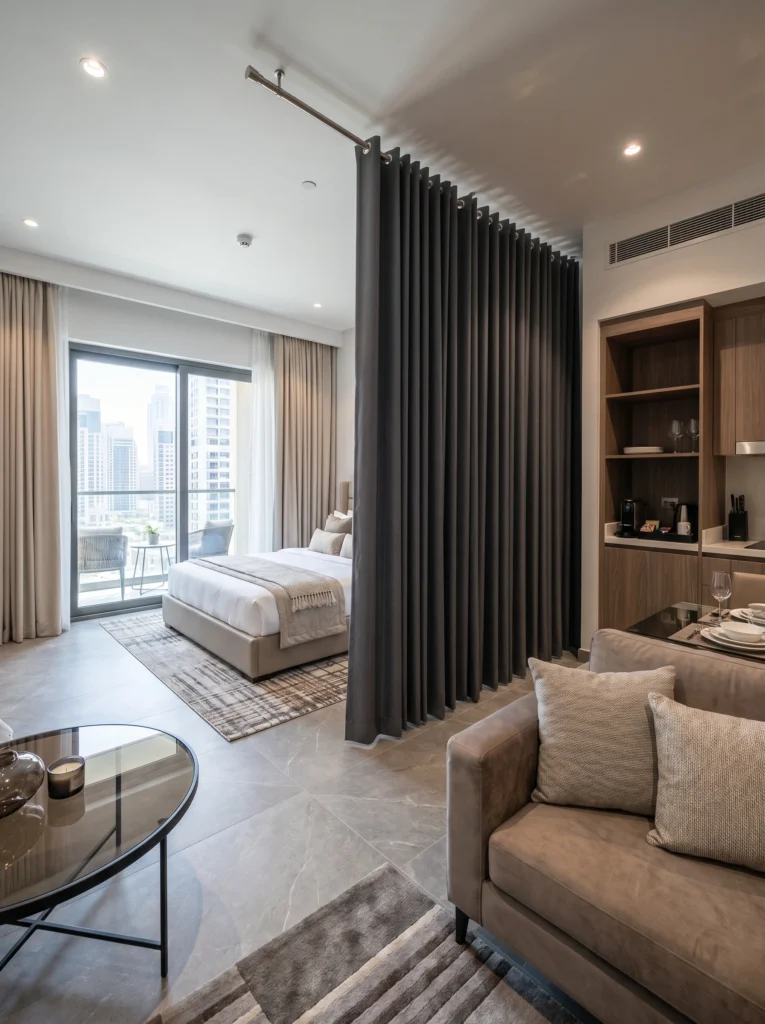
When the apartment itself is polished — marble floors, city views, recessed lighting — the divider needs to match that energy. This dark charcoal curtain does it with authority. Heavy, floor-to-ceiling, grommet-topped: it reads as hotel-level privacy, not “I needed to hide my bed somewhere.” The key is fabric weight and fullness. A flimsy curtain in a sleek apartment looks like an afterthought you haven’t gotten around to fixing.
Save vs. splurge: Spend on the fabric quality, save on the track hardware itself.
13. The Louvered Screen With Plants That Breathe Life In
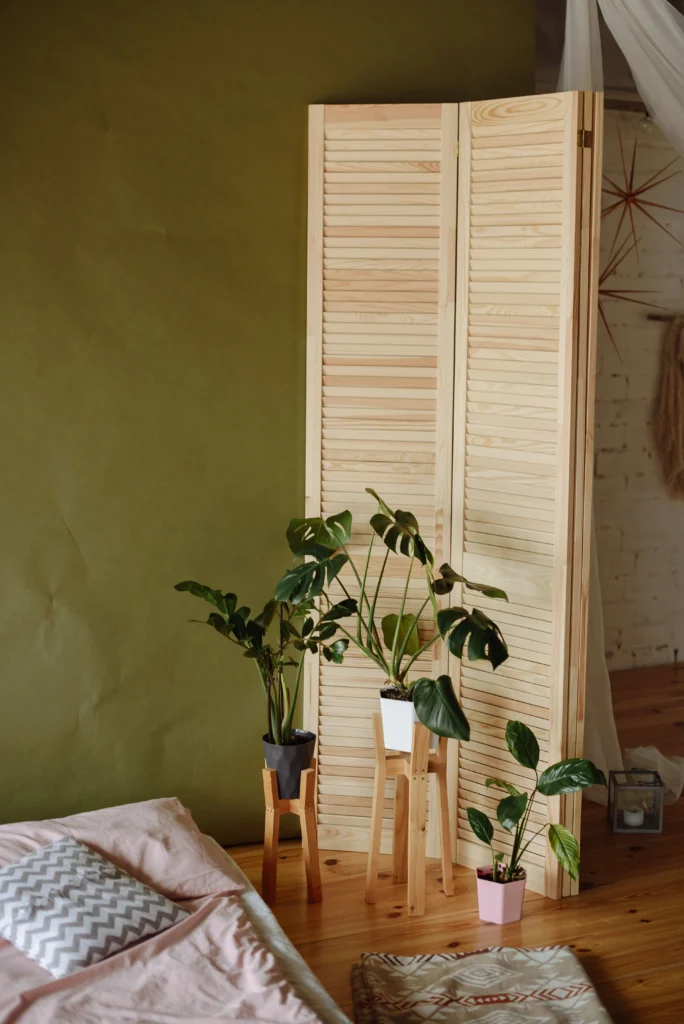
Louvered wood screens have a quiet, almost architectural quality — and the slatted design makes them natural companions for plants. In this setup, a cluster of monsteras and tropical greens turns the screen into something between a divider and a garden. The olive green wall ties it together. A basic louvered pine screen starts at around $50–$90.
Renter-friendly alternative: Stain or paint the screen before you set it up — the raw pine takes color beautifully and you can customize it to match your exact palette.
14. The Dramatic Upholstered Screen for Dark Maximalists
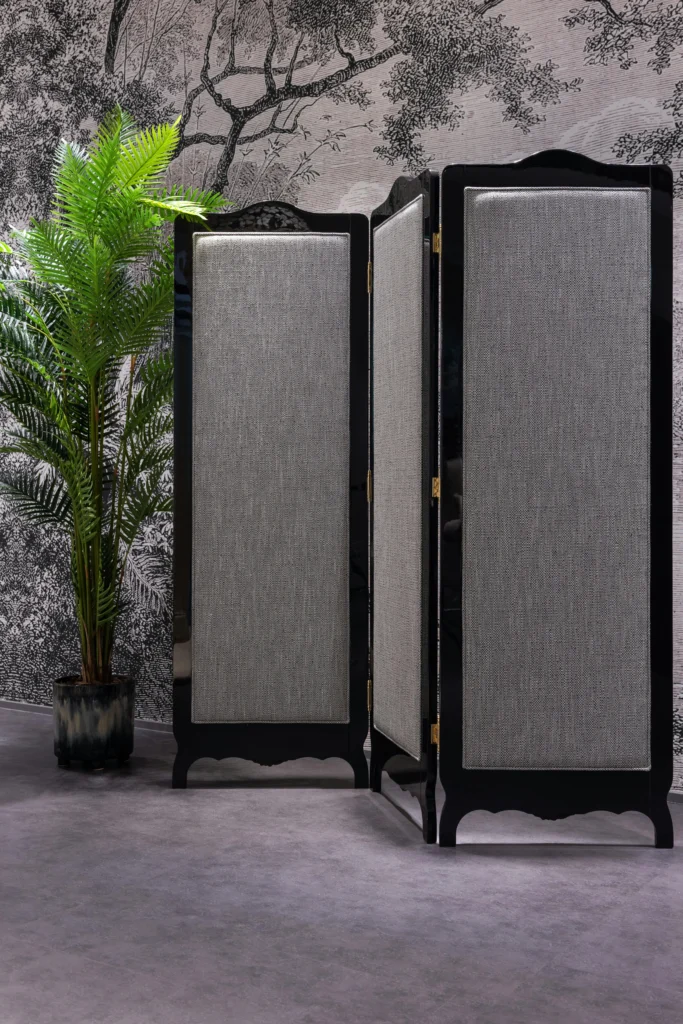
This is the upholstered screen for people who don’t do soft and pretty. Black lacquer frame, grey linen panels, gold brass hinges, and a dramatic toile mural behind it — the whole vignette is a complete design statement. If your studio leans dark and editorial, a screen like this works harder than a curtain because it holds its own as a standalone object. Expect $150–$300 for this quality.
Sofia’s honest take: Worth every cent if it matches your aesthetic. Completely wrong if it doesn’t.
15. The Bamboo Slatted Screen With a Natural Finish
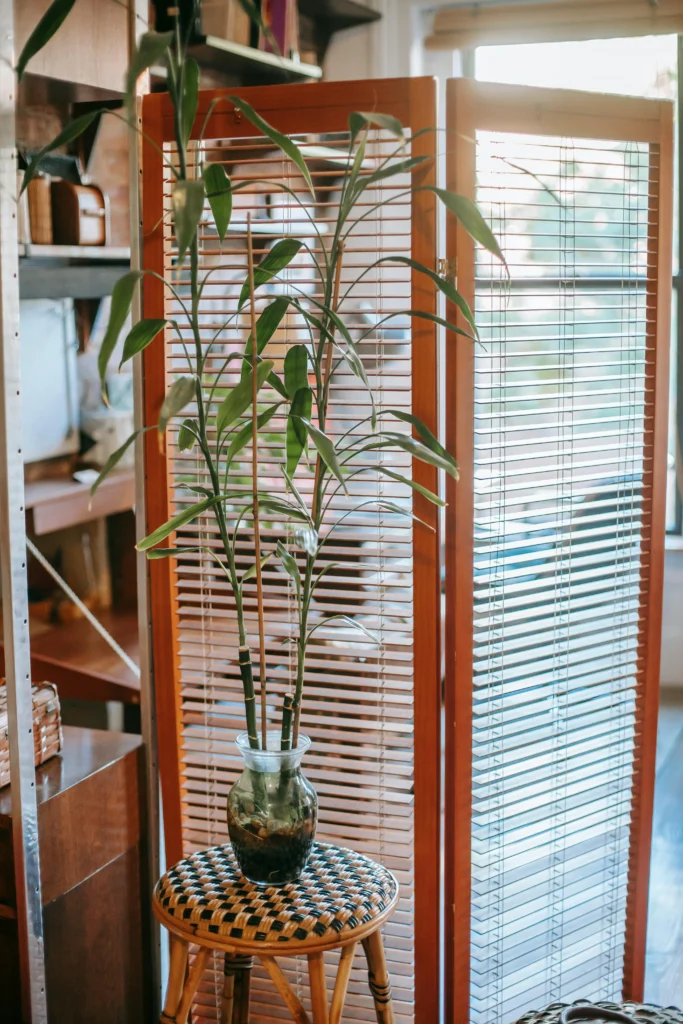
Bamboo and rattan screens bring organic texture to a space that synthetic materials simply can’t replicate. The slatted construction here lets light pass through while still marking a boundary — and paired with actual bamboo growing in a glass vase, the whole corner becomes a little moment of nature. These screens are often the most affordable option, running $35–$80.
Pro tip: Lean it against a bookshelf or wall for extra stability rather than free-standing it — bamboo panels can be top-heavy in lighter builds.
16. The Fabric Screen as a Dressing Nook
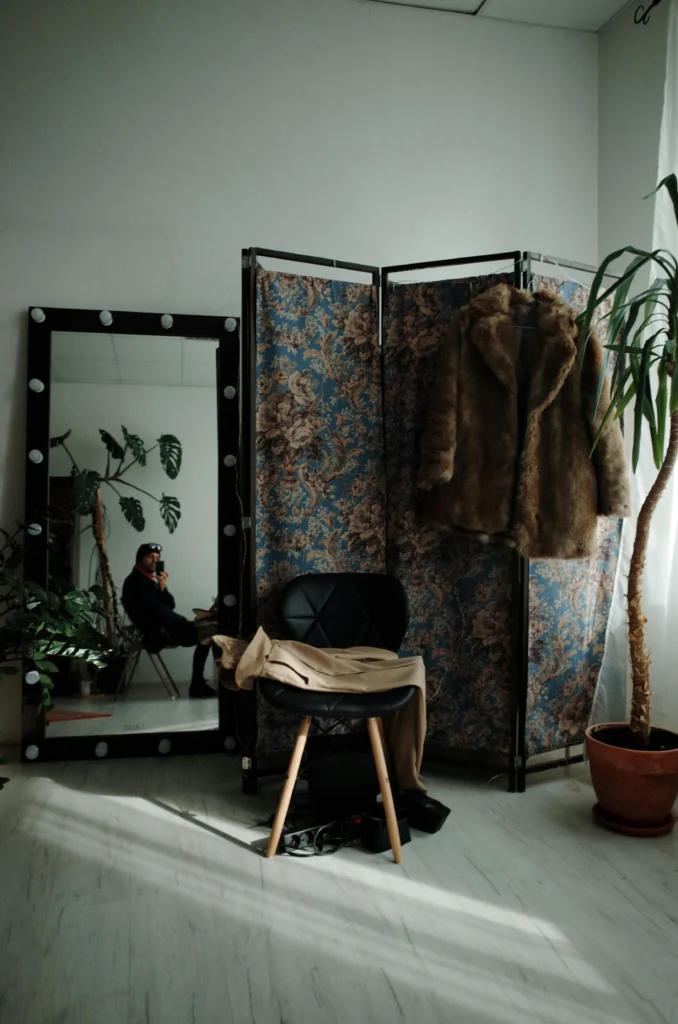
Here’s a use most people don’t think about: putting a folding screen to work as a dressing area divider rather than a room separator. In a studio, having somewhere to change that isn’t right there in the open matters — especially if you have a partner, a roommate, or just value a little morning ritual of your own. A fabric-panel screen costs $50–$100 and creates a private corner instantly.
Pro tip: Hang a small hook on the frame for tomorrow’s outfit. Function and privacy at once.
17. The Louvered Pine Screen With Wicker Accessories
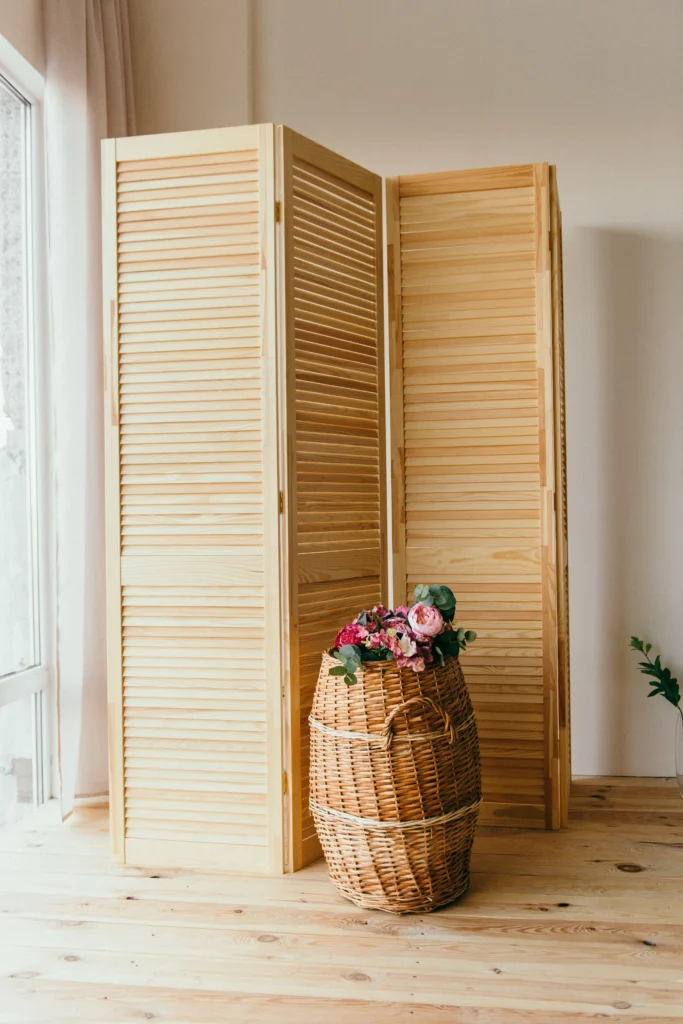
Simple, bright, and utterly flexible — a raw pine louvered screen is the blank canvas of dividers. Paint it white and it disappears into a minimal space. Leave it natural and it adds warmth. Stain it dark and it anchors a moody corner. The wicker baskets here add storage function right at the base, which is a smart use of a zone that often goes to waste. At under $70 for most versions, this is the easiest starting point.
Renter-friendly alternative: Raw pine already photographs beautifully and pairs with everything — no paint needed.
Final Thoughts
The right divider doesn’t just divide — it defines. It tells your brain that this corner is for sleeping, that one is for working, and this one is for actually relaxing. That psychological boundary is worth more than most people realize when you’re living in a single open room.
You don’t need a big budget or a permanent solution. Pick the idea that made you stop scrolling — then go get it.
A studio apartment without zones is just a room. Add a divider, and suddenly it’s a home.