17 Studio Apartment Shelf Decor Ideas That Instantly Reduce Clutter
Living in a studio means your shelf isn’t just a shelf — it’s a wall, a divider, a personality test, and half your storage solution. The good news? When you style it right, one bookshelf can do the work of an entire room. Here are 17 setups I keep coming back to, each one tested by someone actually living in a small space.
1. Style Your Shelves Around One Color Story
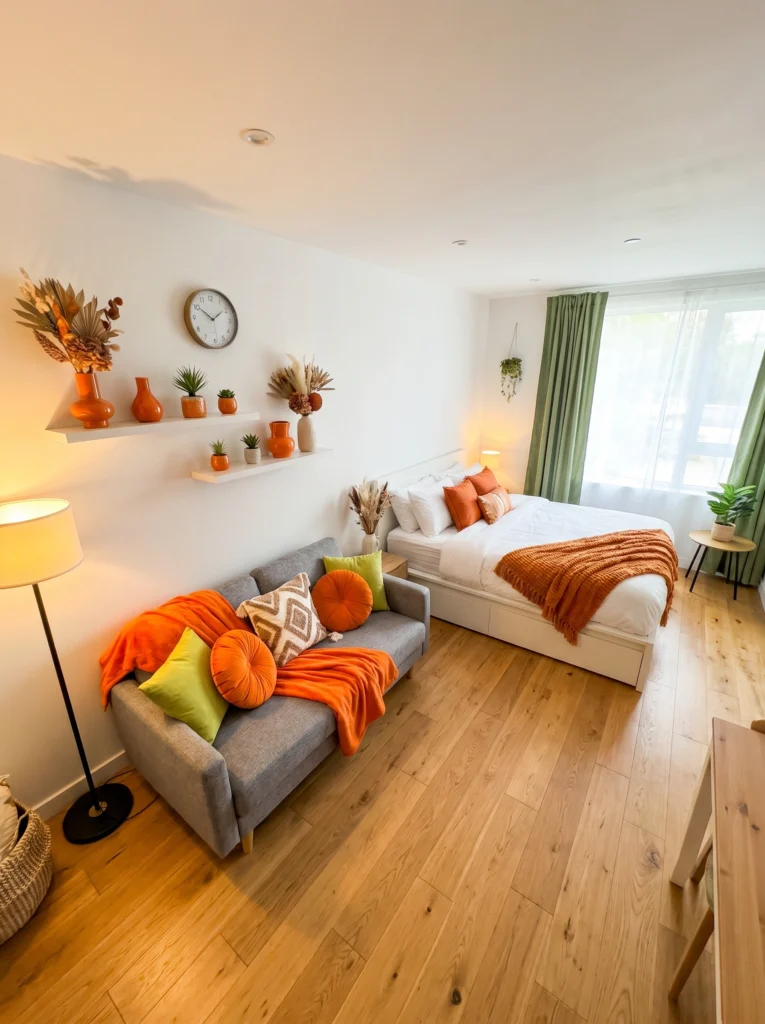
Here’s the thing about shelf styling: most people mix too many colors and wonder why it looks busy. Pick one anchor color and build around it. In this studio, every shelf object is orange, rust, or terracotta — with small green succulents for contrast. The result is a display that reads as intentional art, not random stuff. White walls and a single wall clock keep it from feeling heavy. One color story, total cohesion.
Don’t waste your money on: Shelf styling kits or “decor sets.” Buy three things in your color and edit from there — less is always more on a shelf.
2. Let a Bookcase Work as a Room Feature
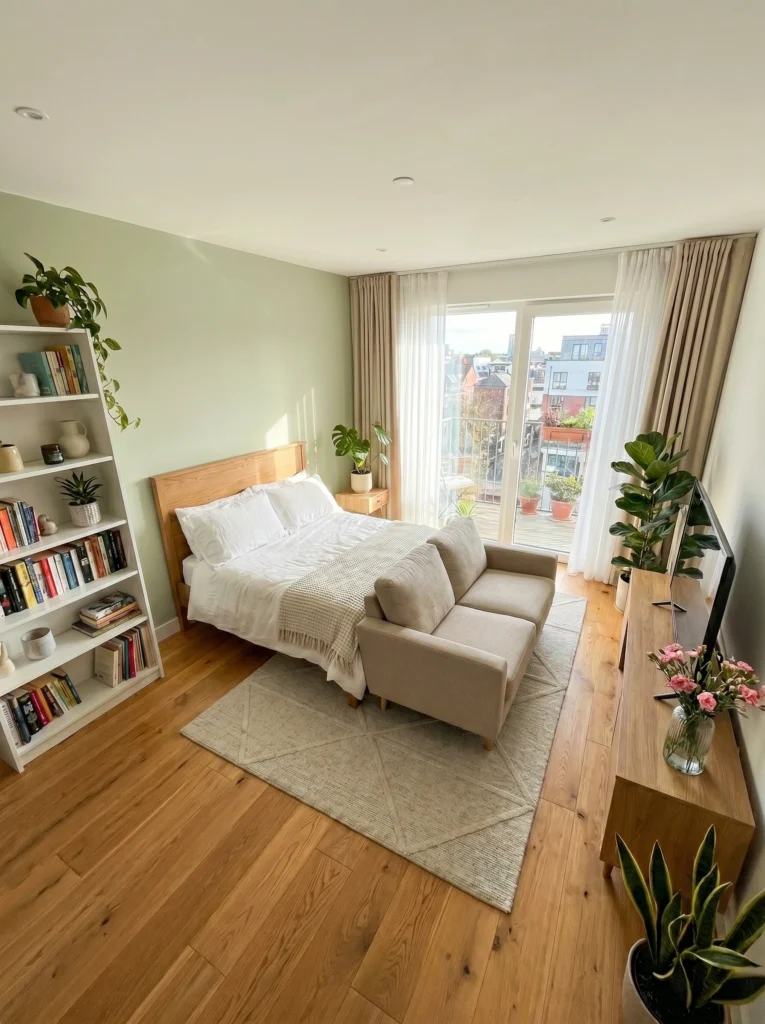
A full-height bookcase does two things at once: it stores everything and becomes a focal wall. Here, a white BILLY-style unit against sage green paint holds books spine-out by color, a trailing pothos, and a few ceramics. It looks like a design choice, not a storage solution. The key is leaving some shelves deliberately open — breathing room between objects is what separates a styled bookcase from a cluttered one.
My favorite: Group books by spine color in one section and face-out in another. It adds visual rhythm without buying anything new.
3. Go Floor-to-Ceiling for Maximum Impact
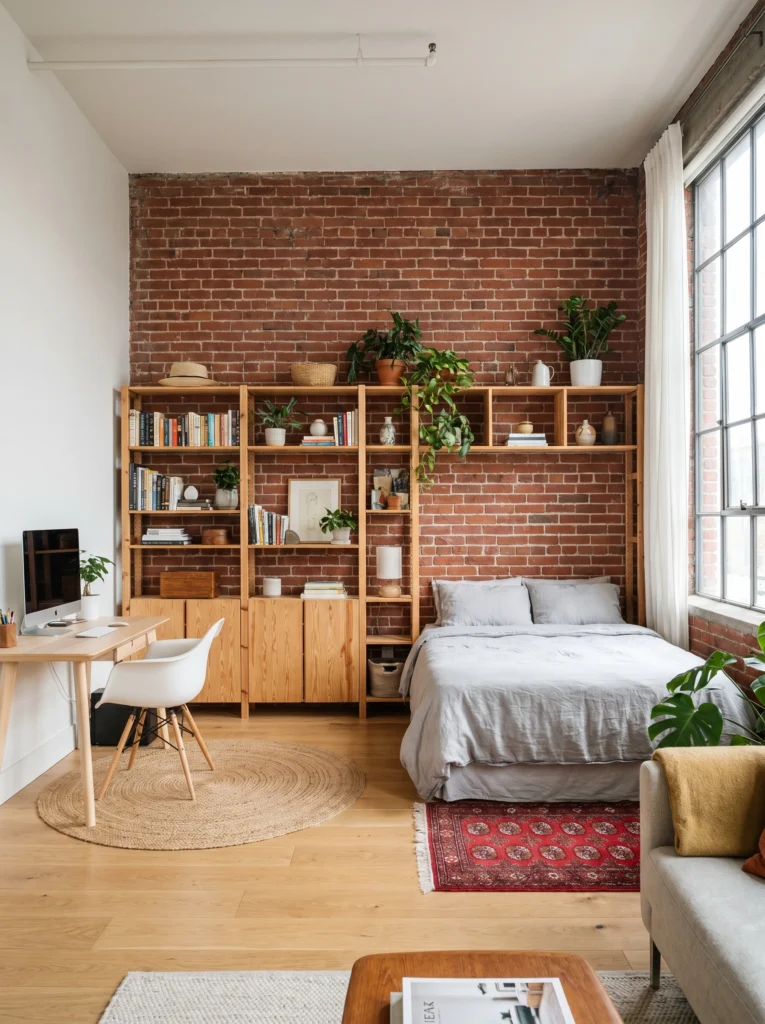
When you go all the way to the ceiling, a shelf unit stops being furniture and becomes architecture. This loft does it beautifully — three wooden units lined up against exposed brick, holding books, trailing plants, baskets, and ceramics across multiple heights. Nothing feels crammed because the scale is generous. In a studio, a shelf wall like this replaces a dresser, a bookcase, and a display cabinet simultaneously. One wall, all the storage.
Pro tip: Anchor tall freestanding shelves to the wall with an anti-tip strap ($8 at any hardware store). Non-negotiable if you’re going floor-to-ceiling.
4. Tuck a Shelf Nook Into a Forgotten Corner
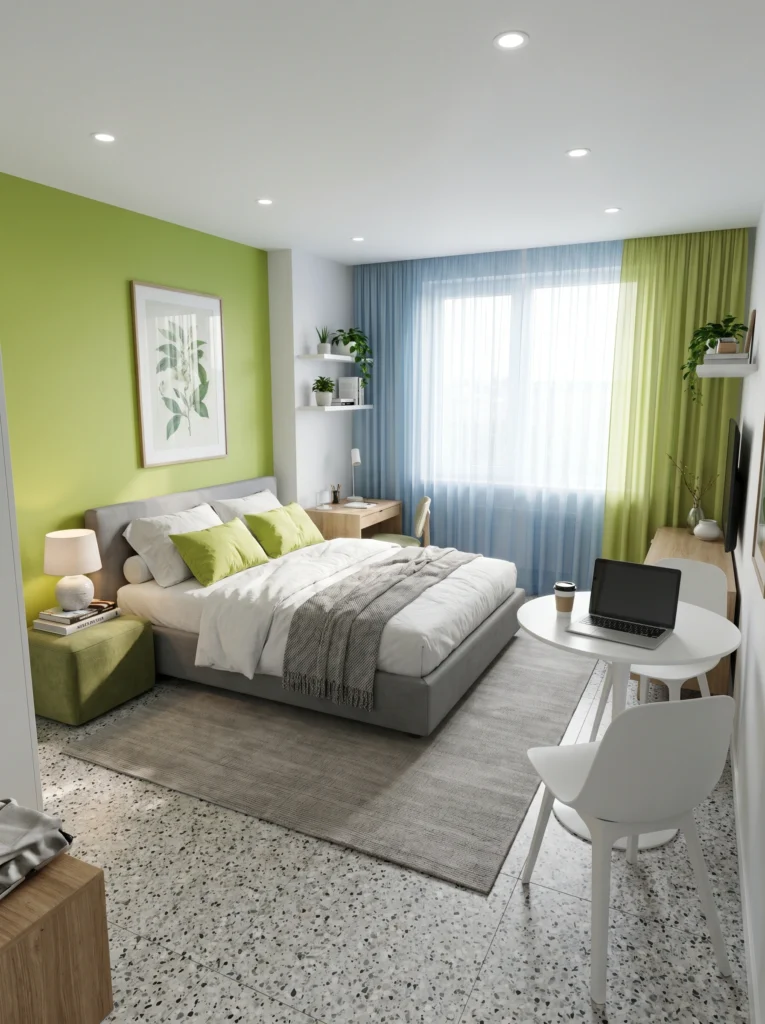
Corner shelves are the most underused square footage in any studio. Two or three staggered floating shelves in a corner handle plants, small books, and a speaker without touching your main wall space. In this studio, the corner behind the bed becomes a mini shelf nook — plants at different heights, a small lamp below, botanical art above. It makes the corner feel purposeful instead of empty. Small effort, outsized result.
Sofia’s honest take: Corner shelves from IKEA (LACK corner shelf, ~$20) look far more expensive than they are. Style with one plant and two objects — don’t overcrowd them.
5. Use Floating Shelves to Store Up, Not Out
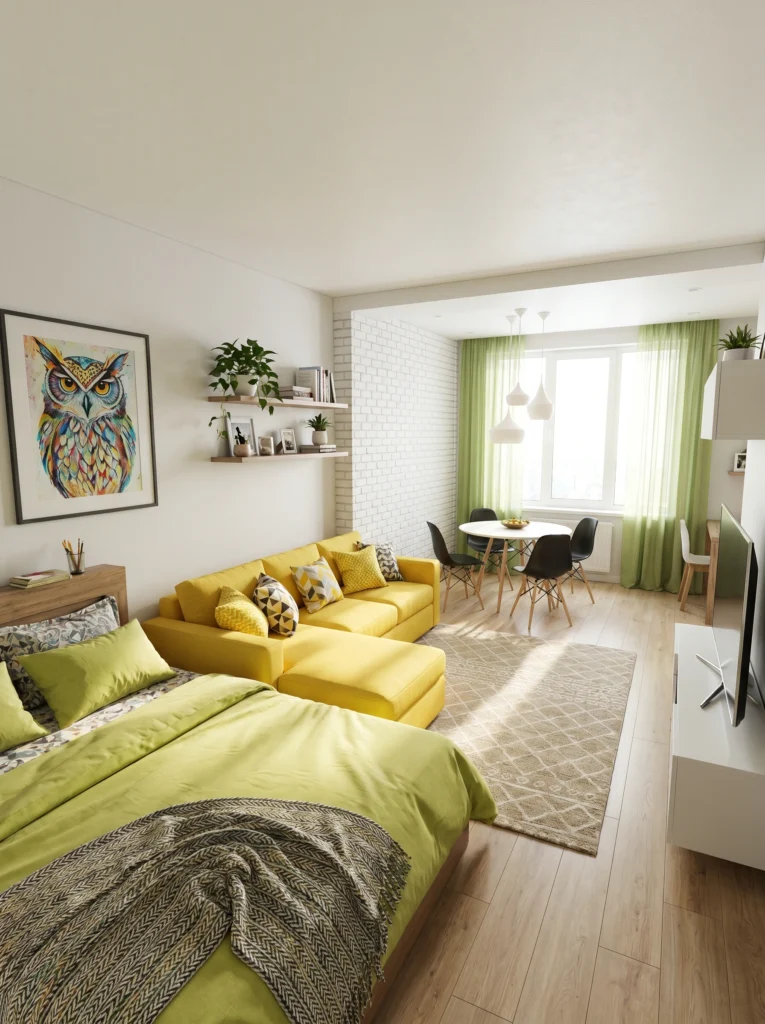
Floor space is precious. Wall space is free. Floating shelves stacked vertically keep books, plants, and small decor off every surface below — and the room feels open because your eye sees clear floors. Style them with intention: group plants together, spine-face books you actually want to see, add one small object per shelf. Crowded shelves just move clutter upward. Curated shelves make a studio feel like a real home.
Budget vs. splurge: IKEA LACK shelves ($8 each) hold up to 22 lbs and look clean in any style. Splurge on solid wood only if they’re going somewhere permanent.
6. Choose a Storage Bed and Never Look Back
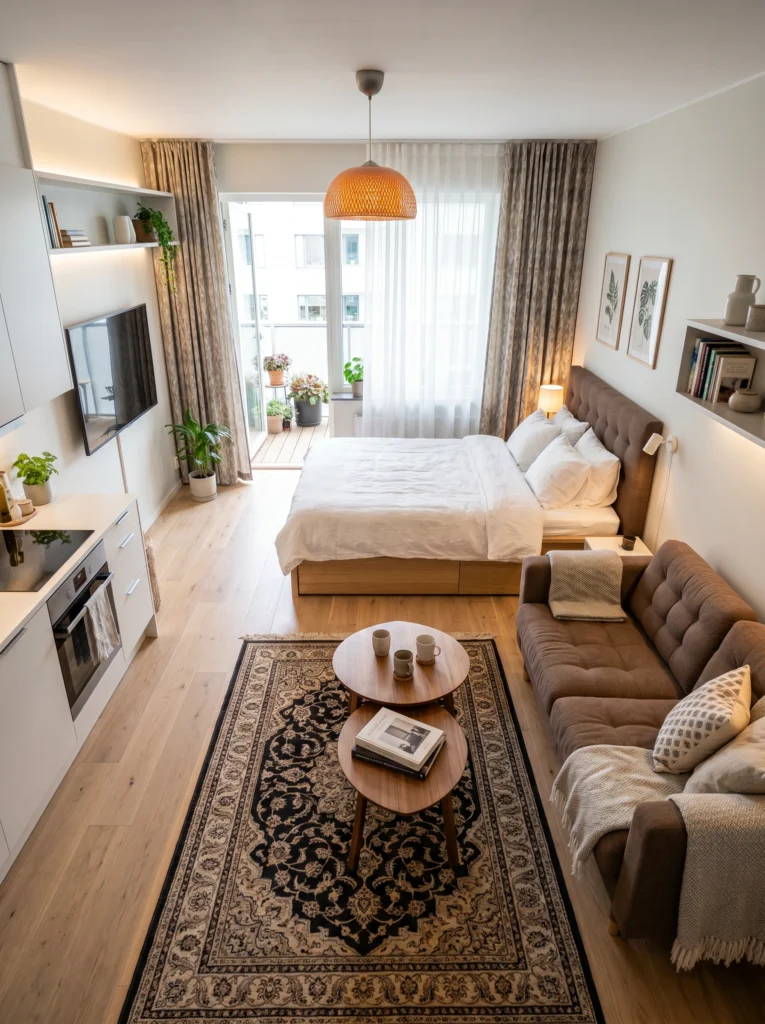
Under the bed is the most underused storage in any studio. A platform bed with built-in drawers gives you the equivalent of a full dresser without taking up a single extra square foot. Extra bedding, off-season clothes, spare towels — all out of sight. If you’re shopping for a bed frame right now, this is the one upgrade worth prioritizing above everything else. The difference in available space is immediate.
I’ve tested this: A queen storage bed from IKEA (NORDLI frame, ~$549) has two deep drawers on each side — enough to eliminate a dresser entirely in most studio setups.
7. Build In a Dedicated Work Corner
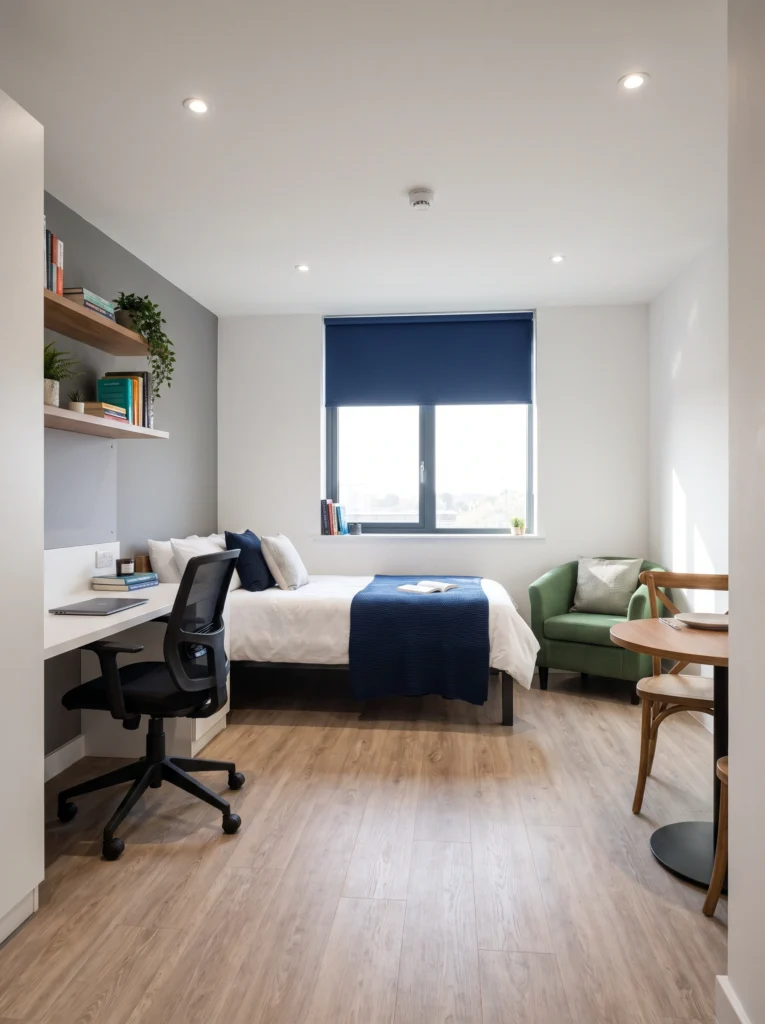
Work clutter spreads if it doesn’t have a home. A dedicated desk nook — even just 24 inches wide — keeps laptops, books, and cables contained to one zone. Floating shelves directly above handle overflow: books, plants, a small candle. The rest of the room stays clear. When work has its own corner, you’re less likely to spread it across the bed or coffee table, which is where studio chaos really begins.
Renter-friendly alternative: No built-ins? A wall-mounted fold-down desk from Amazon (~$60) folds flat when not in use and installs with four screws.
8. The Curtain-and-Cube Combo
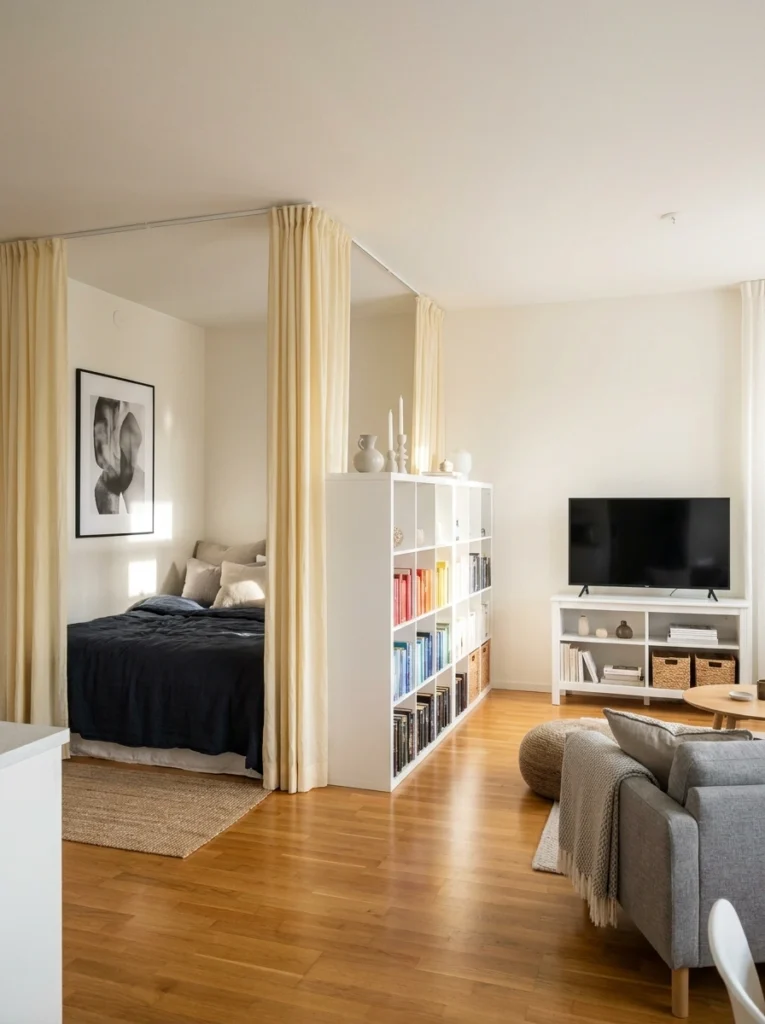
The cube shelf does the visual divide. The ceiling-mounted curtains do the privacy. Together, they give you a real bedroom on demand — pull the curtains at night, tuck them behind the shelf during the day. The rainbow book arrangement is doing serious heavy lifting here.
Renter-friendly alternative: Use tension rods or adhesive ceiling tracks for the curtains. No drilling, no deposit drama, full bedroom vibes.
9. The Color-Coded Cube Wall
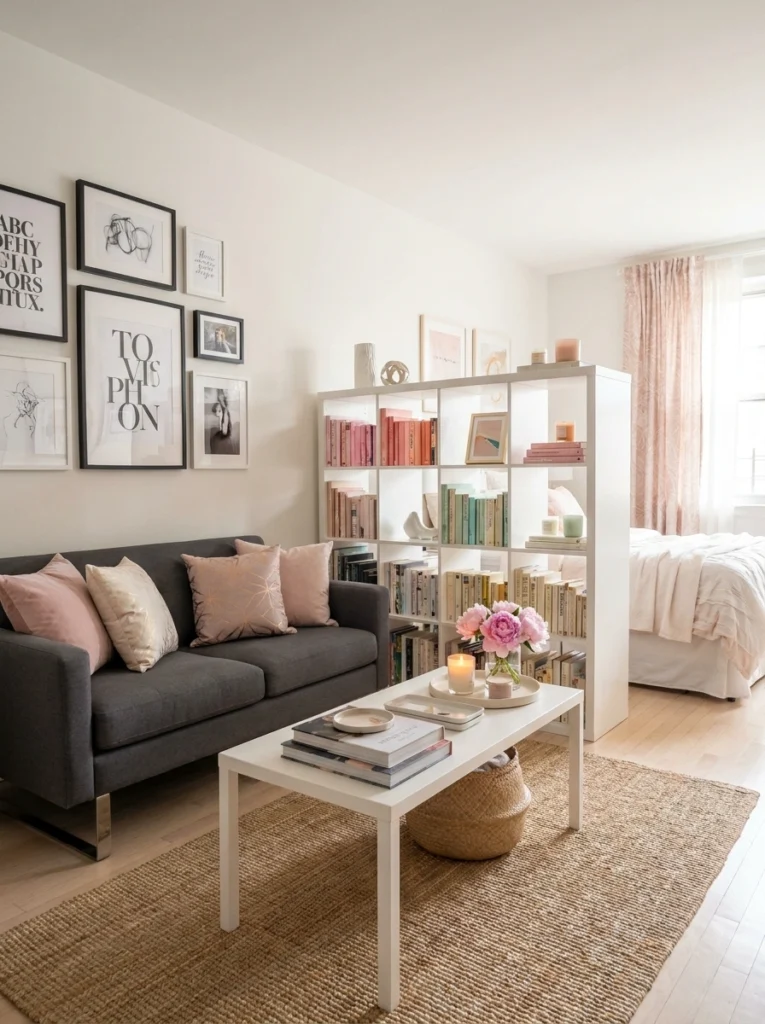
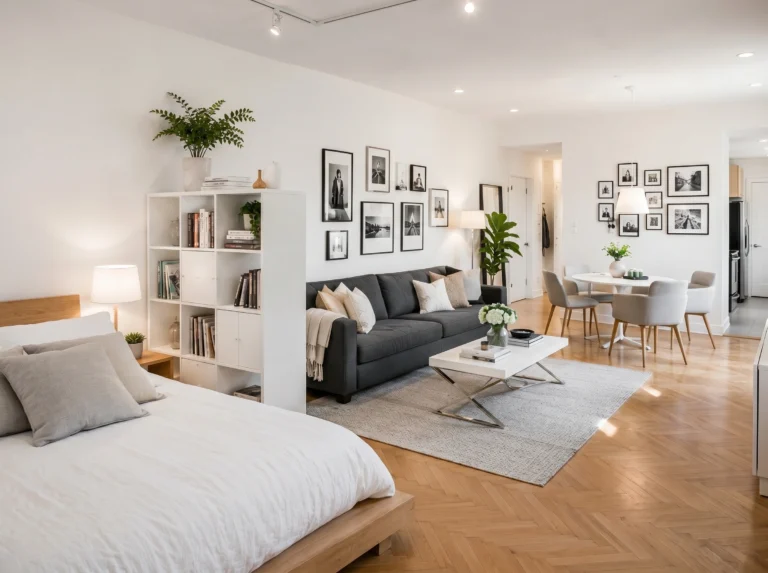
A white cube shelf splits the studio into “living” and “sleeping” without closing anything off. The trick here is the color-coded books — pink fading to coral fading to sage. It turns storage into art.
Pro tip: Color-coding only works if you read all the spines as decor first, books second. If you grab the same three reads from the same shelf every night, group those separately so you don’t keep wrecking the gradient.
10. The Slim Column Shelf
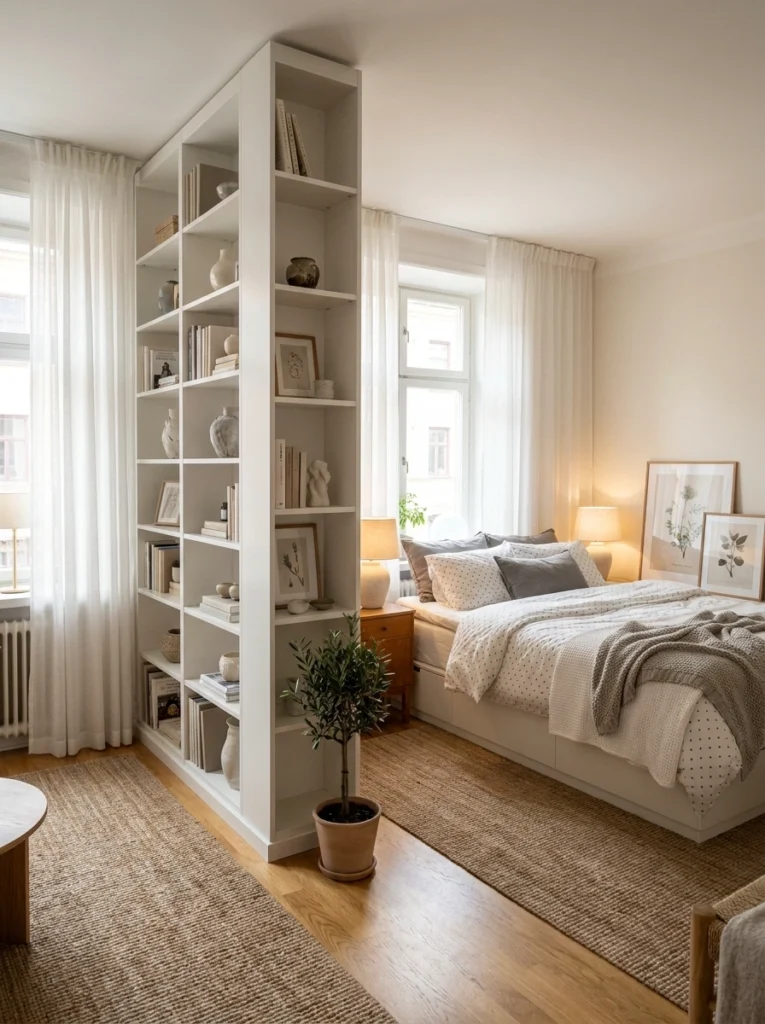
When you don’t want a giant wall of cubes, go vertical and skinny. This slim column shelf barely takes any floor space but still creates real separation between the bed and the rest of the room. Style it sparsely — small vases, framed botanicals, a few books, one trailing plant. The empty space between the objects is what makes it look intentional instead of cluttered. Minimalism only works if you leave room to breathe.
11. The Half-Wall Solid Divider
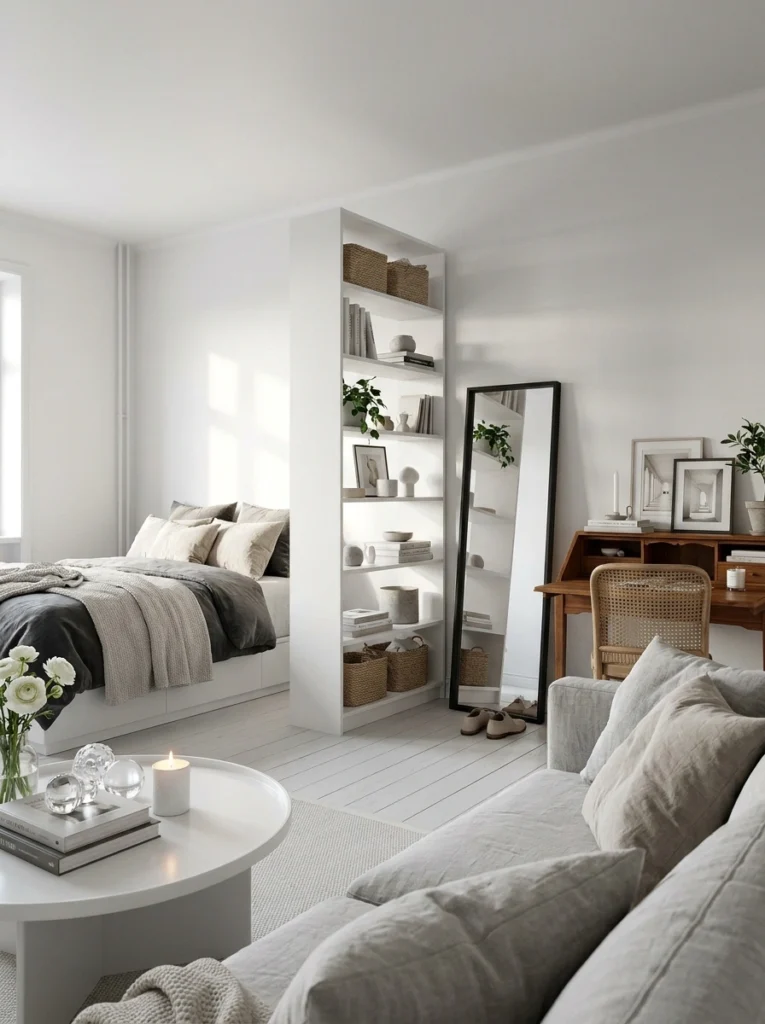
Sometimes you don’t want see-through. You want an actual wall — but a short one. A solid-back, half-height shelf gives you visual privacy for the bed without killing the natural light. The top becomes a styling shelf for ceramics and baskets, the inside holds the books you don’t need to show off.
This is the most peaceful studio layout I’ve ever lived with. If you crave quiet, copy this one.
12. The Double-Sided Showpiece
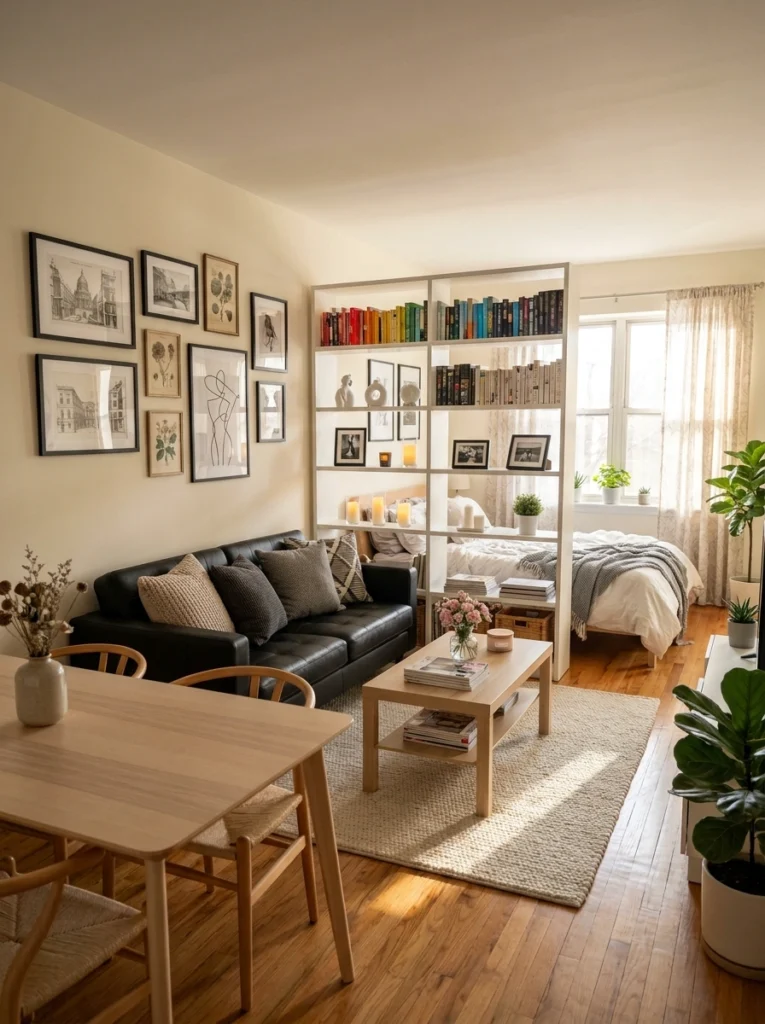
Open shelves face two rooms at once. That means everything you put on them gets seen twice — once from the living side, once from the bed side. So style both sides equally. Front: candles, framed art, plants facing the couch. Back: books and small objects facing the bed. The rainbow row of books on top is the visual anchor that ties the whole divider together. Both rooms win.
13. The Low Divider with Gallery Wall
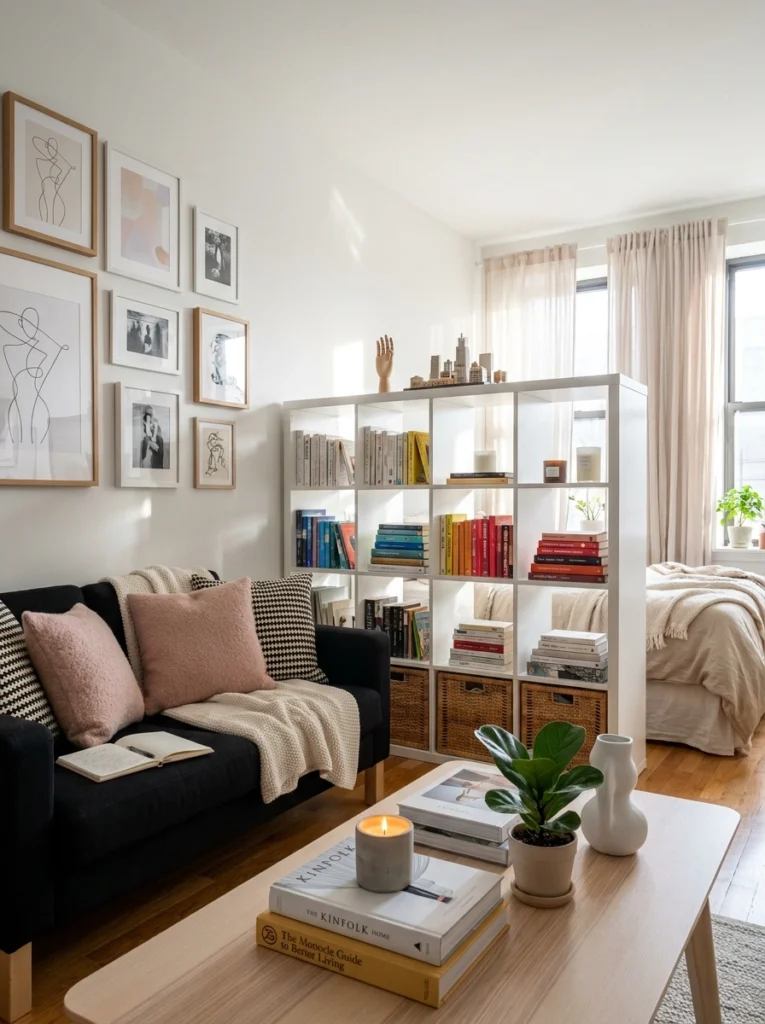
A waist-high cube shelf is the easy mode of studio dividers. It zones the space without blocking the windows, the light, or the view. Pair it with a dense gallery wall above the sofa and you’ve basically built yourself a “living room corner.” The line-art prints in wood frames keep it gallery-cool instead of dorm-cute. Trust me on this one — low dividers age much better than tall ones in tiny rooms.
14. The Behind-the-Bed Shelf
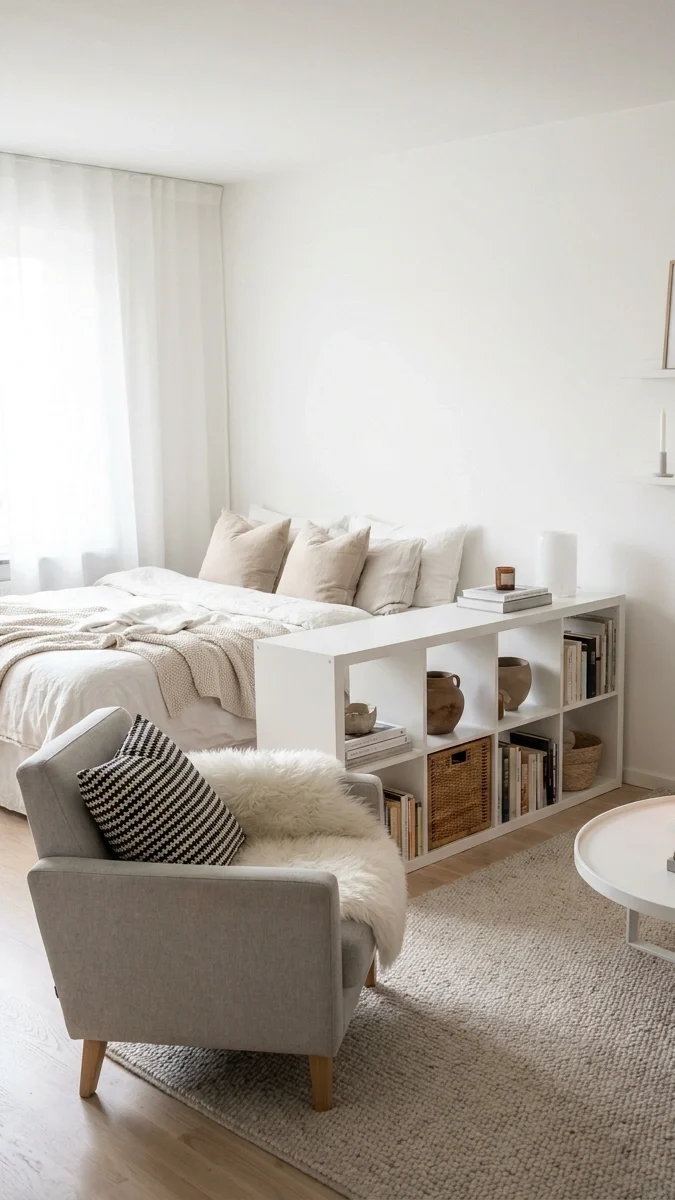
If you’ve got the bed floating in the middle of the room (because the windows wouldn’t let you do anything else), put a low cube shelf behind it as a faux headboard. It hides the back of the mattress, gives you storage, and creates the illusion of a “bed zone.” Style the top with stacked books, ceramic vessels, and a single candle. This is the part most people skip — and that’s exactly why their floating bed looks lost.
15. The Family-Friendly Cube Wall
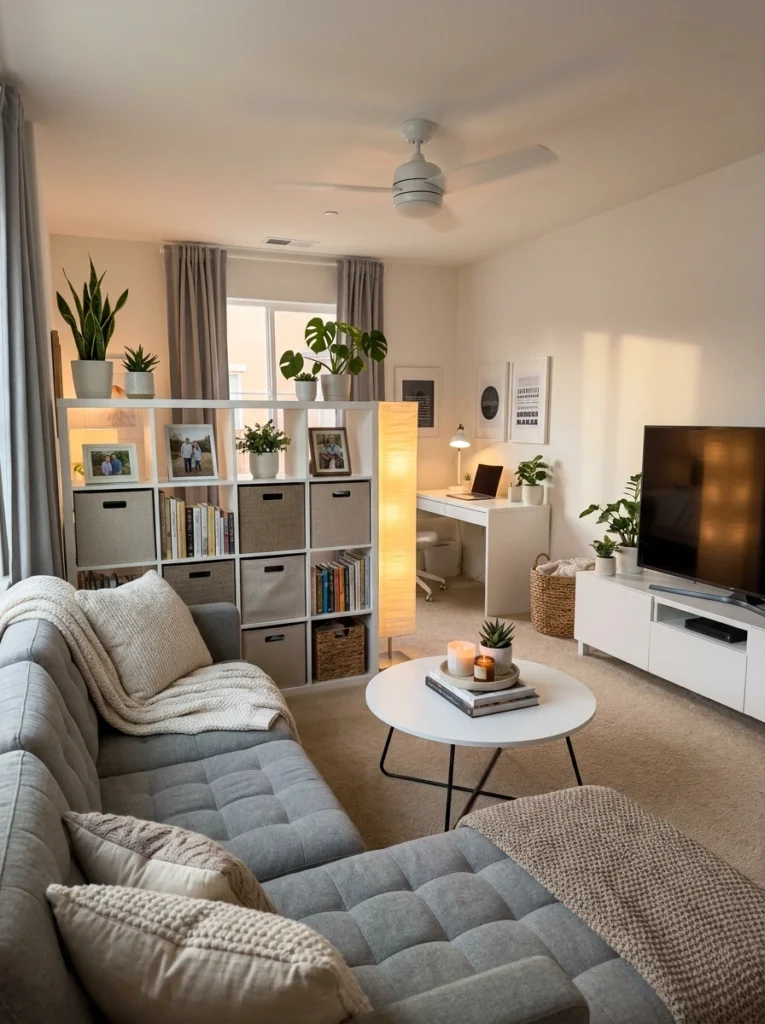
Studios for one are easy. Studios for couples or roommates need real storage. This setup uses fabric bins inside the cubes to hide laundry, cables, and the mess of daily life, while the top becomes the family-photo display you actually want to look at. The paper lantern lamp behind it adds soft, warm light that makes the corner feel like its own room. Real-life studios over Pinterest studios. Every time.
16. The Curated Cube Shelf
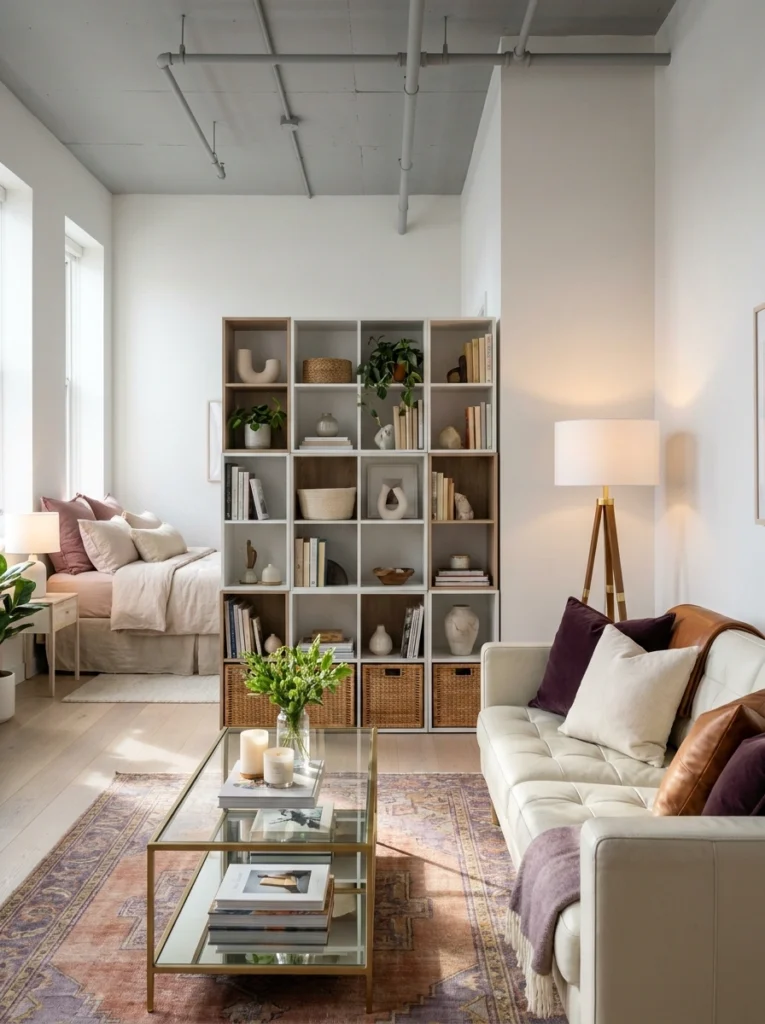
This shelf isn’t really for books. It’s a curated cabinet — sculptural vases, small ceramics, one stack of design books, a few woven baskets at the bottom for the boring stuff. The point is restraint. Three to five objects per cube, not fifteen.
My favorite thing here: the cream tufted sofa with the plum velvet pillow against that vintage rug. Studios can look this elevated. You just have to edit harder than you decorate.
17. The Sculptural Shelf
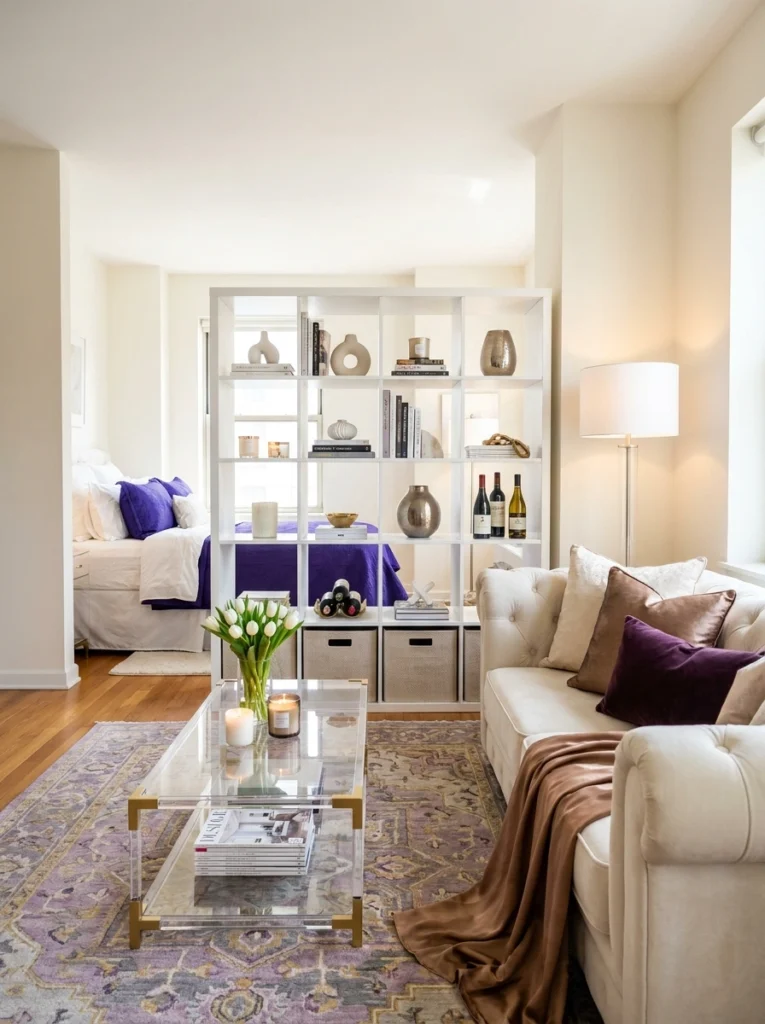
Who said shelves need books? This one is pure sculpture — round vases, paired vessels, soft metallics, one rich purple bedspread peeking through the cubes. It’s basically a gallery wall you can see through. The lesson: if your books are ugly, hide them in baskets at the bottom and let beautiful objects do the front-row work.
Don’t waste your money on matching “decor sets” — collect odd, mismatched ceramics over time. They look richer.
Final Thoughts
Your shelf is the hardest-working piece of furniture in a studio. It stores, it divides, it decorates, and on a good night, it makes the whole room feel like yours. Pick the version that fits your actual life — your books, your mess, your light, your rules. Start with one shelf. Style it slowly. Move things around for a week before you commit. The rest will follow naturally.
Your studio isn’t small — it’s just asking you to be more intentional. The shelf is where that starts.
Happy decorating, — Sofia