17 Studio Apartment Ideas That Balance Beauty and Function
Studio apartments ask a lot of you. They want you to sleep, work, cook, lounge, and occasionally host — all within the same four walls. The ones that actually work aren’t just minimal or just colorful. They’re intentional: every piece earns its place, every corner has a purpose, and somehow the whole thing still feels like home.
Here are 17 ideas, pulled straight from studios that nail the balance between looking good and living well.
1. Commit to a Bold Color Story
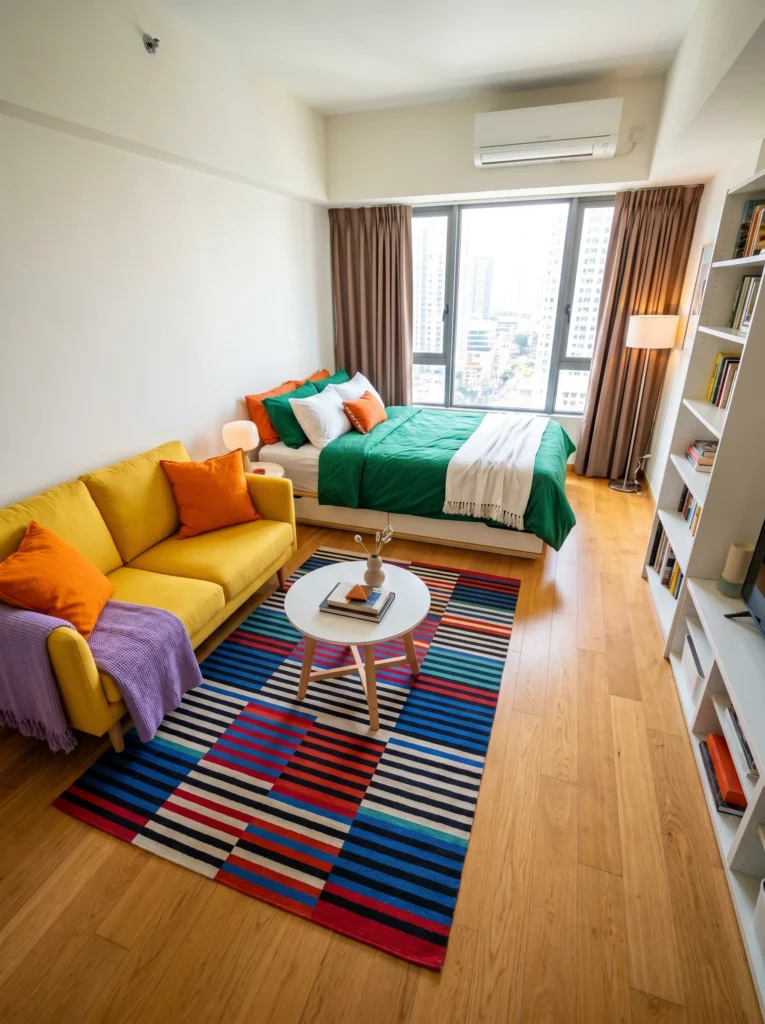
When your whole life happens in one room, beige can feel suffocating. This studio leans hard into color — a mustard yellow sofa, a bold striped rug in red, blue, and black, emerald green bedding — and it works because every color choice connects. Pick two or three anchor hues, then let your textiles repeat them. The result feels curated, not chaotic.
Pro tip: Keep your walls white or off-white. That gives you full permission to go bold everywhere else without the room closing in.
2. Use Floating Shelves as a Decor Zone
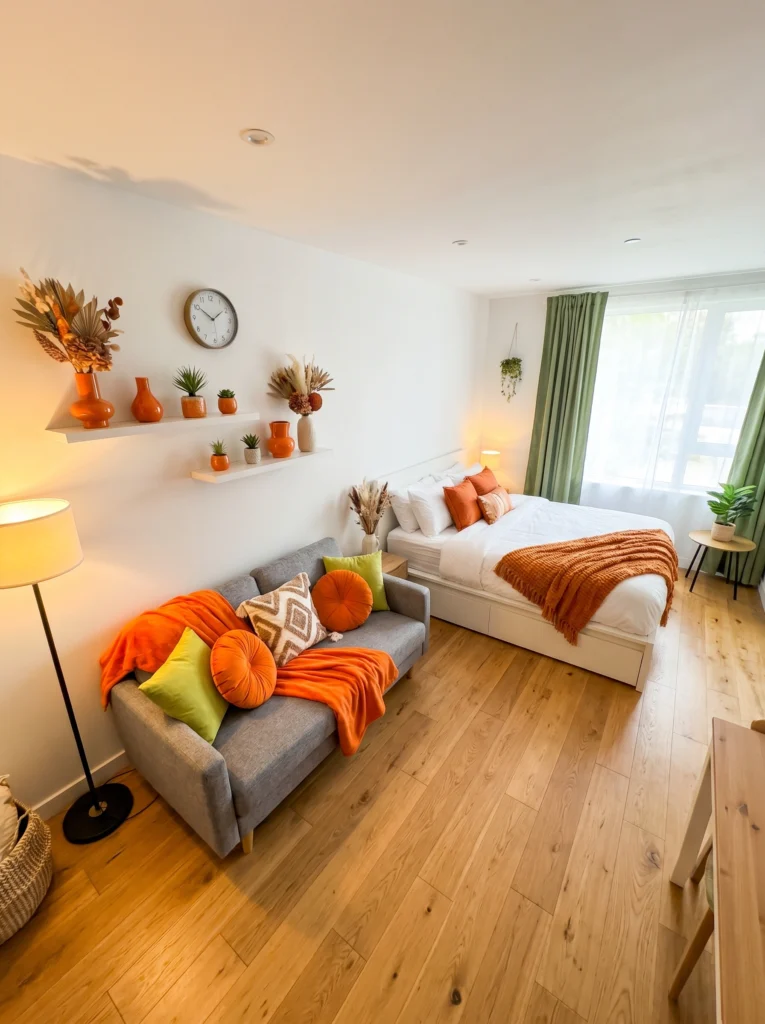
Floating shelves are the unsung hero of studio decorating. Here, two long shelves above a gray sofa hold orange vases, dried botanicals, small succulents, and a wall clock — all the personality of a gallery, none of the square footage. Style them in odd numbers and vary heights so it doesn’t read as a lineup. Functional? Yes. Beautiful? Also yes.
Sofia’s honest take: Dust them every two weeks. Cluttered, dusty shelves cancel out the whole effect faster than you’d think.
3. Layer Warm Wood Tones Throughout
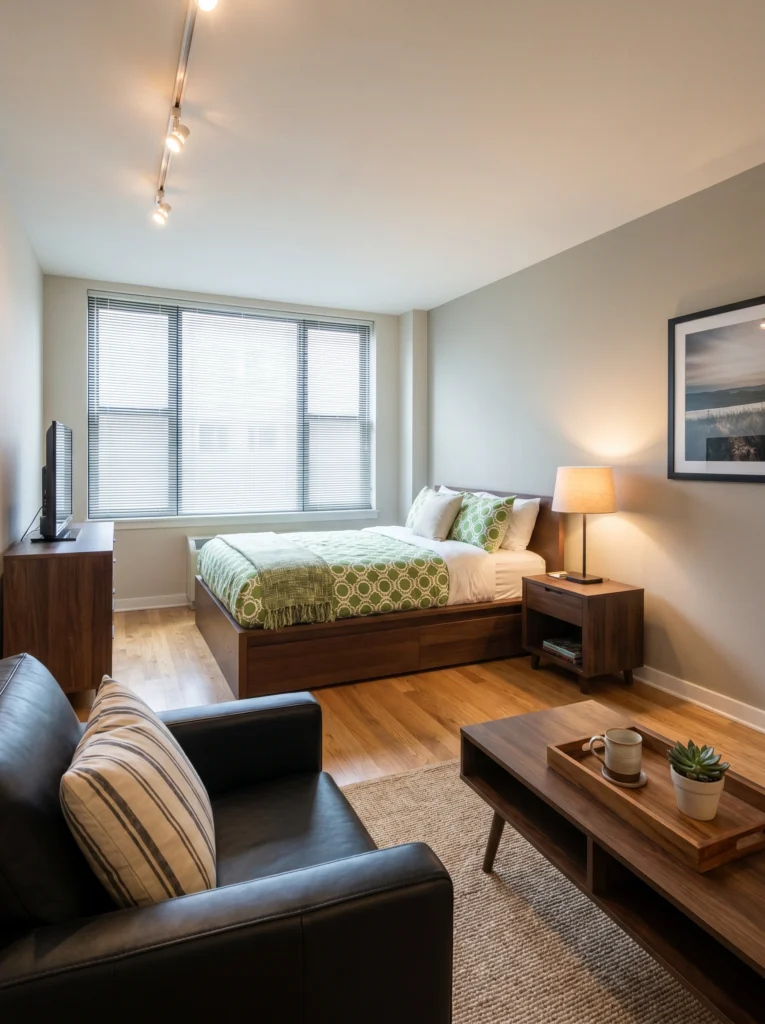
Track lighting, a walnut storage bed, a matching walnut dresser, and a dark leather sofa — this studio feels pulled together because every wood tone sits in the same warm family. Warm brown anchors both the sleep zone and the living zone, making the space feel cohesive instead of like two mismatched rooms accidentally shoved together. The jute rug ties the floor together.
Renter-friendly alternative: Can’t swap the furniture? A walnut-finish contact paper on a basic IKEA side table bridges the gap for about $12.
4. Let Your Sofa Define the Living Zone
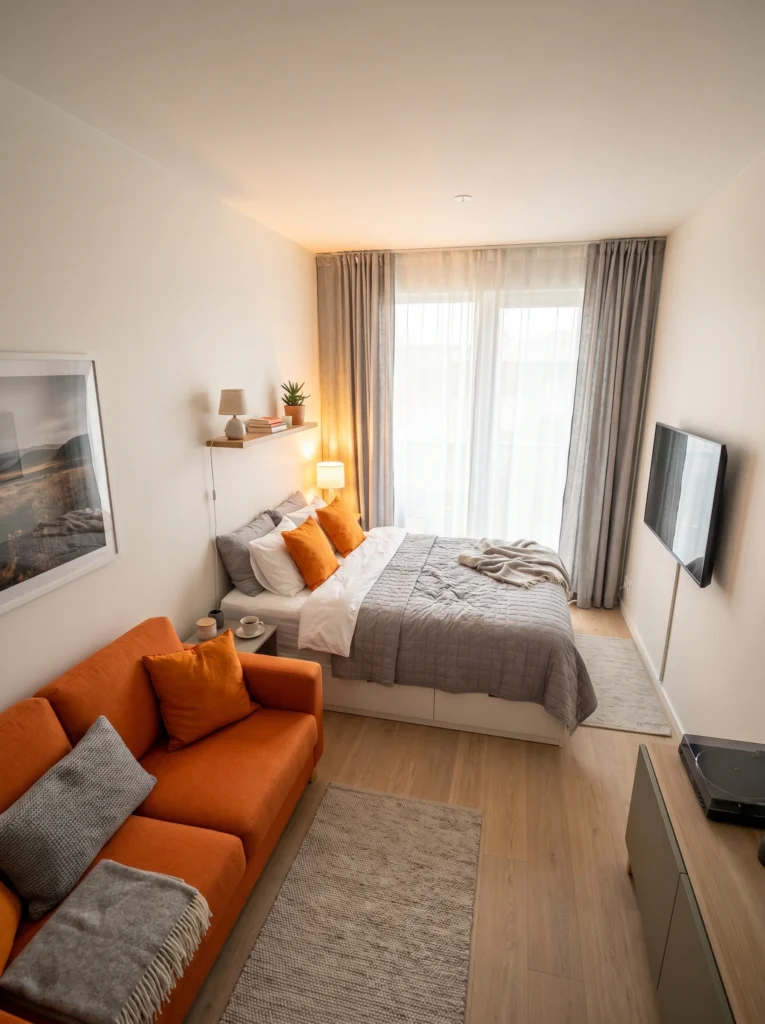
In this layout, an orange velvet sofa placed parallel to the bed does something clever — it signals “this side is the living room.” No wall, no curtain, just intentional furniture placement doing the heavy work. A small floating shelf above the bed holds books and a plant, and the wall-mounted TV anchors the media zone. Smart spatial storytelling with zero construction required.
My tip: Face your sofa away from the bed whenever possible. That simple rotation creates the psychological sense of separate rooms.
5. Build a Gallery Wall That Does Double Duty
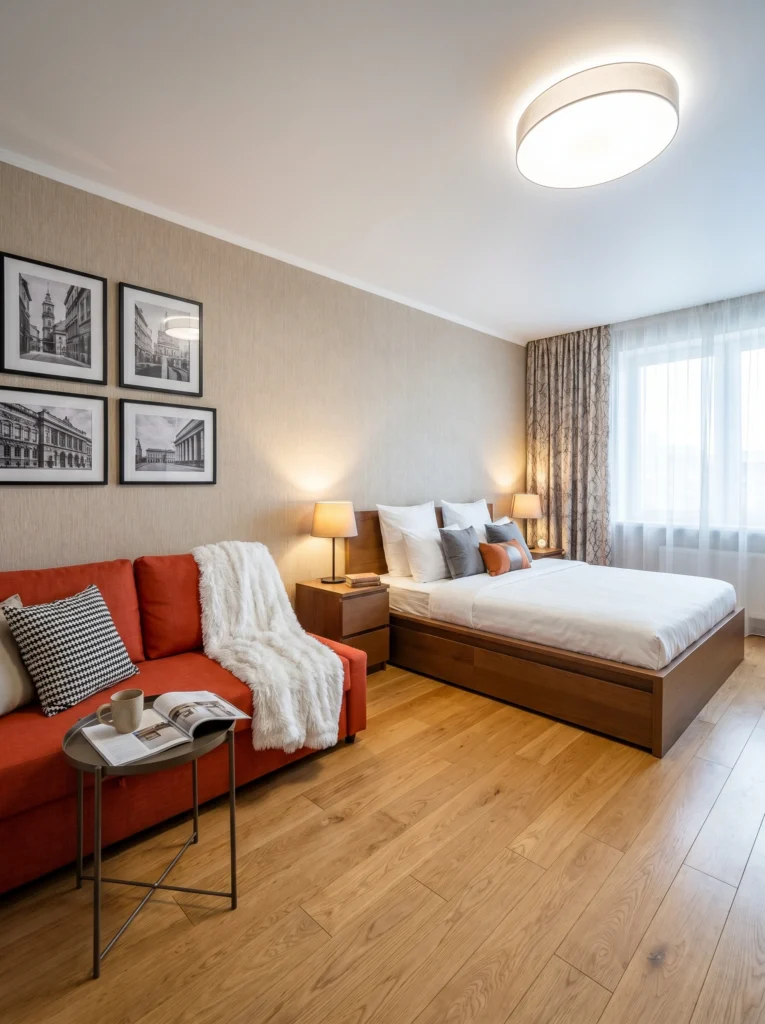
A 2×2 grid of black-and-white architectural prints above this red sofa does two things at once: it fills the wall so it doesn’t feel bare, and it creates a visual anchor that makes the sofa feel intentionally placed. Matching table lamps on either side of the walnut bed add symmetry that makes the sleep zone feel like a proper bedroom.
Budget vs. splurge: Print your own photos in black-and-white at a copy shop ($2–$4 each), then frame them identically for a high-end look on a very low budget.
6. Use Colorful Box Shelves Instead of a Bookcase
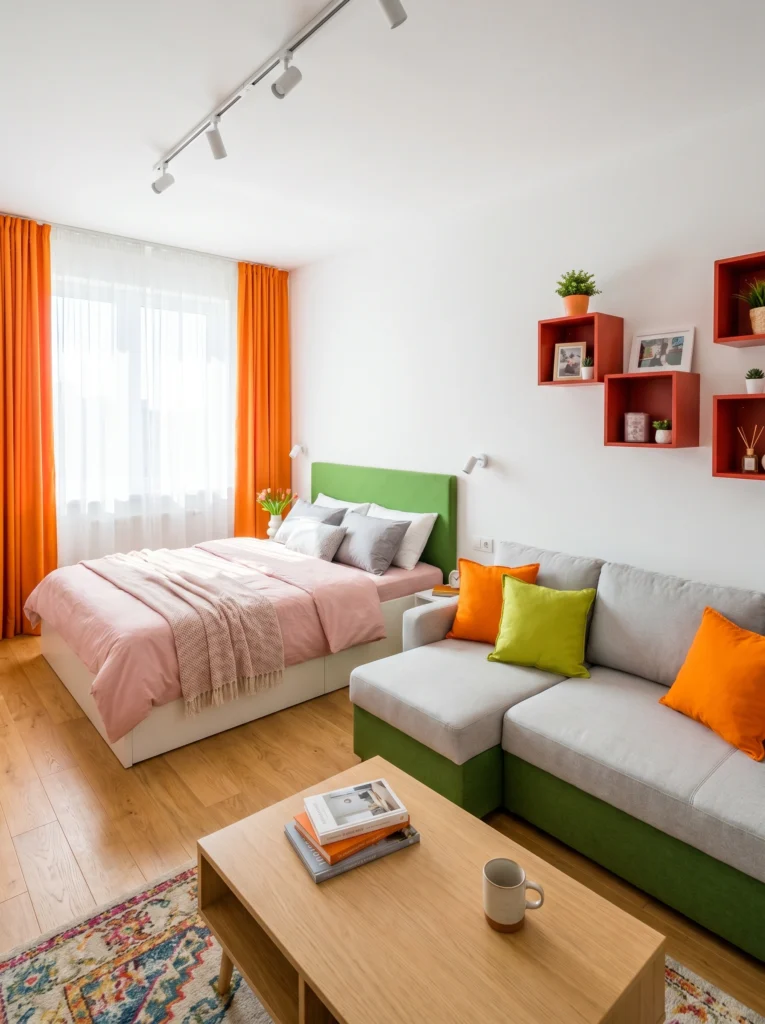
Standard bookcases eat floor space. These staggered red box shelves mounted on the wall hold plants, frames, and small objects without ever touching the ground at all. The green upholstered headboard and bold orange curtains keep the energy high, while track lighting on the ceiling handles the very practical task of actually illuminating the room without crowding the floor plan.
I’ve tested this: Box shelves work best when you treat each cube as its own little vignette — one plant, one object, one photo. More than that and it reads as clutter.
7. Create Three Distinct Zones in One Room
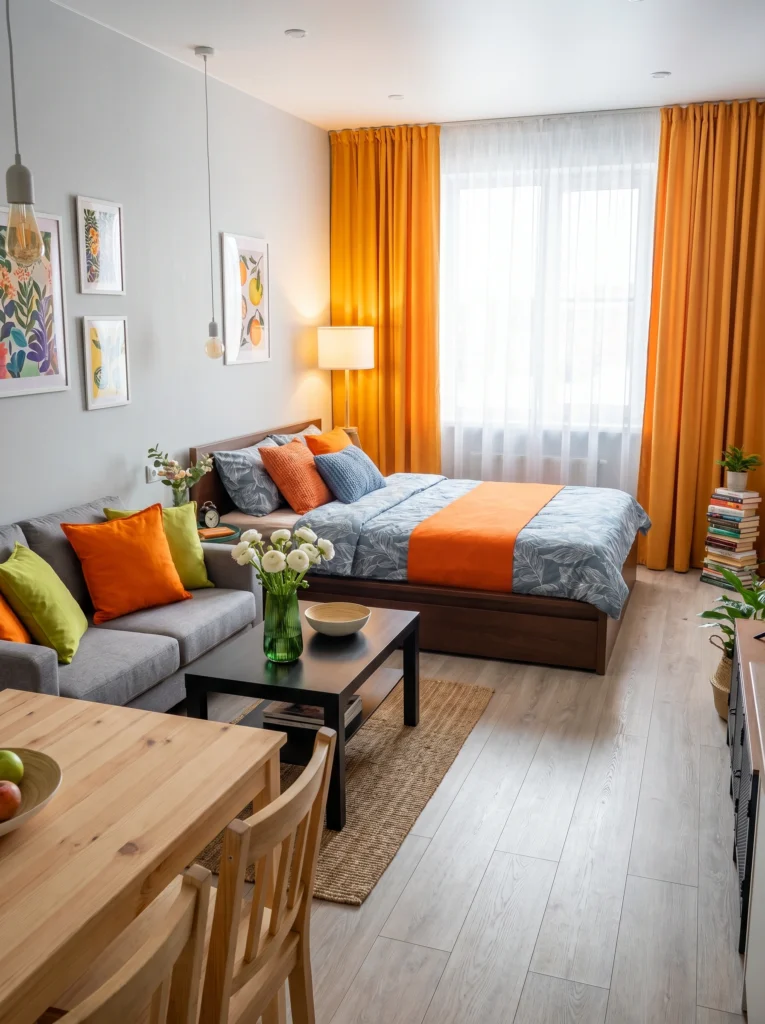
This is one of the best-organized studios I’ve seen. A wooden dining table sits in one corner, a gray sectional with a coffee table creates the lounge zone, and the bed anchors the sleeping area — all defined by rug placement and furniture orientation rather than walls. Orange curtains pull the warmth together across every zone. Three distinct zones, one beautifully open room.
Pro tip: Use a different rug under each zone. It’s the easiest way to define spaces without building anything.
8. Anchor the Room With Statement Art Above the Bed
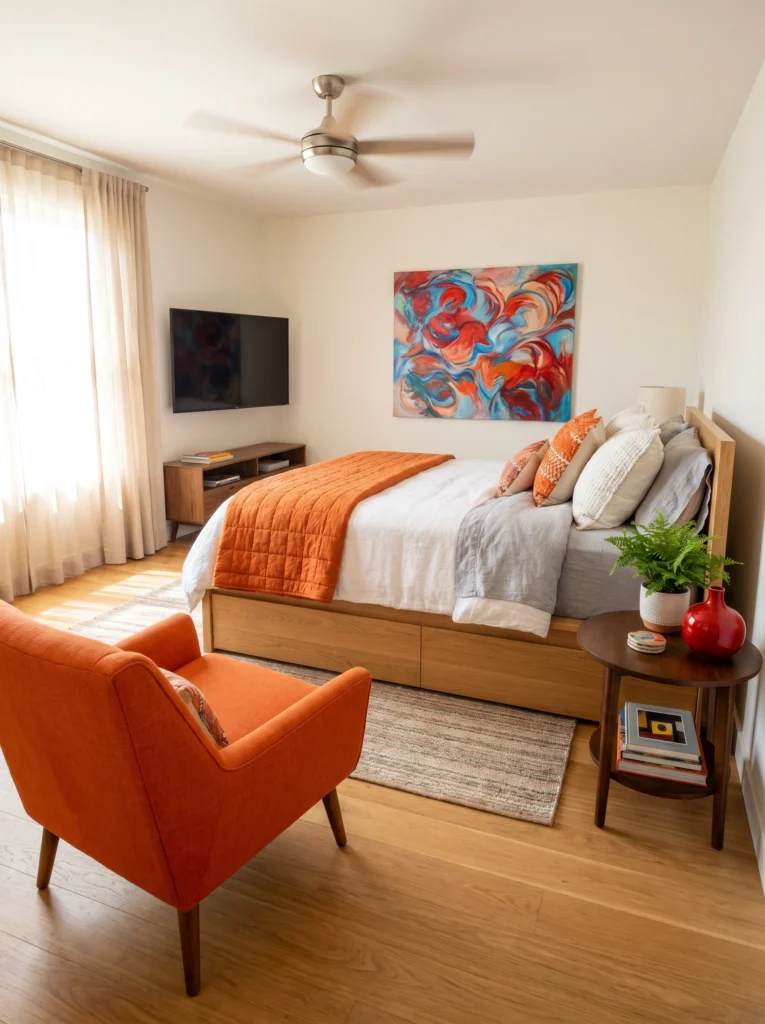
A large abstract canvas in red, blue, and orange hangs centered above this walnut storage bed — and it immediately becomes the entire room’s focal point. A matching orange armchair tucked in the corner echoes the painting’s palette without directly copying it. The result feels like a real, fully considered bedroom, not just a bed shoved against a wall as an afterthought.
My favorite: Storage beds with under-frame drawers. This one likely holds bedding, off-season clothes, or anything you’d otherwise have no place for.
9. Go Grand With a Chandelier and Oversized Art
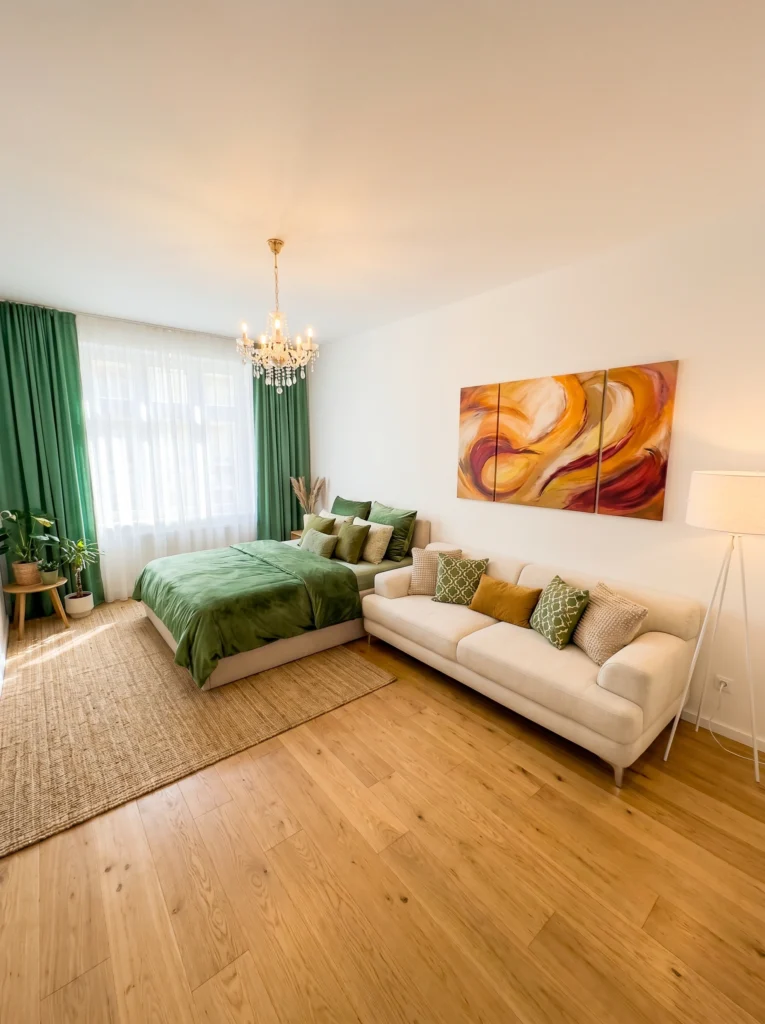
Most people play it safe in studio apartments. This one doesn’t — and it genuinely wins for it. A crystal chandelier, a three-panel abstract artwork spanning nearly half the wall, emerald green curtains, and a lush jute rug layer up with real confidence. The cream sofa keeps things from going overboard. The rule here: one statement piece per zone, then deliberately pull back.
Don’t waste your money on: Tiny art in a big studio. Scale up. One large piece is far more impactful than five small ones fighting for attention.
10. Let Plants Be Your Primary Decor
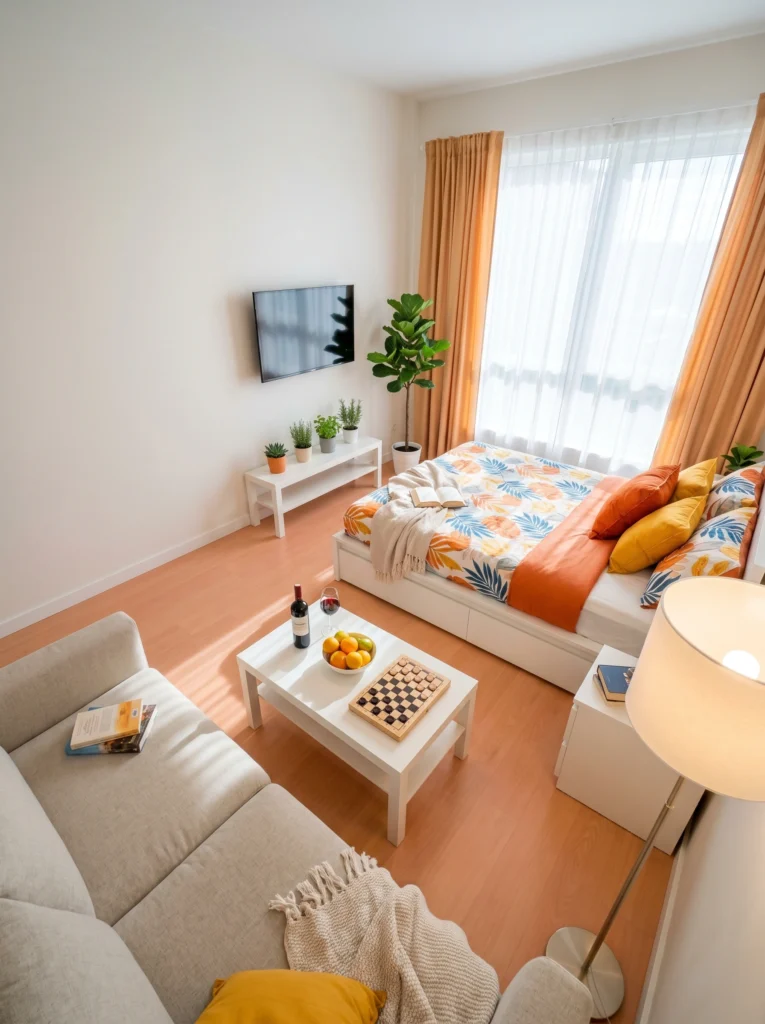
A fiddle leaf fig in the corner, a row of small herb pots on a console table, and leafy tropical bedding prints — this studio uses botanicals as its entire design language. It’s fresh, cheerful, and costs almost nothing to build over time. The all-white furniture base means the plants always pop against the background, no matter what season you’re in.
Renter-friendly alternative: No green thumb? Realistic faux plants from IKEA’s FEJKA line are indistinguishable from two feet away and require zero sunlight.
11. Paint One Accent Wall to Anchor the Bedroom Zone
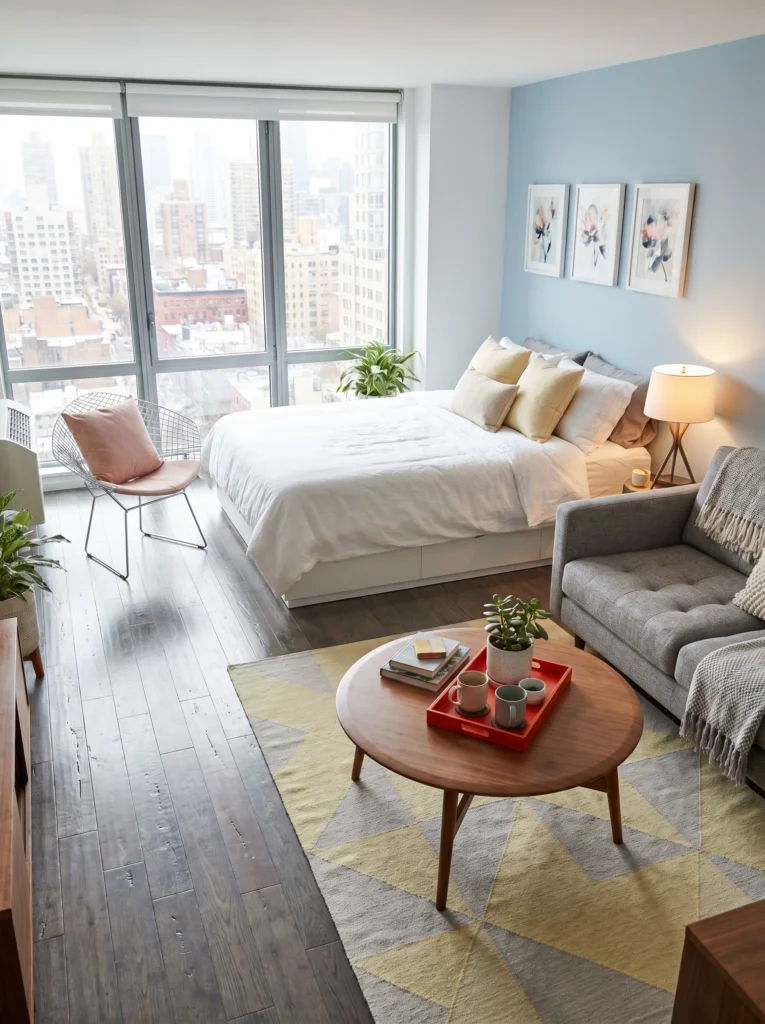
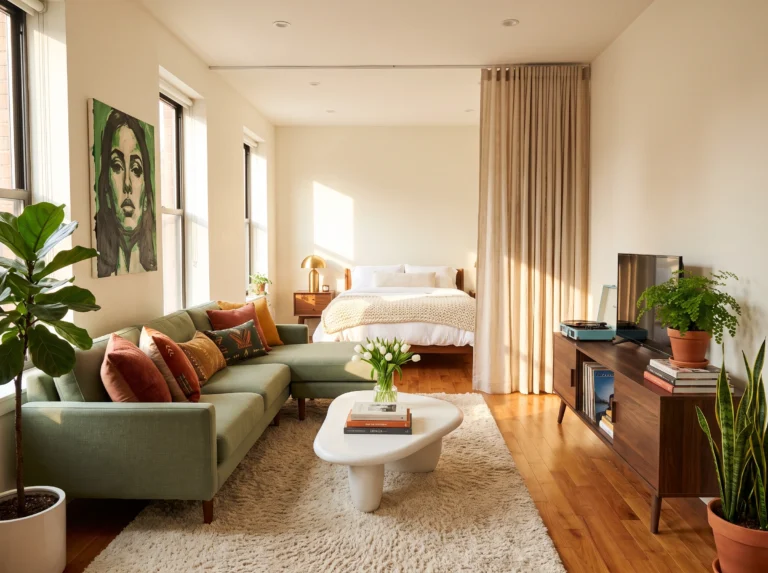
A single powder blue accent wall behind the bed makes the sleeping area feel like its own defined room — no partition required. Three matching botanical prints in warm frames tie the color story together, and the round walnut coffee table in the living zone adds mid-century contrast. Floor-to-ceiling windows flood the space with light and handle the rest of the heavy lifting here.
My tip: If you’re renting, check whether your lease allows a single accent wall. Many landlords say yes when you commit to repainting on move-out.
12. Use Curves to Soften a Square Space
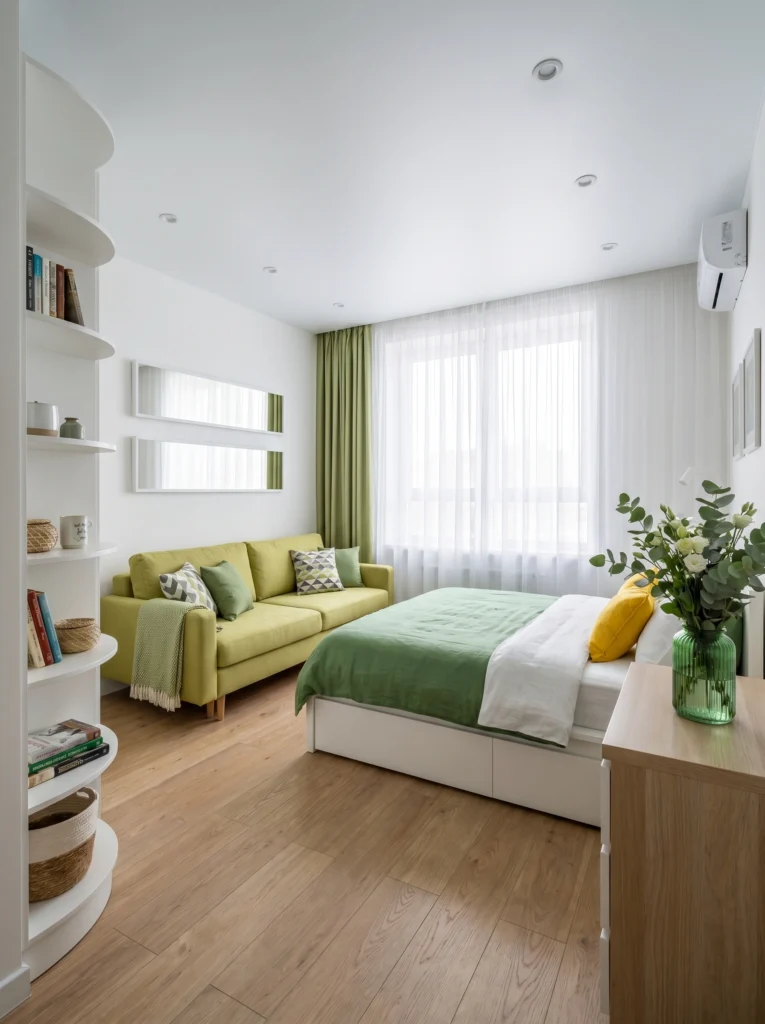
Straight lines dominate most studios — boxy furniture, square windows, rectangular walls. This one breaks the pattern with a curved tower bookshelf that softens the room’s geometry immediately. Paired with stacked horizontal mirrors that bounce natural light around, and a lime green sofa that brings real energy, it’s solid proof that shape matters just as much as color in a small space.
Sofia’s honest take: A curved shelving unit sounds like a splurge. IKEA’s HYLLIS can be adapted, or check Facebook Marketplace — they show up often.
13. Make a Statement With Art Poster Pairings
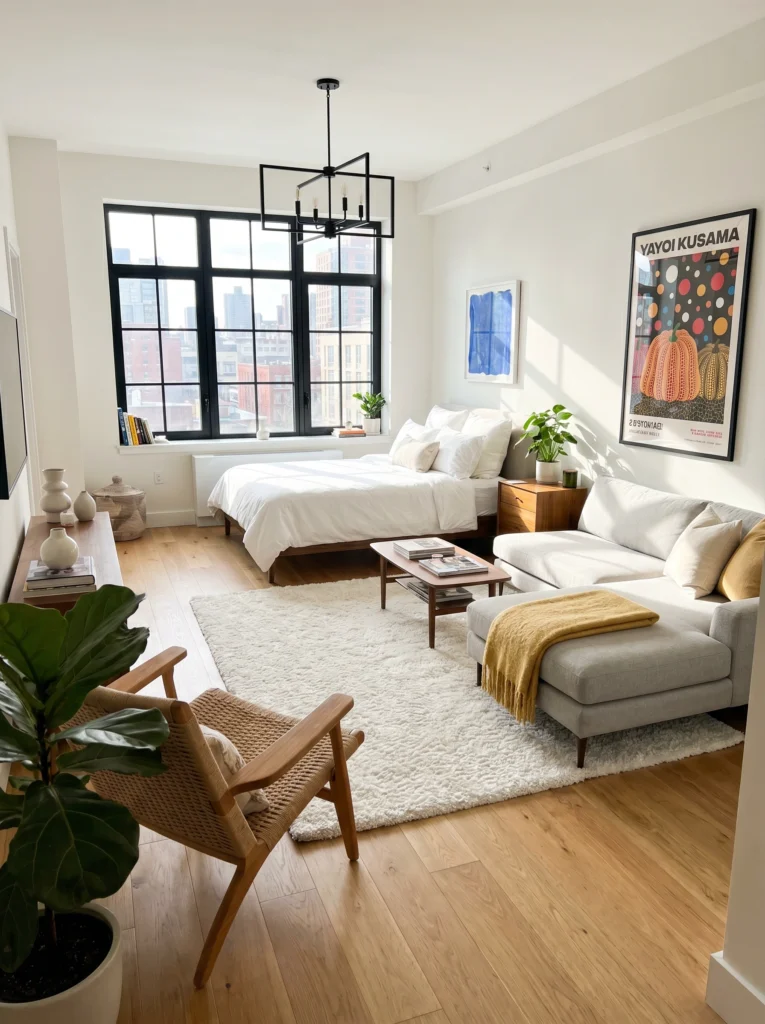
Two large framed posters — one abstract, one a Yayoi Kusama print — hung side by side on a white wall create instant personality without renovating anything. The industrial black pendant chandelier overhead and a fluffy white shag rug below give the room real texture contrast. This is how you make a rental feel like a home you chose on purpose.
Budget vs. splurge: Museum posters from actual exhibition shops run $15–$30. Frame them in matching black frames from IKEA for a gallery-quality look under $80 total.
14. Commit to a Bold Accent Wall Color
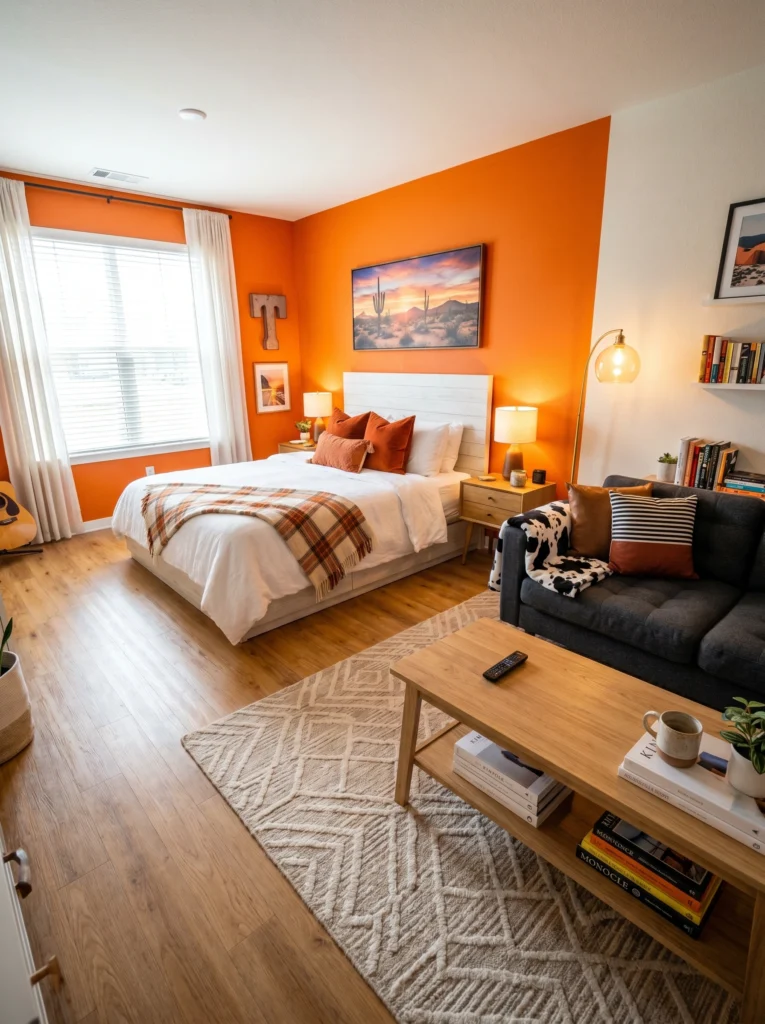
Not everyone wants to live in a neutral box — and this studio proves you absolutely don’t have to. A deep burnt orange accent wall wraps the bedroom corner while the rest of the walls stay crisp white, so the color energizes without overwhelming the entire room. A southwestern landscape painting, a plaid throw, and a warm lamp keep the mood intentional and cohesive.
My favorite: Burnt orange pairs surprisingly well with charcoal grey, warm wood, and cream — all the neutrals most people already own.
15. Mix Lighting Types for Maximum Function
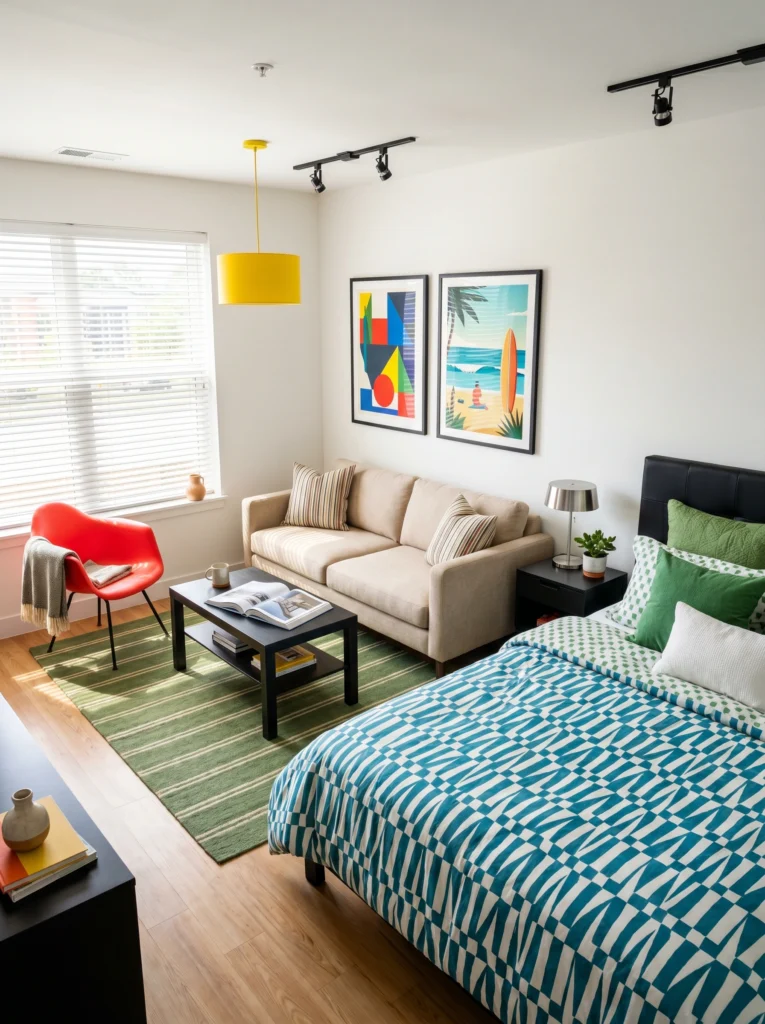
This studio runs three types of lighting at once — a yellow drum pendant for ambient glow, black track lighting for directed task light, and a small bedside lamp. That layered approach means every corner of the room is usable regardless of time of day. Bold retro art prints and a teal geometric duvet make the visual side equally considered.
Pro tip: Warm bulbs (2700K) in the pendant, slightly cooler (3000K) in the track lights. The combination flatters every corner of the room.
16. Build a True Multifunctional Layout With a Dining Nook
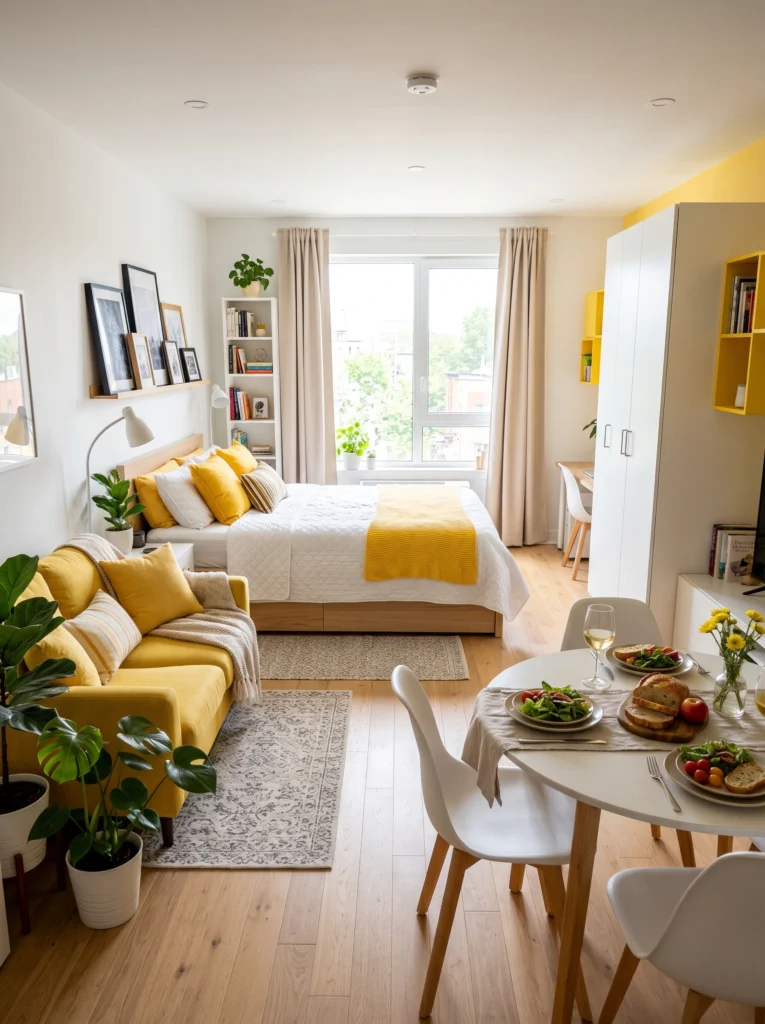
The most ambitious layout of the bunch: a dedicated dining nook with a round white table, a lounge zone with a yellow sofa, a sleeping area with storage bed, a wardrobe, and a yellow wall cubby for books. A monstera plant anchors one corner. A picture rail holds leaning frames without a single nail hole. Every square foot is earning its keep.
Renter-friendly alternative: A round dining table is the right call in a studio — it fits two to four people, takes up less visual space than a rectangle, and tucks into corners cleanly.
17. Master Full Zone Separation Without Walls
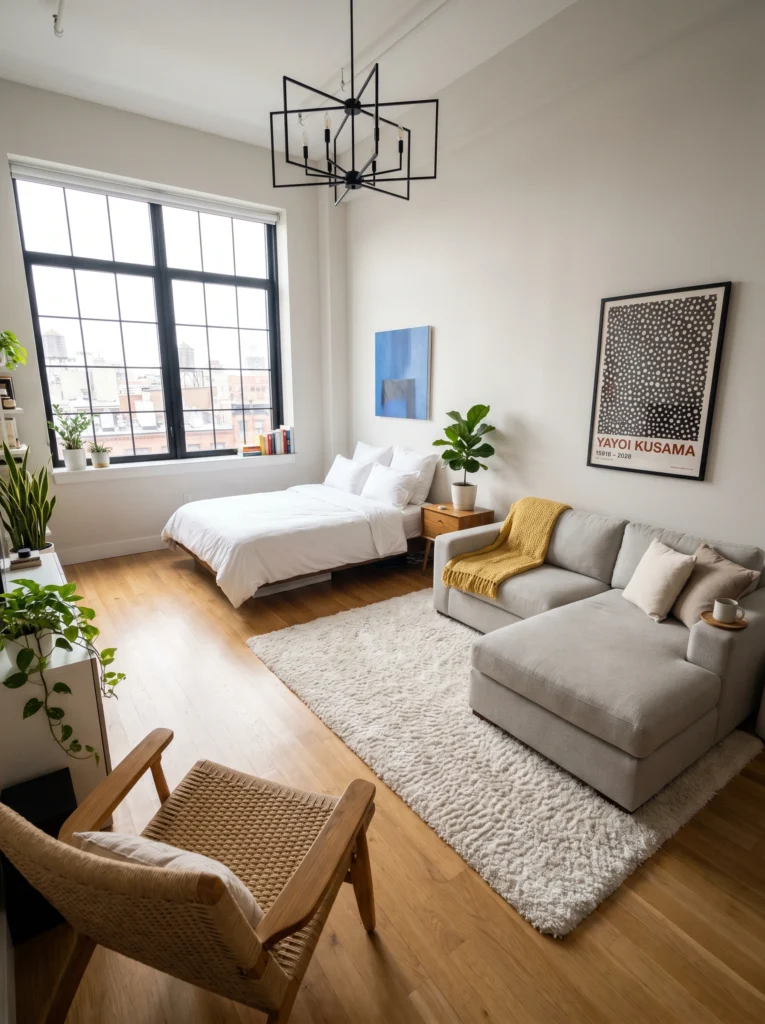
This wider angle of the same loft shows exactly how zone separation works in practice: the bed faces the window wall, the sectional defines the living area perpendicular to it, and a woven wood armchair creates a separate reading corner — all without a single divider. Each zone has its own rug, its own lighting, its own reason to exist.
I’ve tested this: The “reading chair” is the most underrated studio addition. It creates a third zone and gives you somewhere to go that isn’t the bed or the sofa.
Final Thoughts
A studio apartment doesn’t have to feel like a compromise. The spaces that work best — the ones that actually feel like homes — make deliberate choices about color, zones, lighting, and scale. They don’t try to hide the fact that everything happens in one room. They lean into it.
You don’t need all 17 of these ideas. Pick two or three that feel like you and start there. Rearrange your furniture. Hang one piece of art you love. Add a lamp to a dark corner. The difference is always smaller than you think — and always bigger than you expected.
A beautiful studio isn’t about more space. It’s about knowing exactly what to do with the space you have.